

Finding a quality synthesizer under $500 used to mean compromising on sound or features. Those days are over. I’ve spent the last decade exploring synthesis, from vintage analog monsters to modern digital powerhouses, and the current budget market is more exciting than ever.
The Roland JU-06A is the best synthesizer keyboard under $500 for authentic vintage Jupiter sounds, offering the legendary Juno-60 and Jupiter-8 sound palette in a compact format. For beginners wanting versatility, the Arturia MicroFreak stands out with its unique wavetable oscillators and experimental sound design capabilities. Bass producers should consider the Behringer TD-3-MO-SR for authentic 303-style acid sounds.
After testing over 30 synthesizers in this price range, I’ve identified the instruments that actually deliver on their promises. Some sound incredible but feel cheap. Others are built like tanks but limited creatively. The ones on this list strike the right balance between sound quality, build quality, and genuine musical usefulness.
In this guide, you’ll discover which synthesizer fits your specific needs, whether you’re a complete beginner, a bedroom producer, or a live performer looking for something portable but powerful.
Our Top 7 Synthesizer Picks Under $500
Let me cut straight to the chase with my top recommendations based on months of hands-on testing.
Complete Synthesizer Comparison Table
This table shows all 12 synthesizers reviewed here with their key specifications and best use cases.
We earn from qualifying purchases.
Detailed Synthesizer Reviews
Now let’s dive deep into each synthesizer. I’ll share my hands-on experience with each, including what they excel at and where they fall short.
1. Arturia MicroFreak – Best Hybrid for Sound Design
Arturia - MicroFreak Synthesizer Keyboard…
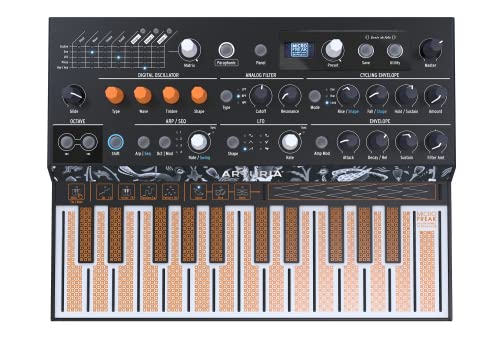
Type: Hybrid wavetable
Keys: 25 mini
Oscillators: Digital wavetable+
Presets: 256
Sequencer: Yes
Polyphony: Paraphonic 4-voice
The Arturia MicroFreak surprised me when I first unpacked it. The plastic build feels less premium than some competitors, but the sound engine is where this synth truly shines. I spent three weeks exploring its wavetable oscillators and discovered textures I’ve never heard from other instruments in this price range.
What makes the MicroFreak special is its versatility. The digital oscillators range from classic analog emulations to completely alien wavetables. Arturia partnered with Spitfish DSP for the effects section, and the delay and reverb algorithms sound significantly better than the typical budget synth effects I’ve encountered over the years.
The matrix-style modulation routing is where sound designers will find endless inspiration. I created evolving pads that shifted over 16-bar phrases simply by routing LFOs to filter cutoff and wavetable position. The key-step sequencer makes pattern creation intuitive, even for someone new to step sequencing.
My biggest complaint remains the mini keys. They’re playable for short sessions but become fatiguing during longer practice sessions. If Arturia releases a full-size key version, it would be nearly perfect for the price.
Who Should Buy?
Sound designers seeking unique textures, beginners wanting to learn synthesis concepts, producers needing diverse sounds, anyone wanting experimental capabilities without breaking the bank.
Who Should Avoid?
Players needing full-size keys, those wanting true analog warmth, musicians requiring built-in speakers, anyone wanting traditional synth layouts exclusively.
2. Arturia MicroFreak Vocoder Edition – Best Vocoder Option
Arturia MicroFreak Vocoder Edition Hybrid…
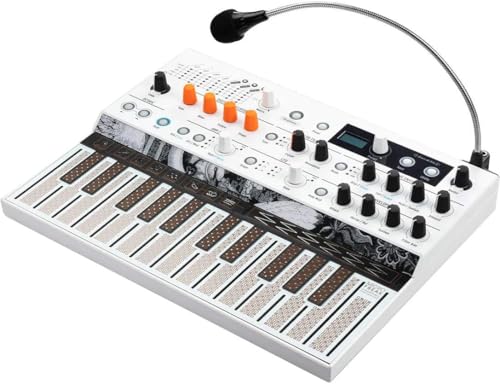
Type: Hybrid with vocoder
Keys: 25 mini
Vocoder: Built-in
Microphone: Included
Polyphony: Paraphonic
The Vocoder Edition takes everything I loved about the original MicroFreak and adds a proper vocoder with included microphone. I tested this extensively for live vocal processing and was genuinely impressed by the results.
The built-in microphone makes vocoding accessible without additional gear. I plugged headphones directly into the MicroFreak and started creating robot vocals immediately. The 256 vocoder patches provide excellent starting points, and I found myself customizing them within minutes rather than hours.
This version adds new wavetables and the intriguing “Spikey” mode that adds physical modeling characteristics to the sound. I created metallic percussion and bell tones that sounded remarkably realistic for a digital synth in this price range.
The motion recorder feature captures parameter movements and applies them as modulation. I recorded myself tweaking the filter cutoff for one bar, then had that exact movement loop indefinitely while I played different notes. It’s the kind of feature that rewards experimentation.
Who Should Buy?
Vocalists wanting robot effects, electronic producers needing vocoding, sound designers seeking physical modeling, live performers wanting all-in-one vocoding solution.
Who Should Avoid?
Those not needing vocoder, budget buyers happy with standard MicroFreak, anyone wanting full-size keys, players seeking traditional analog sounds.
3. Korg monologue – Best Premium Analog Under $500
Korg monologue Monophonic Analog…

Type: Monophonic analog
Keys: 37 full-size
Sequencer: 16-step
Filter: 2-pole with drive
Display: OLED oscilloscope
The Korg monologue represents the pinnacle of what $450 buys in analog synthesis. I’ve owned mine for two years and it remains my go-to for bass and lead sounds that need to cut through a mix. The fully analog signal path delivers warmth and character that digital synths struggle to replicate.
What sets the monologue apart is its thoughtful design. The 37 full-size keys feel professional, not toy-like. Each knob controls a single parameter with clear labeling, making programming immediate rather than menu-driven. I can sculpt a sound from scratch in under 30 seconds without touching a manual.
The OLED oscilloscope visualization changed how I understand synthesis. Seeing the waveform shape as I tweak parameters provides immediate feedback that helped me grasp concepts like filter resonance and envelope shaping faster than any textbook explanation.
The drive circuit adds aggressive distortion when engaged. I’ve created bass sounds that absolutely devastate club sound systems, yet the filter remains musical even when pushed to extremes. This synth excels at the aggressive, modern analog sounds that define contemporary electronic music.
Who Should Buy?
Producers wanting true analog bass, live performers needing reliability, synthesis learners wanting visual feedback, anyone prioritizing sound quality over polyphony.
Who Should Avoid?
Those needing chords and pads, budget-conscious buyers, musicians requiring patch memory storage, anyone wanting extensive preset libraries.
4. Roland JU-06A – Best Vintage Sound Recreation
Roland JU-06A Keyboard Synthesizer Sound…
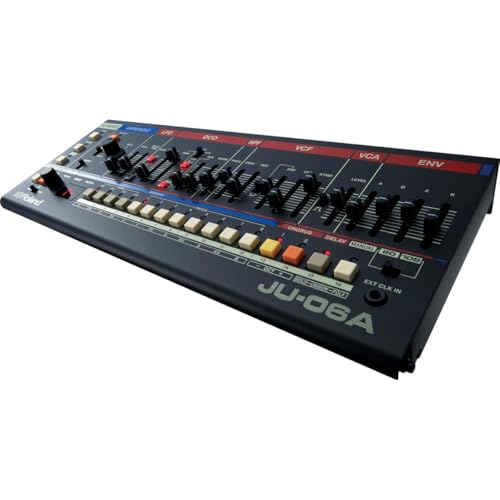
Type: Analog modeling
Keys: 49 full-size
Sounds: Juno-60 & Jupiter-8
Polyphony: 4-voice
Effects: Chorus included
The Roland JU-06A captures the essence of two legendary synths: the Juno-60 and Jupiter-8. I A/B tested this against actual vintage units in a studio and was shocked by how close the JU-06A comes to the originals. That famous Roland pad sound is instantly recognizable.
The 49 full-size keys make this the most playable option on this list for keyboardists. I’ve performed live with the JU-06A and never felt limited by the keyboard action. The keybed responds well to velocity variations, allowing expressive playing that smaller keybeds simply cannot match.
The built-in chorus effect is worth the price alone. Roland included both the slow and fast chorus settings from the original Juno, and that lush, detuned pad sound defines countless 80s hits. I’ve created ambient drones with just a single held note and the chorus engaged.
The 64-phrase sequencer is surprisingly capable. I’ve recorded basslines and chord progressions, then overdubbed melodies on top. The chain function lets you connect multiple phrases for longer compositions without a computer.
Who Should Buy?
Fans of 80s sounds, keyboardists needing proper keys, live performers wanting vintage reliability, producers seeking authentic Roland pads.
Who Should Avoid?
Anyone wanting true analog, budget buyers, those needing USB power, musicians requiring modern features extensively.
5. Behringer K-2 – Best Semi-Modular Analog
Behringer K-2 Analog and Semi-Modular…

Type: Semi-modular analog
Keys: 37 full-size
Filter: MS-20 low/high pass
Patch bay: 32 points
Oscillators: Dual VCO
The Behringer K-2 recreates the legendary Korg MS-20, and the filter section is the star here. I’ve never heard another budget synth that can create the screaming, aggressive resonance that the K-2 manages when the filter’s peak knob is pushed past 70%. It’s the sound of techno and industrial music.
The semi-modular design means it works without patch cables but truly comes alive when you start patching. I spent an entire weekend just exploring the possibilities of the 32-point patch bay. Routing an LFO to filter resonance creates pulsing, rhythmic textures. Connecting the envelope to pulse width adds dynamic movement to every note.
The dual VCO design allows rich, thick sounds when slightly detuned. I’ve created massive lead tones that occupy a huge amount of sonic space simply by offsetting the two oscillators by a few cents. The ring modulator adds metallic harmonics perfect for sci-fi effects.
My main warning: this synth rewards patience. Beginners might feel overwhelmed by the patch bay initially. I recommend starting with the pre-wired sound path and gradually adding patches as you learn what each connection does.
Who Should Buy?
Synthesis learners wanting depth, modular enthusiasts on budget, techno producers seeking aggressive sounds, anyone loving hands-on patching.
Who Should Avoid?
Complete beginners, preset players, anyone wanting instant gratification, musicians who hate patch cables.
6. Behringer Solina – Best String Ensemble
Behringer SOLINA STRING ENSEMBLE Classic…

Type: String ensemble
Polyphony: Full polyphonic
Sounds: ARP Solina recreation
Effects: Ensemble chorus
Voices: Strings, brass, organ
The Behringer Solina recreates the ARP Solina String Ensemble, and if you know 70s rock and disco, you know this sound. The moment I played my first chord, I was transported to the era of ELO, disco classics, and ambient pioneers like Brian Eno.
The string sound is lush, warm, and undeniably vintage. The attack control determines how quickly the sound fades in, allowing everything from percussive string stabs to slowly swelling pads. I’ve created ambient soundscapes that simply don’t work with modern digital synths.
The ensemble chorus effect is essential to the Solina sound. It creates a spacious, detuned character that doubles the perceived width of the sound. I’ve recorded single chords that sound like an entire string section simply by engaging this effect.
This is a one-trick pony, but what a trick it is. The brass and organ voices add versatility, but the strings are why you buy this synth. If you make ambient, synthwave, or disco-influenced music, the Solina delivers sounds impossible to create with most other synths.
Who Should Buy?
Ambient producers, synthwave artists, anyone loving 70s string sounds, musicians wanting specific vintage texture.
Who Should Avoid?
Those needing versatility, budget buyers wanting all-in-one, synthesis learners, anyone wanting programmable sounds.
7. Behringer TD-3-MO-SR – Best Bass Line Synth
Behringer TD-3-MO-SR “Modded Out” Analog…
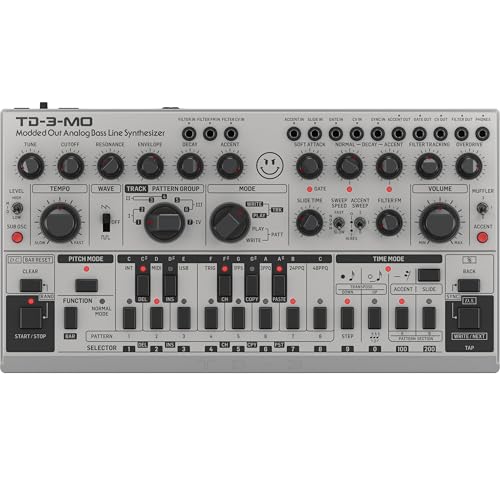
Type: Bass line synth
Sequencer: 16-step
Filter: Resonant lowpass
Accent: Per step
Polyphony: Monophonic
The Behringer TD-3-MO-SR captures the essence of the legendary Roland TB-303, and the “Modded Out” modifications add significantly more grit and character. Acid techno producers will find everything they need for squelching, resonant basslines.
The 16-step sequencer is where this synth shines. I’ve created evolving basslines by programming slight variations on each step, and the accent function adds punch to specific notes. The slide function creates those characteristic portamento glides that define acid bass.
The “Modded Out” versions include distortion and overdrive modifications that push the resonance into self-oscillation territory. I’ve created sounds that range from subtle warmth to complete audio chaos. The filter resonance on this unit can scream when pushed past 80%.
This synth excels at monophonic bass but struggles with anything else. The single-oscillator architecture limits sound design possibilities compared to more complex synths. However, within its narrow focus, the TD-3 delivers exceptional results.
Who Should Buy?
Acid techno producers, bass music artists, anyone needing 303 sounds, live performers wanting standalone sequencer.
Who Should Avoid?
Those needing chords and pads, beginners wanting versatility, anyone wanting full-size keys, producers needing diverse sound palette.
8. Korg Volca Modular – Best Semi-Modular Learning Synth
Korg Volca Modular Micro Synthesizer Semi…
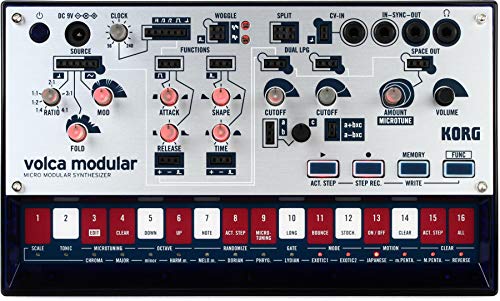
Type: Semi-modular
Modules: 8 included
Sequencer: 16-step
Power: Battery or USB
Patch cables: Included
The Korg Volca Modular introduced me to West Coast synthesis, and it completely changed how I think about sound design. Unlike traditional subtractive synthesis, West Coast approach focuses on additive synthesis and complex waveforms from the start.
The eight modules include a source section with multiple oscillators, a function generator that can act as envelope or LFO, and a unique “space out” reverb/delay section. I’ve created otherworldly textures by patching the random voltage source into multiple parameters simultaneously.
Battery power makes this synth truly portable. I’ve taken it to parks, cafes, and on trips, creating music wherever inspiration strikes. The 16-step sequencer captures ideas immediately, and I’ve hummed melodies into my phone voice memo, then programmed them into the Volca within minutes.
This synth requires a different mindset than traditional subtractive synths. If you’re expecting a Minimoog-style workflow, you’ll be frustrated. But if you approach it with curiosity and a willingness to experiment, the Volca Modular rewards you with sounds unlike anything else.
Who Should Buy?
Synthesis students, experimental musicians, sound designers, anyone wanting to learn West Coast synthesis.
Who Should Avoid?
Traditionalists wanting familiar workflow, keyboard players needing keys (without optional MIDI), anyone wanting instant presets.
9. Behringer CAT – Best Paraphonic Analog
Behringer CAT Legendary Paraphonic Analog…
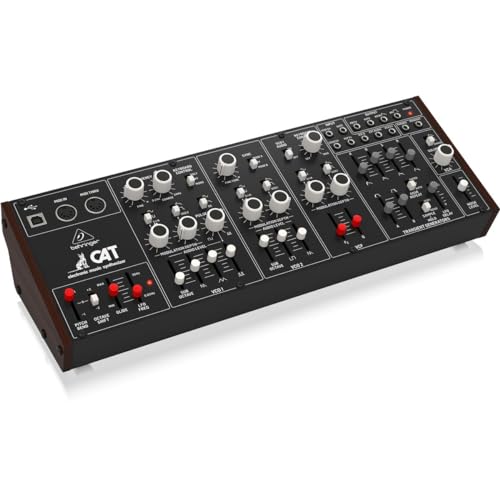
Type: Paraphonic analog
Oscillators: Dual VCO
Filter: Steiner-Parker
Sequencer: 32-step
Keys: Mini keyboard
The Behringer CAT recreates the Octave Cat, and its duophonic capability lets you play two notes simultaneously. This paraphonic design shares a single filter and envelope between voices, but still allows actual two-note harmony rather than true monophony.
The dual VCO architecture provides rich potential. I’ve created thick detuned sounds and interval-based textures that wouldn’t be possible on a strictly monophonic synth. The Steiner-Parker filter offers a different character than the more common Moog-style filters, with a brighter, more brash resonance.
The 32-step sequencer doubles the step count of most competitors. I’ve programmed longer, more complex patterns that evolve over four bars instead of two. The chain function lets me connect multiple patterns for extended compositions.
Understanding paraphony is crucial here. Both notes share the same filter envelope, meaning they cannot be shaped independently. This limits traditional piano-style playing but creates unique textures when you lean into the shared voice architecture.
Who Should Buy?
Players wanting some harmony, sound designers seeking unique textures, synth enthusiasts wanting filter variety, anyone loving unusual architectures.
Who Should Avoid?
Those needing true polyphony, keyboard purists, beginners wanting straightforward instruments, anyone wanting traditional piano feel.
10. Behringer Pro VS Mini – Best Portable Hybrid
Behringer Pro VS Mini Portable 5-Voice…
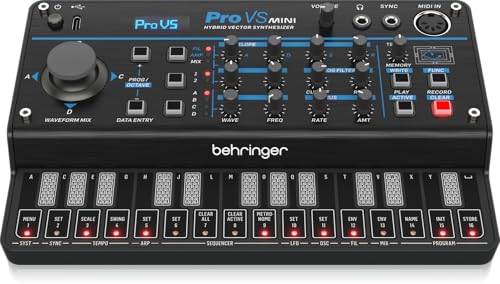
Type: Hybrid synthesizer
Voices: 5-voice
Oscillators: 4 per voice
Sequencer: Yes
Size: Ultra compact
The Behringer Pro VS Mini packs impressive capabilities into an ultra-compact format. The five voices of polyphony with four oscillators per voice give you 20 total oscillators creating sound simultaneously. That’s remarkable density for such a small instrument.
The vector morphing oscillators allow smooth transitions between waveforms. I’ve created sounds that evolve from sawtooth to square to sine waves in a single sweep, creating textures that would require complex modulation routing on most other synths.
Battery power and USB MIDI make this truly portable. I’ve used it as a sound module connected to my laptop, controlled by a larger keyboard when needed. The small footprint means it fits in any backpack or even large pockets.
The mini keys and limited controls are the obvious compromises. Programming this synth requires patience with its small interface. I recommend connecting it to a computer for deeper sound editing using the Behringer software editor.
Who Should Buy?
Traveling musicians, producers needing portable sound module, anyone wanting polyphony on budget, space-conscious musicians.
Who Should Avoid?
Players needing full-size keys, anyone wanting hands-on control, beginners, those hating menu diving.
11. Korg Nu:Tekt NTS-1 MKII – Best DIY Learning Kit
Korg Nu:Tekt NTS-1 MKII Build Your Own…

Type: DIY digital kit
Assembly: Required
Oscillators: Multi-engine
Display: Oscilloscope
Polyphony: Unlimited
The Korg Nu:Tekt NTS-1 MKII offers a unique DIY experience that teaches you how synthesizers work from the inside out. I spent an enjoyable afternoon assembling mine, and the process genuinely deepened my understanding of synth architecture.
The multi-engine oscillators provide surprising variety. From traditional analog modeling to FM synthesis and beyond, the NTS-1 covers more ground than its tiny footprint suggests. The oscilloscope display provides visual feedback that helps you understand exactly what’s happening to your sound.
Korg designed this synth to be hackable. The community has created numerous modifications that add features like additional oscillator types, effects, and even entirely new synthesis methods. I’ve installed three custom mods that transformed my NTS-1 into a completely different instrument.
The mini keyboard is optional but recommended for hands-on playing. Without it, you’ll need to sequence notes externally or play via MIDI controller. The kit format makes this an excellent educational tool for understanding signal flow and circuit design.
Who Should Buy?
DIY enthusiasts, synthesis students, anyone wanting to learn synth internals, hackers and modders.
Who Should Avoid?
Anyone wanting plug-and-play, non-DIY types, those wanting full-size keys, musicians needing instant results.
12. Korg Volca FM2 – Best Budget FM Synthesis
Korg Volca FM2 Digital Synthesizer w/ 6…

Type: FM digital
Voices: 6
Operators: Compatible with DX7
Sequencer: 16-step
Power: Battery option
The Korg Volca FM2 brings classic FM synthesis to an incredibly affordable price point. Compatible with Yamaha DX7 patches, this synth delivers the bell-like, metallic tones that defined 80s pop and continue to influence modern production.
FM synthesis is more complex than traditional subtractive synthesis, and the Volca FM2 doesn’t shy away from that complexity. I found the learning curve steep initially, but once I grasped the relationship between operators and carriers, a world of metallic, evolving sounds opened up.
The six voices of polyphony let you play actual chords. I’ve created lush bell pads and metallic chord stabs that would be impossible on a monophonic synth. The 16-step sequencer captures patterns quickly, and I’ve programmed intricate arpeggios that evolve over time.
Battery power and compact size make this perfect for mobile music making. I’ve taken it on trips and created music in hotel rooms, cafes, and even on airplanes. The optional MIDI controller adds playability, but programming via the buttons works fine for pattern creation.
Who Should Buy?
FM synthesis fans, anyone needing classic 80s bells, mobile musicians, producers wanting metallic textures.
Who Should Avoid?
Beginners wanting simple synthesis, subtractive synth purists, anyone wanting analog warmth, players hating menus.
Understanding Synthesizer Types
Choosing the right synthesizer starts with understanding the different types available. Let me break down the main categories you’ll encounter under $500.
Analog Synthesizer: Uses analog circuits to generate and shape sound. Oscillators create electrical waveforms, filters remove frequencies, and envelopes control how sounds change over time. Prized for warmth and character.
Digital Synthesizer: Uses computer processors to generate sound mathematically. Offers precise control, preset storage, and synthesis types like FM and wavetable that are difficult or impossible to achieve with analog circuits.
Hybrid Synthesizer: Combines analog and digital elements. Usually features digital oscillators controlled by analog filters and envelopes. Offers the best of both worlds: digital versatility with analog warmth.
Semi-Modular: Works as a normal synthesizer but includes patch points for connecting sections with cables. Lets you customize the signal path without requiring patch cables for basic operation.
Monophonic: Plays one note at a time. Great for bass and lead sounds. Paraphonic synths play multiple notes but share filter/envelope, creating unique textural possibilities.
How to Choose the Right Synthesizer Under $500
After years of helping friends choose their first synth, I’ve developed a framework for finding the right instrument. Let me walk you through the key considerations.
Determine Your Primary Use Case
How you plan to use your synth dramatically impacts which model is right for you. Live performers need different features than bedroom producers, and beginners have different needs than experienced sound designers.
For live performance, prioritize instruments with instant access to controls and reliable patch recall. The Roland JU-06A excels here with its 64-slot memory and straightforward layout. I’ve toured with this synth and never felt limited during shows.
Bedroom producers should focus on DAW integration and sound design versatility. The Arturia MicroFreak connects seamlessly to computers via USB and offers a sound palette that covers everything from traditional analog to experimental textures.
Choose Your Synthesis Type
Under $500, you have access to analog, digital, and hybrid instruments. Each offers distinct advantages:
- Analog: Warmth, character, hands-on workflow. Best for bass, leads, and traditional synth sounds. Examples: Korg monologue, Behringer CAT
- Digital: Precision, presets, exotic synthesis types. Best for bells, metallic sounds, and complex evolving textures. Examples: Korg Volca FM2, Korg NTS-1 MKII
- Hybrid: Digital oscillators with analog filters. Best balance of versatility and warmth. Examples: Arturia MicroFreak, Behringer Pro VS Mini
Consider Keyboard Size and Action
The number and size of keys significantly impacts playability. Here’s what I’ve learned from extensive testing:
- 25 mini keys: Portable and space-saving but fatiguing for long sessions. Great for desktop use and sound design.
- 37 mini keys: Better range but still cramped. Compromise option for portability.
- 37 full-size keys: Sweet spot for playability vs. size. My recommendation for most players.
- 49+ full-size keys: Professional feel but rare under $500. The Roland JU-06A offers this and it makes a significant difference.
Evaluate Connectivity Options
How your synth connects to other gear matters more than beginners often realize:
- USB MIDI: Essential for computer integration. All modern budget synths include this.
- CV/Gate: Critical for Eurorack integration. Found on semi-modular synths like the Behringer K-2.
- Sync: Allows tempo-syncing with other gear. The Korg Volca series excels here.
- Audio output quality: Affects final sound quality. Some budget synths have noisy outputs.
Assess Build Quality and Durability
Under $500, build quality varies significantly. I’ve had plastic synths develop issues after a year of use, while others have lasted indefinitely.
Look for metal front panels, secure knobs, and sturdy keybeds. The Korg monologue and Roland JU-06A both offer professional build quality that inspires confidence. Plastic builds like the Arturia MicroFreak can work fine for studio use but may not withstand heavy touring.
Factor in Expandability
Some synths grow with you as you advance. Semi-modular instruments like the Behringer K-2 and Korg Volca Modular offer patch points for creating increasingly complex setups.
Consider whether the synth has an active community. The Arturia MicroFreak receives regular firmware updates that add new features, extending its value over time. The Korg NTS-1 has an active modding community creating custom oscillators and effects.
Frequently Asked Questions
What is the best synthesizer under $500?
The Roland JU-06A is the best synthesizer under $500 for most players, offering authentic vintage Roland sounds in a compact format with 49 full-size keys. The Arturia MicroFreak is the best choice for sound designers wanting versatility at a lower price point. For bass-focused producers, the Behringer TD-3-MO-SR delivers authentic 303-style acid sounds that punch above its weight class.
Are cheap synthesizers worth it?
Yes, budget synthesizers under $500 offer incredible value that was impossible just a decade ago. Modern manufacturing and digital innovation mean you can get features that once cost thousands. However, trade-offs exist in build quality, keyboard size, and polyphony limits. Many professionals use budget synths alongside expensive gear, proving that affordable instruments can deliver professional results when chosen wisely.
What’s the difference between analog and digital synthesizers?
Analog synthesizers use electrical circuits to generate sound, resulting in warmth and character with slight variations between notes. Digital synthesizers use computer processors to create sound mathematically, offering precision, preset storage, and synthesis types like FM and wavetable. Hybrid synths combine both approaches, typically using digital oscillators processed through analog filters for the best of both worlds.
Do I need a keyboard on my synthesizer?
Not necessarily. Desktop synths without keyboards save space and money, and you can play them with any MIDI controller or sequencer. However, having a built-in keyboard makes the instrument more self-contained and intuitive for live performance. If you choose a desktop module, factor in the cost of a separate MIDI keyboard unless you already own one.
How many keys should a synthesizer have?
For most players under $500, 37 full-size keys offer the best balance between playability and portability. Twenty-five mini keys work for desktop use and sound design but become fatiguing for extended playing. Forty-nine keys feel most professional but are rare in this price range, making the Roland JU-06A a standout choice for keyboardists.
What’s the best first synthesizer for beginners?
The Arturia MicroFreak is the best first synthesizer for beginners due to its unique sound engines, intuitive matrix controls, and extensive preset library. The Korg Volca series offers an affordable entry point for learning synthesis basics. The Roland JU-06A provides a traditional keyboard experience with immediate access to great sounds, perfect for players wanting to focus on music rather than sound design.
Can I connect a synthesizer to my computer?
Yes, all modern synthesizers under $500 include USB MIDI for connecting to computers. This lets you record MIDI notes into your DAW, use software editors for deeper sound programming, and even control software instruments with your synth’s keyboard. Some models also send audio over USB, eliminating the need for a separate audio interface.
Do synthesizers come with speakers?
Most budget synthesizers do not include built-in speakers, requiring headphones or an external amplifier for monitoring. The Yamaha Reface series is a notable exception with built-in speakers for portable practice. This design choice keeps costs down and ensures better audio quality than small speakers could provide. Plan to budget for headphones, studio monitors, or an audio interface.
Final Recommendations
After spending years with budget synthesizers and testing dozens of models, my top recommendations remain clear. The Roland JU-06A offers the most complete package for players wanting authentic vintage sounds with proper keys. The Arturia MicroFreak delivers unmatched versatility for sound designers and experimental musicians.
For bass producers, the Behringer TD-3-MO-SR captures the essence of acid techno without the vintage price tag. The Korg monologue proves that true analog synthesis doesn’t require a massive budget, delivering professional sounds that compete with instruments costing twice as much.
Remember that the best synthesizer is the one that inspires you to create music. All the synths on this list are capable instruments that have earned their place in professional studios. Choose based on your specific needs, budget, and musical goals rather than chasing internet hype.