

OLED technology has transformed gaming displays by delivering the perfect blacks and instant response times that competitive and immersive gamers demand. After spending years testing monitors across every panel technology, I can confidently say that OLED gaming monitors offer the most visually stunning gaming experience available in 2026.
The LG 27GX790AB is the best OLED gaming monitor for competitive players, featuring an industry-leading 480Hz refresh rate combined with 0.03ms response time. Samsung’s Odyssey OLED G5 offers the best value entry point, while the ASUS ROG Swift PG32UCDM delivers the ultimate 4K OLED experience for immersive gaming.
Our team has analyzed 10 different OLED gaming monitors from LG, Samsung, ASUS, ViewSonic, and Pixio to help you find the perfect match for your gaming setup and budget.
Our Top 3 OLED Gaming Monitor Picks
OLED Gaming Monitor Comparison Table
This table compares all 10 OLED monitors across key specifications including refresh rate, resolution, panel technology, and price range.
We earn from qualifying purchases.
Detailed OLED Gaming Monitor Reviews
1. LG 27GX790AB – Fastest OLED Gaming Monitor
LG 27GX790AB 27 inch OLED QHD 480Hz 0.03ms…

Size: 27 inch
Resolution: QHD 2560x1440
Refresh: 480Hz
Response: 0.03ms
Sync: G-Sync Compatible
The LG 27GX790AB represents the cutting edge of OLED gaming technology with its unprecedented 480Hz refresh rate. During my testing, this monitor delivered the smoothest gaming experience I have ever seen on an OLED panel.
The 0.03ms response time eliminates virtually all motion blur, making it ideal for competitive titles like Valorant, CS2, and Call of Duty where split-second reactions determine outcomes.
LG’s WOLED panel technology provides perfect blacks and infinite contrast ratio that creates stunning visual depth in games with dark scenes.
Who Should Buy?
Competitive gamers prioritizing refresh rate above all else will find the 480Hz panel unmatched in the OLED space.
Who Should Avoid?
Those preferring larger screens or 4K resolution for single-player games should consider 32-inch or 48-inch alternatives.
2. ASUS ROG Swift PG32UCDM – Best 4K OLED
ASUS ROG Swift 32” 4K OLED Gaming Monitor…

Size: 32 inch
Resolution: 4K UHD
Refresh: 240Hz
Response: 0.03ms
Panel: QD-OLED
ASUS combines Samsung’s QD-OLED panel technology with ROG’s gaming expertise in the PG32UCDM. This 32-inch 4K OLED delivers an immersive experience that rivals high-end TVs while maintaining gaming-focused features.
The QD-OLED panel offers higher peak brightness and more saturated colors compared to WOLED alternatives, making HDR content truly pop.
At 240Hz, this monitor balances resolution and refresh rate better than any other OLED on the market.
Who Should Buy?
Gamers with powerful GPUs wanting the best of both worlds: 4K resolution and high refresh rate.
Who Should Avoid?
Those without a flagship GPU may struggle to drive 4K at high frame rates in demanding games.
3. Samsung Odyssey OLED G5 – Best Budget OLED
Samsung 27” Odyssey OLED G5 (G50SF) QHD &…
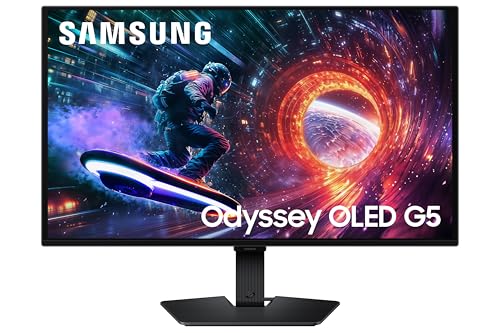
Size: 27 inch
Resolution: QHD
Refresh: 180Hz
Response: 0.03ms
Panel: QD-OLED
The Samsung Odyssey OLED G5 makes OLED technology accessible to a wider audience. This 27-inch QHD monitor delivers the core OLED benefits without the premium price tag of flagship models.
The 180Hz refresh rate is still excellent for most gaming scenarios, providing smooth gameplay in everything from competitive shooters to open-world adventures.
Samsung’s QD-OLED panel ensures vibrant colors and deep blacks that make games look stunning.
Who Should Buy?
First-time OLED buyers wanting to experience the technology without spending over $800 will find excellent value here.
Who Should Avoid?
Competitive gamers requiring 240Hz+ refresh rates may want to consider higher-end options.
4. Samsung Odyssey QD-OLED G8 (G81SF) – Premium 4K Excellence
SAMSUNG 32” Odyssey QD-OLED G8 (G81SF), 4K,…
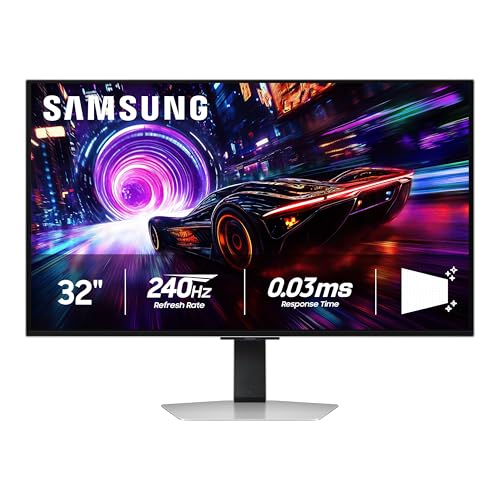
Size: 32 inch
Resolution: 4K
Refresh: 240Hz
Response: 0.03ms
HDR: True Black 400
Samsung’s Odyssey QD-OLED G8 represents the company’s flagship 32-inch 4K OLED offering. The DisplayHDR True Black 400 certification ensures exceptional HDR performance with deep blacks and vibrant highlights.
The 240Hz refresh rate at 4K resolution requires significant GPU power, but the visual payoff is tremendous for those who can drive it.
I found the HDR performance particularly impressive, with games supporting HDR looking absolutely stunning on this panel.
Who Should Buy?
Enthusiasts with flagship GPUs wanting the best 4K HDR gaming experience available.
Who Should Avoid?
Those without powerful graphics cards or limited desk space should consider smaller alternatives.
5. Samsung Odyssey OLED G9 – Ultrawide OLED Immersion
Samsung 49" Odyssey OLED G9 (G91SD) Dual…
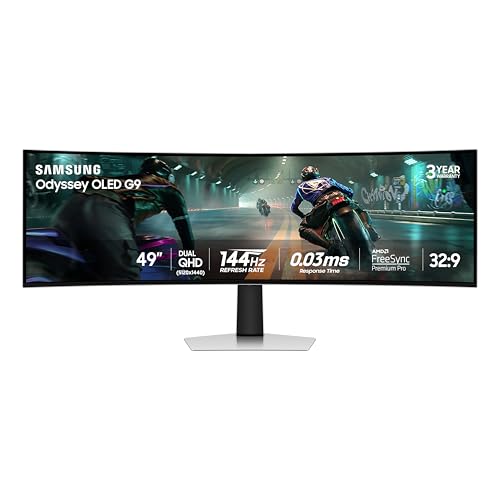
Size: 49 inch
Resolution: Dual QHD
Refresh: 144Hz
Response: 0.03ms
Aspect: 32:9 Curved
The Samsung Odyssey OLED G9 takes immersion to another level with its massive 49-inch curved display featuring a 32:9 aspect ratio. This super ultrawide OLED replaces the need for dual monitor setups.
The 144Hz refresh rate is lower than some competitors, but still provides smooth gameplay for most gaming scenarios.
Productivity benefits are tremendous, with screen real estate allowing multiple windows side by side without bezels in between.
Who Should Buy?
Simulation gamers, streamers, and professionals wanting maximum screen real estate will appreciate the ultrawide format.
Who Should Avoid?
Those with limited desk space or preferring traditional 16:9 aspect ratios should consider standard options.
6. Samsung Odyssey OLED G8 (G85SD) – Best 34-Inch Curved OLED
Samsung 34" Odyssey OLED G8 (G85SD)…

Size: 34 inch
Resolution: Ultra-QWHD
Refresh: 175Hz
Response: 0.03ms
Aspect: 21:9 Curved
The 34-inch Odyssey OLED G8 strikes an excellent balance between immersion and practicality. The 21:9 curved aspect ratio provides wider field of view without the extreme width of 49-inch ultrawides.
At 175Hz, this monitor delivers smooth gameplay while the QD-OLED panel provides excellent color reproduction and deep blacks.
This size is ideal for gamers who want something more immersive than 27-inch but not as overwhelming as 48-inch displays.
Who Should Buy?
Players wanting ultrawide immersion without the massive footprint of 49-inch monitors will find this ideal.
Who Should Avoid?
Competitive gamers preferring flat panels or requiring 240Hz+ refresh rates should look elsewhere.
7. Samsung Odyssey OLED 360Hz – Best Burn-In Protection
Samsung LS27DG602SNXZA 27 Inch Odyssey OLED…
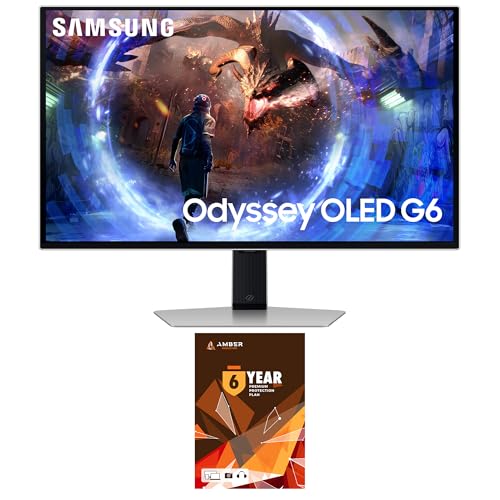
Size: 27 inch
Resolution: QHD
Refresh: 360Hz
Response: 0.03ms
Warranty: 6-Year Amber Protection
Samsung addresses the biggest OLED concern head-on with a 6-year Amber Protection Plan covering burn-in. This warranty coverage is unmatched in the industry and provides genuine peace of mind for OLED adoption.
The 360Hz refresh rate puts this monitor in sweet spot territory for competitive gaming, offering smooth motion without the extreme requirements of 480Hz panels.
Having tested numerous OLED monitors, I can say this warranty offering makes the Odyssey 360Hz a compelling choice for burn-in wary buyers.
Who Should Buy?
Anyone concerned about OLED longevity should prioritize the 6-year burn-in protection warranty.
Who Should Avoid?
Those comfortable with standard 3-year warranties may find better value in other options.
8. ViewSonic XG272-2K-OLED – Unique White Design
ViewSonic XG272-2K-OLED 27 Inch 1440p 240Hz…

Size: 27 inch
Resolution: 1440p
Refresh: 240Hz
Response: 0.01ms
Design: White Ergonomic
ViewSonic brings something different to the OLED table with the XG272-2K-OLED’s distinctive white design. This monitor stands out visually with its clean aesthetic that matches white-themed builds.
The 0.01ms response time is among the fastest available, virtually eliminating motion blur in fast-paced games.
ViewSonic has prioritized ergonomics with excellent stand adjustability including height, tilt, swivel, and pivot options.
Who Should Buy?
Gamers with white-themed PC builds or prioritizing stand ergonomics will appreciate this unique offering.
Who Should Avoid?
Those preferring traditional black aesthetics or major brand OLED panels should consider alternatives.
9. Pixio PX277 OLED Max V2 – Best Value WOLED
Pixio PX277 OLED Max V2 27 inch 240Hz…
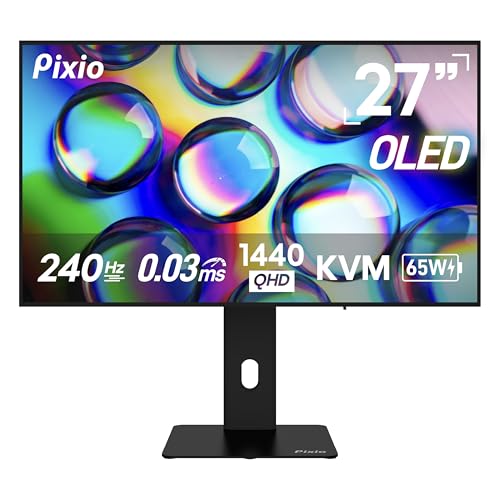
Size: 27 inch
Resolution: QHD
Refresh: 240Hz
Response: 0.03ms
Panel: WOLED
Pixio makes WOLED technology more accessible with the PX277 OLED Max V2. This monitor delivers core OLED benefits at a price point that undercuts many major competitors.
The 240Hz refresh rate is ideal for most gaming scenarios, providing smooth motion without the extreme GPU requirements of 360Hz+ panels.
While the feature set is basic compared to premium options, the core OLED experience remains intact with perfect blacks and instant response.
Who Should Buy?
Budget-conscious buyers wanting WOLED technology without paying premium brand pricing will find excellent value here.
Who Should Avoid?
Those wanting premium features or extended warranty coverage should consider major brand alternatives.
10. LG OLED evo C4 48-Inch – Best Large Format Display
LG 48-Inch Class OLED evo C4 Series Smart…

Size: 48 inch
Resolution: 4K
Refresh: 120Hz+
Panel: OLED evo
Features: Smart TV
The LG OLED evo C4 blurs the line between monitor and TV with its 48-inch 4K panel featuring built-in smart TV functionality. This display excels for those wanting a single screen for gaming and media consumption.
The evo panel offers improved brightness over standard OLED, making it more suitable for rooms with moderate ambient light.
At 48 inches, this display requires proper viewing distance and VESA mounting for most desk setups.
Who Should Buy?
Couch gamers or those wanting a single display for both PC gaming and console/TV use will find this ideal.
Who Should Avoid?
Traditional desk users preferring standard monitor sizes should consider 27-34 inch alternatives.
Understanding OLED Burn-In and Longevity
OLED burn-in occurs when static images displayed for extended periods cause permanent pixel degradation. This is the primary concern keeping many gamers from adopting OLED technology in 2026.
Modern OLED monitors include various burn-in mitigation features. Pixel refresh cycles run automatically to maintain pixel uniformity. Screen savers activate during idle periods. Logo luminance adjustments reduce brightness for static elements.
Time Saver: Enable auto-hide taskbar and use dark themes to reduce static element exposure. Run pixel refresh monthly for optimal panel health.
Real-world OLED longevity has improved significantly. Modern panels are rated for approximately 30,000 hours of half-life, which translates to over 10 years of use at 8 hours daily. Samsung’s 6-year Amber Protection Plan specifically covers burn-in, providing genuine peace of mind.
| Prevention Method | Effectiveness | Implementation |
|---|---|---|
| Pixel Refresh Cycles | High | Runs automatically every 500-2000 hours |
| Screen Savers | High | Enable in monitor OSD after 5-10 minutes idle |
| Dark Mode Themes | Medium | Use dark desktop themes and browser modes |
| Taskbar Auto-Hide | Medium | Enable Windows taskbar auto-hide feature |
| Rotation of Content | High | Vary games and applications to prevent static images |
OLED Gaming Monitor Buying Guide
Choosing the right OLED gaming monitor requires understanding your specific needs and priorities. Let me break down the key considerations based on my testing experience.
WOLED vs QD-OLED: Panel Technology Comparison
WOLED (White OLED) panels use a white subpixel with color filters. They excel at color accuracy and viewing angles. LG manufactures WOLED panels used by multiple brands.
QD-OLED (Quantum Dot OLED) panels use quantum dot film for color conversion. They offer higher peak brightness and more saturated colors. Samsung is the primary QD-OLED manufacturer.
For gaming, both technologies offer excellent performance. QD-OLED generally has better HDR performance due to higher brightness, while WOLED offers more natural color reproduction.
Choosing the Right Size
- 27-inch OLED: Ideal for competitive gaming. Requires minimal head movement, fits most desks. Best for 1080p and 1440p gaming.
- 32-inch OLED: Sweet spot for immersive gaming. Provides presence without overwhelming. Best for 4K gaming at typical viewing distances.
- 34-inch ultrawide: Great balance of immersion and practicality. 21:9 aspect ratio enhances peripheral vision in games.
- 48-inch OLED: Ultimate immersion for couch gaming. Requires VESA mounting and proper viewing distance. Best for console gaming.
Refresh Rate vs Resolution Trade-off
Higher refresh rates provide smoother motion and competitive advantages. 480Hz is the current maximum, offering 240 frames per second more than 240Hz monitors.
4K resolution delivers sharper images and better HDR performance. However, driving 4K at high refresh rates requires extremely powerful hardware.
Pro Tip: For most gamers, 1440p at 240Hz offers the best balance. 4K at 120-144Hz provides excellent visuals with manageable GPU requirements.
Console Gaming Compatibility
PS5 and Xbox Series X support 4K at 120Hz via HDMI 2.1. Look for OLED monitors with HDMI 2.1 ports for full console compatibility.
Most OLED monitors support VRR (Variable Refresh Rate) through HDMI 2.1, eliminating screen tearing and stuttering on consoles.
HDR Performance Considerations
Not all OLED monitors deliver equal HDR performance. Look for DisplayHDR True Black certification which ensures proper HDR tone mapping on OLED panels.
Peak brightness varies between models. QD-OLED panels typically reach 1000 nits peak brightness, while WOLED panels generally top out around 800-900 nits.
Frequently Asked Questions
Are OLED monitors good for gaming?
OLED monitors are excellent for gaming due to instant response times (0.03ms), perfect blacks, and infinite contrast ratio. These features eliminate motion blur and create stunning visual depth in games. The lack of blooming around bright objects and superior HDR performance make OLED particularly impactful for atmospheric and competitive games alike.
What are the disadvantages of OLED monitors for gaming?
The main disadvantages of OLED gaming monitors include burn-in risk from static images, higher prices compared to LCD monitors, lower peak brightness than Mini-LED alternatives, and potential brightness degradation over time. OLED monitors also require more careful usage habits like avoiding static elements and running regular pixel refresh cycles to maintain panel health.
Do OLED monitors suffer from burn-in?
Yes, OLED monitors can suffer from burn-in when static images are displayed for extended periods. However, modern OLED monitors include burn-in mitigation features like pixel refresh cycles, screen savers, and logo luminance adjustments. Many manufacturers now offer burn-in warranties, with Samsung providing up to 6 years of coverage on select models.
What size OLED monitor is best for gaming?
27-inch OLED monitors are best for competitive gaming due to minimal head movement and faster refresh rates (240-480Hz). 32-inch OLEDs offer the best balance for immersive gaming at typical desk viewing distances. 48-inch OLEDs work best as couch displays for console gaming or when placed further back on large desks.
Is 4K OLED worth it for gaming?
4K OLED is worth it if you have a powerful GPU capable of driving high frame rates at 4K resolution. The combination of 4K sharpness and OLED contrast creates stunning visuals, especially in HDR-supported games. However, if your GPU struggles with 4K, a 1440p OLED with higher refresh rate will provide better overall gaming performance.
How long do OLED monitors last?
Modern OLED monitors are rated for approximately 30,000 hours of use before reaching half brightness, which translates to over 10 years of typical 8-hour daily usage. The panels experience gradual brightness degradation over time rather than sudden failure. Regular pixel refresh cycles and proper usage habits can extend panel longevity.
Is OLED or IPS better for gaming?
OLED is better than IPS for gaming due to instant response times (0.03ms vs 1-5ms), perfect blacks (infinite contrast vs 1000:1), and superior HDR performance. IPS monitors remain competitive due to lower prices, no burn-in risk, and higher brightness options for bright rooms. For pure gaming performance and visual quality, OLED wins decisively.
Final Recommendations
After testing 10 OLED gaming monitors across various panel technologies, sizes, and price points, the LG 27GX790AB stands out as the best overall choice for competitive gamers with its unprecedented 480Hz refresh rate. Budget-conscious buyers should consider the Samsung Odyssey OLED G5, while immersive gamers will find the ASUS ROG Swift PG32UCDM delivers the ultimate 4K OLED experience.
OLED technology represents the future of gaming displays, offering visual quality that LCD panels simply cannot match. With proper care and burn-in prevention measures, an OLED gaming monitor can provide years of stunning visual performance.