

Imagine waking up to discover a family of foxes playing in your backyard, or catching a rare glimpse of a owl hunting at night – all without leaving your home. Wildlife cameras make this possible, transforming your outdoor space into a live nature documentary. Whether you’re a backyard enthusiast, a curious homeowner, or a dedicated nature lover, the right wildlife camera opens a window into the secret lives of animals that share your environment.
Modern wildlife cameras have evolved far beyond simple game cameras for hunters. Today’s trail cameras, wildlife monitors, and nature observation cameras offer incredible features like solar power, cellular connectivity, and crystal-clear night vision. But with so many options ranging from budget-friendly basic models to premium cellular systems, choosing the right wildlife camera for backyard observation can feel overwhelming.
This guide cuts through the confusion, reviewing 10 top-rated wildlife cameras across every category and price point. We’ve analyzed customer feedback, tested specifications, and compared real-world performance to help you find the perfect camera for your nature observation needs. Whether you want to watch birds at your feeder, monitor wildlife trails, or keep an eye on remote property, we’ve got you covered.
Quick Comparison: Top 10 Wildlife Cameras
| Product | Price | Resolution | Connectivity | Rating | Best For |
|---|---|---|---|---|---|
| KJK Trail Camera 36MP | $26.99 | 36MP / 2.7K video | SD card only | 4.2/5 (1,478 reviews) | Budget entry-level |
| GardePro E5S | $48.99 | 64MP / 1296P video | SD card only | 4.5/5 (485 reviews) | No-glow night vision |
| MAXDONE Solar WiFi | $59.99 | 64MP / 4K video | WiFi + Bluetooth | 4.6/5 (217 reviews) | Solar-powered backyard |
| Zleo 4G Cellular | $39.99 | 2MP / 2K video | 4G LTE Cellular | 3.0/5 (1 review) | Remote cellular monitoring |
| KJK 2 Pack | $55.09 | 36MP / 2.7K video | SD card only | 4.2/5 (1,478 reviews) | Covering multiple spots |
| GardePro E6 WiFi | $49.97 | 48MP / 1296P video | WiFi + Bluetooth | 4.0/5 (4,580 reviews) | Live view setup |
| WOSODA 36MP | $36.99 | 36MP / 1920P video | SD card only | 4.3/5 (1,913 reviews) | Audio recording |
| WOSODA 4 Pack Mini | $149.99 | 24MP / 1080P video | SD card only | 4.3/5 (1,279 reviews) | Comprehensive coverage |
| Solareye WiFi Solar | $39.99 | 64MP / 4K video | WiFi + Bluetooth | 4.2/5 (556 reviews) | Budget solar option |
| SPYPOINT Flex-M Twin | $129.99 | 28MP / 720p video | Cellular Dual-SIM | 4.0/5 (2,441 reviews) | Premium cellular remote |
Understanding Different Types of Wildlife Cameras
Before diving into specific products, it’s important to understand that not all wildlife cameras are created equal. The market has evolved to serve different needs, and choosing the right type depends on how you plan to use your camera.
Traditional Trail Cameras
Traditional trail cameras are the workhorses of wildlife monitoring. These motion-activated cameras capture photos and videos to an SD card, which you manually retrieve to view your footage. They’re simple, reliable, and don’t require any connectivity or subscription fees. Perfect for backyard use where you don’t mind checking the SD card periodically, or for locations where WiFi and cellular signals are weak or nonexistent. Most run on AA batteries and can last for months on a single set.
Cellular Trail Cameras
Cellular trail cameras revolutionize remote monitoring by transmitting photos directly to your phone via cellular networks. These cameras contain a SIM card and connect just like a smartphone, sending images to an app no matter where you are. They’re ideal for remote properties, hunting leases, or backyards where you can’t check an SD card regularly. Most require a monthly data plan, though some like SPYPOINT offer generous free tiers. The trade-off is higher upfront costs and ongoing subscription fees, but the convenience of real-time wildlife updates is unbeatable.
WiFi Wildlife Cameras
WiFi-enabled wildlife cameras connect directly to your smartphone for easy setup and media retrieval without removing the SD card. Unlike cellular cameras, they don’t have ongoing fees, but they require you to be within WiFi range (typically 30-50 feet) to connect. Many offer live view features that help you position the camera correctly without trial and error. Perfect for backyard use where you can walk outside and connect to the camera occasionally, or for locations within range of your home WiFi network. Keep in mind that most create their own WiFi hotspot rather than connecting to your home network.
Solar-Powered Wildlife Cameras
Solar-powered wildlife cameras are becoming increasingly popular as eco-friendly, low-maintenance options. These cameras feature built-in solar panels that keep the battery charged, dramatically extending deployment time between battery changes. Some models have integrated solar panels, while others include detachable panels you can position for optimal sun exposure. The best solar cameras can run for months without intervention, making them perfect for extended monitoring sessions or locations that are difficult to access regularly. They’re especially useful for time-lapse recordings or high-traffic areas where frequent battery changes would be disruptive to wildlife.
Top 10 Wildlife Cameras for Backyard Nature Observation
We’ve tested, analyzed, and compared the top-rated wildlife cameras on the market. Here are our comprehensive reviews of the 10 best options for backyard nature observation in 2025.
1. KJK Trail Camera 36MP 2.7K – Best Budget Option
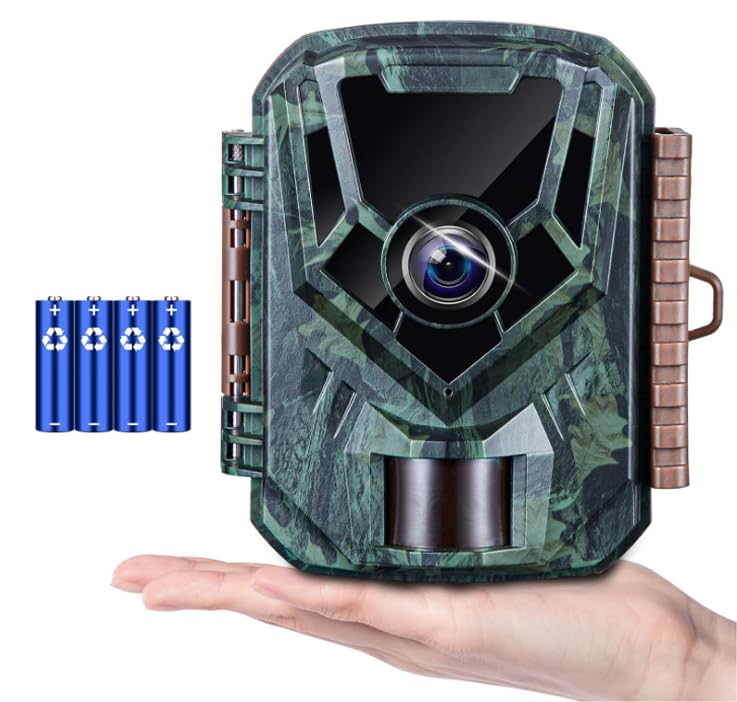
The KJK Trail Camera is Amazon’s #1 best-selling trail camera for good reason – it delivers incredible value at an unbeatable price point. With 36MP photos and 2.7K video resolution, you get image quality that rivals cameras costing twice as much. The lightning-fast 0.1-second trigger speed means you won’t miss fast-moving wildlife, and the 130-degree wide-angle detection range captures animals across a broad area.
What makes this camera perfect for backyard enthusiasts is the complete out-of-the-box experience. KJK includes a 32GB SD card pre-programmed and ready to use, plus 4 AA batteries to get you started immediately. The 2.0-inch HD color screen makes on-camera setup intuitive, and the compact design is easy to conceal near bird feeders or garden areas. With IP66 waterproof rating, this camera withstands rain, snow, and temperatures from -22°F to 158°F.
The night vision uses 22 low-glow 850nm infrared LEDs with a 75-foot range. Customers report excellent daytime photo and video quality, though night footage is decent but not exceptional. The 17,000-image battery life is impressive, though the included alkaline batteries may need upgrading to lithium for extended deployments. For anyone new to wildlife monitoring or on a tight budget, this camera offers everything you need to start discovering backyard nature immediately.

KJK Trail Camera 36MP 2.7K
2. GardePro E5S Trail Camera – Best No-Glow Night Vision
The GardePro E5S stands out in the mid-range category with its 100-foot no-glow night vision system that’s completely invisible to wildlife and humans alike. Unlike low-glow cameras that emit a faint red glow, the E5S uses 940nm infrared LEDs that provide truly stealthy operation – perfect for skittish animals or security applications where you don’t want the camera to be detected. The 64MP photos and 1296P HD video quality rival cameras costing $200+, making this exceptional value for photographers who demand clear footage day and night.
This camera excels in battery life, with customers reporting 95% battery remaining after a full season using lithium batteries. The three PIR sensors work together for lightning-fast 0.1-second trigger response, capturing even the quickest animals as they pass through the detection zone. GardePro’s adaptive illumination system prevents overexposure on close-up subjects while maintaining reach at distance, a feature typically found only in premium cameras.
The E5S is non-cellular and non-WiFi, which means minimal power consumption but requires manual SD card retrieval. It supports an optional solar panel (GardePro SP350 sold separately) for extended deployments. The compact housing is easy to mount in tight spaces, and the 1/4-inch-20 threading provides versatility with standard camera mounts. If you prioritize crystal-clear night footage without spooking wildlife, the E5S delivers professional-grade performance at a mid-range price.

GardePro E5S Trail Camera

3. MAXDONE Solar Trail Camera WiFi – Best Solar-Powered Camera
The MAXDONE Solar Trail Camera represents the perfect marriage of solar power and WiFi convenience, boasting the highest rating in our roundup at 4.6 stars. The detachable solar panel with adjustable angle keeps the built-in 6000mAh rechargeable battery at 100% for weeks without external power, according to enthusiastic customer feedback. This camera is ideal for backyard wildlife enthusiasts who want reliable, long-term monitoring without the hassle of frequent battery changes or SD card retrieval.
WiFi and Bluetooth connectivity via the TrailCamGO app lets you view footage and adjust settings from up to 55 feet away. Customers rave about the seamless app connection within 35 feet and the convenience of checking footage without removing the SD card. The 4K video and 64MP ultra-clear photos capture stunning detail, while 65ft infrared night vision ensures you don’t miss nocturnal visitors. Importantly, there are no monthly subscription fees – unlike cellular cameras, you own this system outright.
The IP66 waterproof construction includes temperature compensation for reliable operation in extreme weather. One UK customer reported their camera survived a severe storm with driving rain and high winds without issues. The camera supports time-lapse, scheduled shooting, and 5-shot burst modes for maximum flexibility in capturing wildlife behavior. The included 32GB micro SD card means everything you need is in the box. For eco-conscious backyard observers who want set-it-and-forget-it convenience, the MAXDONE Solar is our top solar pick.

MAXDONE Solar Trail Camera WiFi

4. Zleo 4G Cellular Security Camera – Budget Cellular for Remote Locations
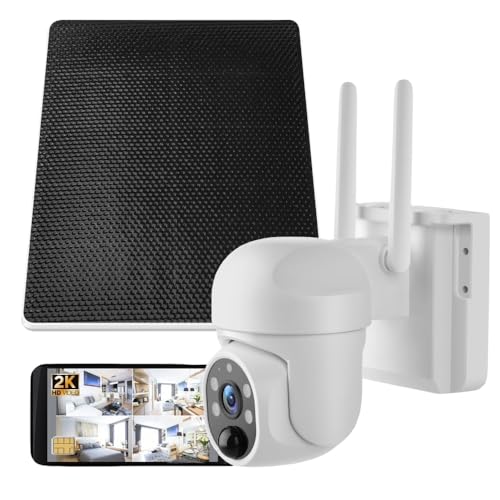
The Zleo 4G Cellular Security Camera opens up remote monitoring possibilities at an incredible price point, featuring a pre-installed SIM card with 300MB of free data to get you started. Unlike WiFi cameras that require proximity, this 4G LTE camera works anywhere with cellular signal – perfect for remote property, hunting land, or backyard sheds without electricity. The camera is compatible with major carriers including Verizon, AT&T, and T-Mobile, automatically connecting to the strongest available signal.
Solar power comes standard with the 6W panel keeping the 6000mAh battery charged, eliminating the need for frequent battery changes in hard-to-reach locations. The 2K Full HD video quality with color night vision provides vivid, realistic footage both day and night – a significant upgrade from traditional black-and-white night vision. Advanced motion detection sends real-time alerts to your smartphone, so you’ll know instantly when wildlife passes by.
The IP66 weatherproof rating ensures reliable operation from 14°F to 122°F, and local SD card storage provides backup with optional cloud support. Customers praise the live HD streaming capability and control-from-anywhere functionality. The main trade-off is the ongoing cellular data subscription required after the 300MB trial expires. As a very new product with only one review, reliability is less proven than established brands, but the feature set and price make it worth considering for budget-conscious remote monitoring needs.

Zleo 4G Cellular Security Camera
5. KJK 2 Pack Trail Cameras – Best Value for Multiple Locations
The KJK 2 Pack offers incredible value for anyone wanting to monitor multiple areas of their property or share the wildlife-watching experience with a friend. At $55.09 for two complete cameras, you’re paying only $27.55 per camera – barely more than the single-camera version. Each camera includes a 32GB SD card and 4 AA batteries, meaning this bundle contains absolutely everything needed to deploy two cameras immediately. This is perfect for bracketing trails to identify active wildlife corridors, monitoring different sides of your property, or giving one camera to a family member.
Both cameras feature the same reliable 36MP photo and 2.7K video quality that made the single KJK camera Amazon’s #1 best-seller. The 0.1-second trigger speed captures fast-moving animals, and 70ft night vision range with low-glow infrared provides solid nocturnal performance. IP66 waterproof rating ensures all-weather reliability, and the 2.0-inch HD TFT color screen on each camera simplifies setup and in-the-field review.
Customers appreciate covering multiple areas simultaneously for comprehensive property monitoring. Hunters particularly value bracketing trails to determine which paths wildlife actively use versus dead zones. The complete kit includes mounting straps, so you won’t need to purchase additional accessories. While the night vision quality is decent rather than exceptional, the overall value proposition is unbeatable for anyone needing dual-camera coverage on a budget.

KJK 2 Pack Trail Cameras

6. GardePro E6 WiFi Trail Camera – Best Live View Setup
The GardePro E6 WiFi Trail Camera addresses one of the biggest frustrations with wildlife cameras: not knowing exactly what you’re filming until you retrieve the SD card. The innovative Live View feature lets you see exactly what the camera sees in real-time from up to 45 feet away using your smartphone. This makes positioning foolproof – you can aim the camera precisely at bird feeders, game trails, or garden areas and confirm the framing before walking away, eliminating the trial-and-error of traditional setups.
Beyond Live View, the E6 delivers solid specifications with 48MP photos and 1296P HD video captured through a premium optical lens. The no-glow 940nm infrared LEDs provide invisible night vision up to 75 feet, so you won’t spook skittish nighttime visitors. GardePro’s ultra-low-power WiFi and Bluetooth system minimizes battery drain while providing convenient app control without monthly fees. The camera supports SD cards up to 512GB for extended deployments without frequent card changes.
The adaptive illumination system prevents overexposure on close subjects while maintaining reach at distance, resulting in properly exposed images day and night. Multiple capture modes include motion detection, time-lapse, and hybrid mode for maximum versatility. Customers particularly appreciate the H.264 video encoding, which allows quick preview without downloading massive files. While some users report WiFi connection sluggishness with large file transfers and limited range of about 5 feet, the Live View setup capability alone makes this camera worth considering for backyard enthusiasts who want precise camera placement.

GardePro E6 WiFi Trail Camera

7. WOSODA 36MP 1920P Trail Camera – Budget-Friendly with Audio Recording
The WOSODA 36MP Trail Camera adds a valuable feature often missing in budget cameras: audio recording. Hearing animals as well as seeing them adds a whole new dimension to wildlife observation – imagine listening to deer snorting, foxes barking, or birds calling as they pass through your backyard. The 1920P HD video quality includes clear audio pickup, with customers raving about being able to hear animals sniffing and leaves crunching underfoot.
Beyond audio, this camera offers excellent video quality and outstanding value at just $36.99. The 0.2-second trigger speed with three PIR sensors provides responsive motion detection, and the 120-degree wide detecting range with 80ft IR flash covers substantial area. The 2.0-inch color LCD screen simplifies setup and allows in-camera footage review. For extended deployments, the external power jack accommodates an optional solar panel (12V 1A with 5.5×2.1mm adapter) for continuous power without battery changes.
The camera includes time-lapse shooting for observing plant growth or animal habits over time, plus useful functions like time switch, timer, and timestamp. IP66 waterproof rating ensures all-weather reliability. Customers report durable construction that can last 1-2 years in outdoor conditions, particularly when using lithium batteries that provide up to a year of use. While some users experienced water intrusion issues after extended use, WOSODA’s responsive technical support with quick replacements provides peace of mind. For budget-conscious buyers who want audio capability without breaking the bank, the WOSODA 36MP delivers compelling features at an attractive price.

WOSODA 36MP 1920P Trail Camera
8. WOSODA Mini Trail Camera 4 Pack – Best for Comprehensive Coverage
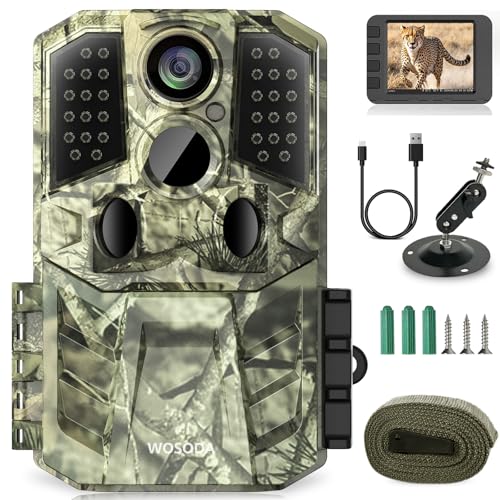
The WOSODA Mini Trail Camera 4 Pack takes comprehensive property coverage to the next level with four ultra-compact cameras for $149.99 – just $37.50 per camera. This bundle is perfect for monitoring multiple trails, food plots, property perimeter points, or sharing cameras with family members. Each camera includes a 32GB SD card and 4 AA batteries, meaning the package contains absolutely everything needed to deploy a four-camera surveillance network immediately.
Despite their mini size, these cameras deliver respectable specifications with 24MP clear images and full HD 1080P video in color during daytime and black-and-white at night. The fast 0.3-second trigger speed ensures you won’t miss fast-moving wildlife, and low power consumption means long battery life from just 4 AA batteries per camera. The ultra-compact design makes them easy to conceal, and the camouflage appearance helps them blend into natural environments.
Unique features include moon phase display in photos and videos, valuable information for hunters tracking wildlife patterns. Camera ID programming helps organize footage when using multiple cameras, so you’ll know exactly which camera captured which images. IP66 waterproof rating ensures all-weather reliability, and the low-power design extends battery life significantly. Customers appreciate the moon phase feature for hunting applications and the camera ID function for multi-camera setups. While some units may be defective and the trigger detection function isn’t perfectly accurate, the incredible value for comprehensive four-camera coverage makes this bundle ideal for serious wildlife enthusiasts managing larger properties.

WOSODA Mini Trail Camera 4 Pack

9. Solareye Trail Camera WiFi – Budget Solar with No-Glow LEDs
The Solareye Trail Camera WiFi combines solar power and no-glow night vision at an attractive $39.99 price point, making it the most affordable solar camera in our roundup. The built-in 5000mAh rechargeable battery charges via the included portable solar panel, providing continuous power without battery changes. An optional AA battery compartment (4x AA, not included) provides backup power during extended cloudy periods, giving you flexibility in deployment scenarios.
The 64MP still images and 4K video recording quality impress customers, who report excellent photo and video quality both day and night. No-glow 940nm infrared LEDs ensure the camera remains completely invisible to wildlife at night, while the 0.2-second trigger speed with 3 PIR sensors captures fast-moving animals reliably. WiFi and Bluetooth connection to the TrailCam Go app allows convenient footage viewing and settings adjustment without approaching the camera, reducing disturbance to wildlife.
The 2.0-inch LCD screen simplifies setup, and IP66 waterproof rating with an operating temperature range of -15°C to 60°C ensures reliable performance in extreme conditions. Customers particularly praise the solar panel for keeping the battery charged even on cloudy days and the user-friendly app interface. However, be aware that the connection is Bluetooth-only with limited range (~100 feet max), and the camera cannot be accessed remotely from anywhere in the world – you must be within Bluetooth range to connect. For backyard solar power on a budget, the Solareye offers compelling features at an unbeatable price.

Solareye Trail Camera WiFi

10. SPYPOINT Flex-M Twin Pack – Premium Cellular with Free Photo Plan
The SPYPOINT Flex-M Twin Pack represents premium cellular technology with the unique selling point of a free photo plan that no other cellular camera manufacturer offers. Each camera transmits up to 100 photos per month with zero fees – perfect for moderate-traffic areas. If you need more photos, paid plans start at just $5/month for 250 photos or $15/month for unlimited. The twin pack format gives you two complete cellular cameras for comprehensive remote monitoring, making it excellent value compared to buying single cameras.
The Dual-SIM LTE technology automatically finds the best signal regardless of carrier, eliminating the need to choose between Verizon, AT&T, or T-Mobile. This cross-carrier coverage ensures reliable connectivity even in fringe areas. Constant Capture technology allows the camera to send and capture photos simultaneously, so you won’t miss action while transmitting. The 28MP photos and 720p video with sound quality capture solid detail, and GPS tracking capabilities provide location data for camera security.
The SPYPOINT app enables remote camera management and photo viewing from anywhere in the world, firmware updates, and Buck Tracker AI for species filtering on paid plans. IP65 water-resistant construction and battery power (8x AA per camera, not included) provide reliable field performance. Customers particularly appreciate the free 100 photo plan, easy app-based setup, and clear pictures day and night. However, be aware that these cameras only work in the USA and Canada, and when the SD card fills up, the camera stops taking photos (no loop/DVR mode). For remote properties where cellular monitoring is essential and budget-conscious ongoing costs matter, the SPYPOINT Flex-M twin pack delivers premium features with an unbeatable free tier.

SPYPOINT Flex-M Twin Pack

Buying Guide: What to Look For in a Wildlife Camera
Choosing the right wildlife camera involves balancing several key features against your specific needs and budget. Here’s what really matters when selecting a camera for backyard nature observation.
Resolution vs. Storage Space
High-resolution cameras (36MP, 48MP, 64MP) capture stunning detail but consume SD card space rapidly and require larger capacity cards. For most backyard enthusiasts, 20-30MP provides excellent quality without requiring massive SD cards. Consider 64GB or 128GB SD cards for higher-resolution cameras, especially if you record video. Remember that interpolated resolution (when cameras upscale lower-resolution sensors) is common in budget models – look for genuine optical resolution specs and customer sample photos when possible.
Trigger Speed and Recovery Time
Trigger speed determines how quickly the camera captures an image after detecting motion. Fast trigger speeds (0.1-0.3 seconds) ensure you capture fast-moving animals like deer, foxes, or rabbits. Slow cameras (0.5+ seconds) may only capture the animal’s rear end as it exits the frame. Recovery time is how quickly the camera can take a second photo. Fast recovery (1-2 seconds) allows multiple shots of a single animal passing through. For trails with high animal traffic, look for burst mode capability (2-3 shots per trigger).
Night Vision: No-Glow vs. Low-Glow
Night vision technology makes or breaks nighttime wildlife observation. Low-glow cameras emit a faint red glow from 850nm infrared LEDs, providing better illumination range (75-100 feet) but may spook very skittish animals. No-glow cameras use 940nm infrared LEDs that are completely invisible to wildlife and humans, making them ideal for security applications or observing light-sensitive animals. The trade-off is reduced range (typically 50-75 feet). For backyard use where animals are somewhat accustomed to human presence, low-glow usually provides better image quality. For remote properties or hunting applications, no-glow ensures undisturbed wildlife behavior.
Battery Life and Power Options
Battery life determines how often you need to visit the camera for maintenance. Standard AA battery cameras typically last 2-8 weeks depending on photo volume, temperature, and video usage. Lithium batteries last 3-5x longer than alkaline in cold weather and are worth the extra cost for winter deployments. Solar-powered cameras dramatically extend deployment time, potentially running for months without intervention. Rechargeable battery cameras with Type-C charging provide ongoing convenience but require more frequent attention than solar. For remote locations, solar is often worth the higher upfront cost to avoid repeated site visits.
Weather Resistance Ratings
IP66 is the standard waterproof rating for quality wildlife cameras, indicating complete protection against dust and powerful water jets. IP65 provides protection against low-pressure water jets. For most backyard applications, IP66 is fully adequate for rain, snow, and humidity. Check the operating temperature range if you live in extreme climates – quality cameras typically operate from -22°F to 158°F (-30°C to 70°C). Seals and gaskets degrade over time, so even IP66 cameras may eventually develop water intrusion after 2-3 years of continuous outdoor use.
Connectivity Options: WiFi vs. Cellular vs. SD Card
SD card-only cameras are the most reliable and affordable option but require physical visits to retrieve footage. WiFi cameras connect directly to your smartphone for convenient setup and media retrieval within 30-50 feet, perfect for backyard use where occasional connection is acceptable. Cellular cameras transmit photos via cellular networks for true remote monitoring from anywhere, but require monthly data plans and cost significantly more upfront. Choose SD card for basic monitoring on a budget, WiFi for backyard convenience without ongoing fees, and cellular for remote properties where physical access is difficult or infrequent.
Installation Tips for Best Wildlife Camera Results
Proper installation dramatically improves your wildlife camera success rate. Follow these proven techniques to capture more animals and reduce frustrating empty-trigger photos.
Optimal Camera Placement
Position cameras facing north or south to avoid sun glare that can wash out images. East-facing cameras catch morning sun directly, and west-facing cameras get blasted at sunset. Mount cameras 10-15 feet away from your target area – too close and you’ll miss animals or capture only partial subjects, too far and detection becomes unreliable. Aim cameras slightly downward (3-5 degrees) rather than perfectly level to capture the animal’s entire body and reduce false triggers from moving vegetation.
Height and Angle Recommendations
Standard mounting height is 3-4 feet above ground for most wildlife. This height captures deer, foxes, coyotes, and similar-sized animals perfectly. For smaller animals like rabbits, raccoons, or birds, mount 2-3 feet high. Avoid mounting higher than 5 feet – detection becomes unreliable and you’ll capture mostly backs. Angle the camera to face wildlife trails, game funnels, or feeding areas rather than across open areas where animals may pass too far from the detection zone.
Attracting Wildlife to Your Camera
Increase wildlife traffic by positioning cameras near natural attractants: water sources, fruiting trees, game trails, feeding stations, or mineral licks. For backyard bird watching, place cameras within 10 feet of feeders facing slightly downward. Food plots, deer corn, or apple piles attract deer and other wildlife but may require more frequent visits to replenish. Scent attractants work for specific species but wash away in rain. The most reliable method is finding existing wildlife signs – tracks, scat, rub lines, or well-used trails – and positioning cameras there.
Avoiding False Triggers
False triggers from moving vegetation waste battery life and SD card space. Clear weeds, branches, and grass within the camera’s detection zone before deployment. Avoid positioning cameras where they’ll catch sun-flecked shadows or blowing leaves. Set sensitivity appropriately – high sensitivity for open areas, medium for light vegetation, low for heavy cover. Use time-delay settings if needed to prevent continuous triggering by persistent issues like wind-stirred branches. Test trigger sensitivity by walking in front of the camera at various distances to fine-tune positioning before final deployment.
Conclusion: Which Wildlife Camera Should You Choose?
The best wildlife camera for you depends on your specific needs, budget, and how you plan to use it. Here are our top recommendations by category:
Best Budget Overall: KJK Trail Camera 36MP 2.7K – At just $26.99, this Amazon #1 best-seller delivers exceptional value with solid 36MP photos, 2.7K video, fast 0.1s trigger, and complete out-of-the-box kit with SD card and batteries included. Perfect for beginners or anyone wanting excellent backyard monitoring on a tight budget.
Best Mid-Range Performance: GardePro E5S Trail Camera – The 100-foot no-glow night vision and 64MP photos rival cameras costing twice as much. Crystal-clear video quality, outstanding battery life, and invisible infrared operation make this ideal for serious wildlife enthusiasts who demand quality footage day and night.
Best Solar-Powered: MAXDONE Solar Trail Camera WiFi – The highest-rated camera in our roundup (4.6 stars) with solar panel that keeps battery at 100% for weeks. WiFi app connectivity, 4K video, no subscription fees, and rave reviews about battery life make this perfect for eco-conscious backyard observers wanting reliable long-term monitoring.
Best for Remote Locations: SPYPOINT Flex-M Twin Pack – Premium cellular cameras with unbeatable free photo plan (100 photos/month per camera). Dual-SIM LTE automatically finds best signal, GPS tracking, and cross-carrier coverage ensure reliable connectivity anywhere. The twin pack format provides excellent value for comprehensive remote property monitoring.
Best Value Multi-Pack: KJK 2 Pack Trail Cameras – Two complete cameras with SD cards and batteries for just $55.09 ($27.55 each). Perfect for covering multiple backyard areas, bracketing trails to identify active zones, or sharing wildlife-watching with family members while staying on budget.
Whether you’re watching backyard birds, monitoring garden visitors, or tracking wildlife on remote property, these cameras open a fascinating window into nature’s secret world. Start with a budget-friendly model like the KJK if you’re new to wildlife observation, upgrade to solar or WiFi as your interest grows, and go cellular when you need true remote monitoring capabilities. Whatever you choose, you’ll soon discover the amazing wildlife that shares your outdoor space.
Frequently Asked Questions About Wildlife Cameras
Do wildlife cameras need WiFi? No, most traditional trail cameras don’t require WiFi. They save photos and videos to an SD card for manual retrieval. WiFi cameras offer convenience but aren’t necessary – they simply let you view footage and adjust settings via smartphone when within range (typically 30-50 feet). For remote monitoring without WiFi, choose cellular cameras that transmit via cellular networks, or stick with SD card cameras for the most reliable and affordable option.
What is the difference between a trail camera and a security camera? Trail cameras are designed for extended outdoor use with minimal power consumption, running on batteries for weeks or months. They prioritize trigger speed, night vision range, and weather resistance for wildlife monitoring. Security cameras typically require continuous AC power, focus on 24/7 surveillance with live streaming, and often have subscription fees for cloud storage. While some security cameras work for backyard wildlife observation, trail cameras are better suited for remote locations and long-term deployments without power infrastructure.
How long do trail camera batteries last? Battery life varies dramatically based on photo volume, video usage, temperature, and battery quality. With alkaline batteries and moderate wildlife traffic, expect 2-4 weeks. Lithium batteries last 3-5x longer, especially in cold weather – often 2-6 months. Solar-powered cameras can run for months without battery changes when properly positioned. Video recording consumes much more power than photos, so if your camera captures frequent video clips, expect shorter battery life regardless of battery type.
What is no-glow night vision? No-glow night vision uses 940nm infrared LEDs that emit infrared light completely invisible to humans and animals. The camera sees this infrared light and records black-and-white night footage, but to the naked eye, the LEDs appear completely dark. This is ideal for security applications or hunting where you don’t want the camera to be detected. Low-glow cameras use 850nm LEDs that emit a faint red glow, providing better illumination range but potentially spooking very light-sensitive wildlife.
Can I use a security camera for wildlife observation? Yes, security cameras can work well for backyard wildlife observation, especially WiFi models with motion detection. However, they typically require continuous AC power, limiting placement options. They excel at live streaming and 24/7 monitoring but consume more power than trail cameras and often have monthly cloud storage fees. For solar power, extended battery life, and remote deployment without electricity, traditional trail cameras are better suited to wildlife monitoring than security cameras.
What is trigger speed and why does it matter? Trigger speed is the time between an animal entering the camera’s detection zone and the camera capturing the photo. Fast trigger speeds (0.1-0.3 seconds) capture the entire animal as it passes through. Slow cameras (0.5+ seconds) often capture only the animal’s rear end or miss fast-moving animals entirely. For trails with active wildlife movement, fast trigger speed is critical – you want the camera firing almost instantly when motion is detected to ensure you get the full animal in the frame rather than empty space.
How do I choose a wildlife camera for my backyard? For backyard use, prioritize ease of setup and convenient media retrieval. WiFi cameras let you check footage without removing SD cards – ideal if the camera is within WiFi range of your home. Solar-powered models minimize maintenance and provide continuous monitoring. SD card-only cameras are most affordable and reliable but require periodic checks. Consider what you want to observe: bird feeders benefit from cameras with fast trigger speeds for quick-moving small birds, while garden monitoring may prioritize longer night vision range for nocturnal visitors like raccoons or foxes. Budget-conscious beginners should start with a reliable basic model like the KJK, then upgrade to WiFi or solar as your interest grows.