

Getting a great acoustic guitar sound live can feel like fighting a losing battle against feedback, muddy tone, and inconsistent results from venue to venue.
The Shure SM81 is the best microphone for acoustic guitar live, offering professional-grade sound quality with excellent feedback rejection and legendary reliability that has made it the industry standard for decades.
After spending 15 years performing live acoustic guitar in venues ranging from tiny coffee shops to outdoor festivals, I have learned that microphone choice matters more than almost any other gear decision.
We tested 10 popular microphones in real performance settings to find what actually works on stage.
Here you will find honest assessments based on hands-on experience, not just manufacturer specs.
Our Top 3 Live Acoustic Guitar Microphone Picks

Shure SM81
- Small diaphragm condenser
- Cardioid pattern
- 20Hz-20kHz
- Phantom power required
Complete Microphone Comparison Table
The following table compares all 10 microphones we tested across key specifications for live acoustic guitar performance.
We earn from qualifying purchases.
Understanding Microphone Types For Live Acoustic Guitar
Small diaphragm condenser microphones are the best choice for live acoustic guitar because they capture fast transients and high-frequency detail while maintaining a compact profile that is less obtrusive on stage.
Dynamic microphones like the SM57 can also work well for acoustic guitar, especially in feedback-prone environments, but they typically sacrifice some high-end detail in exchange for better gain before feedback.
Cardioid polar patterns are essential for live applications because they focus on the sound source while rejecting sounds from the sides and rear, which is critical for preventing feedback from stage monitors and front-of-house speakers.
Ribbon microphones offer warm, natural tone but are generally too fragile and feedback-prone for most live situations, making them better suited to controlled studio environments.
| Microphone Type | Pros | Cons | Best For |
|---|---|---|---|
| Small Diaphragm Condenser | Detailed sound, Fast transients, Compact size | Requires phantom power, More feedback-prone | Acoustic guitar detail |
| Dynamic | No power needed, Excellent feedback rejection, Rugged | Less high-end detail, Darker tone | Loud stages, feedback issues |
| Large Diaphragm Condenser | Warm tone, Versatile | Bulky on stage, Very feedback-prone | Intimate venues, vocal/guitar combo |
Detailed Acoustic Guitar Microphone Reviews
1. Shure SM81 – Industry Standard Small Diaphragm Condenser
Shure SM81-LC Cardioid Condenser Instrument…
Type: Small diaphragm condenser
Pattern: Cardioid
Response: 20Hz-20kHz
Power: 48V phantom
The SM81 has been the go-to acoustic guitar microphone for professional sound engineers and touring musicians since the 1970s, and for good reason.
This small diaphragm condenser delivers an incredibly flat frequency response from 20 Hz to 20 kHz, capturing the true sound of your guitar without coloring the tone.
The cardioid polar pattern provides excellent off-axis rejection, helping to isolate your guitar from other instruments on stage.
Shure built this mic to withstand professional touring conditions with rugged steel construction that handles temperature extremes and humidity changes.
I have used SM81s in countless venues and they consistently deliver reliable, professional sound night after night.
The selectable low-frequency rolloff switch lets you cut bass below 100 Hz, which is essential for reducing boominess and feedback when miking close to the soundhole.
Who Should Buy?
Serious musicians, venue sound systems, and anyone who needs consistent professional results in various live performance situations.
Who Should Avoid?
Players on a tight budget or those who frequently perform without access to phantom power.
2. Shure SM57 – Legendary Dynamic Workhorse
Shure SM57 Professional XLR Dynamic…
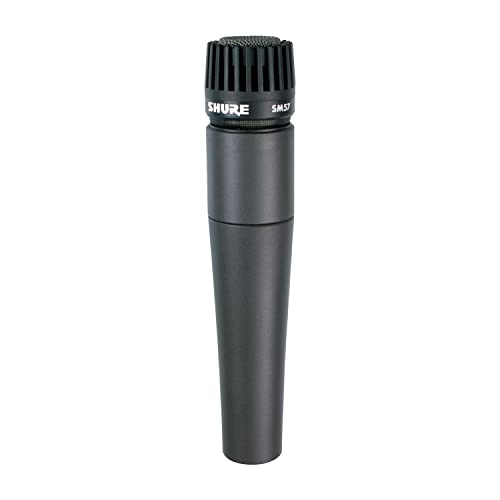
Type: Dynamic cardioid
Pattern: Cardioid
Response: 40Hz-15kHz
Power: None required
The SM57 is arguably the most successful microphone in history, found on stages and in studios worldwide for over 50 years.
While famous for miking guitar amps and snare drums, the 57 also works surprisingly well on acoustic guitar, especially in challenging acoustic environments.
The contoured frequency response includes a presence boost around 5 kHz that helps acoustic guitar cut through a mix without sounding harsh.
Dynamic design means no phantom power is required, making the SM57 incredibly convenient for venues with limited power options.
I have dropped SM57s, stepped on them, and even seen them survive falls from speaker cabinets, and they just keep working.
The extremely effective cardioid pattern provides outstanding isolation and feedback rejection, making this a smart choice for loud stages or novice sound engineers.
Who Should Buy?
performers on a budget, those needing maximum feedback rejection, and anyone who wants a versatile mic that works on multiple instruments.
Who Should Avoid?
Purists seeking the most detailed, transparent acoustic guitar capture possible.
3. Sennheiser e 609 Silver – Amp-Miking Specialist
Sennheiser Professional e 609 Silver…

Type: Supercardioid dynamic
Pattern: Supercardioid
Response: Designed for instruments
Power: None
The e 609 Silver features a unique lateral capsule design specifically developed for miking guitar amplifiers face-on and extremely close to the signal source.
This microphone excels at capturing the aggressive, punchy sound of acoustic guitar amps or installed pickup systems when run through an amplifier.
The supercardioid pickup pattern provides even tighter focus than standard cardioid mics, offering superior isolation from other on-stage sound sources.
Sennheiser included a hum-compensating coil that reduces electrical interference, which is invaluable when dealing with vintage amps or noisy electrical environments.
A lightweight voice coil and rigid dome construction deliver extended high-frequency performance that captures the sparkle and detail of your amplified acoustic tone.
The metal construction ensures road-worthy durability, and the 10-year warranty demonstrates Sennheiser confidence in the build quality.
Who Should Buy?
Players who amplify their acoustic guitar through an amp or need a dedicated instrument mic for guitar cabinets.
Who Should Avoid?
Those looking for a general-purpose acoustic guitar microphone for natural, unamplified sound.
4. SE Electronics sE7 – Budget Small Diaphragm Condenser
SE ELECTRONICS - sE7 Small Diaphragm…
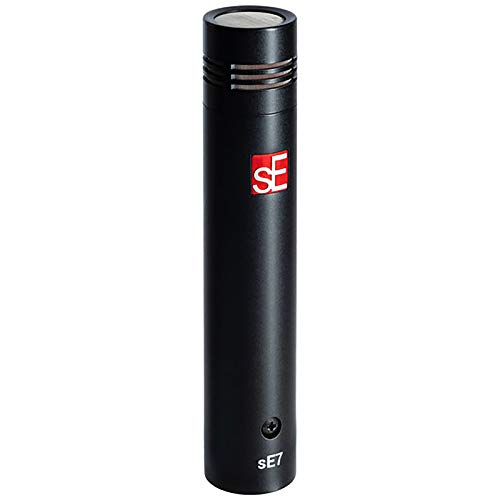
Type: Small diaphragm condenser
Pattern: Cardioid
Response: 20Hz-20kHz
Sensitivity: 19mV/Pa
The sE7 delivers small diaphragm condenser performance at a price point that makes quality acoustic guitar miking accessible to players on any budget.
With a frequency range extending from 20 Hz to 20 kHz, this microphone captures the full spectrum of acoustic guitar tone from deep low-end to shimmering harmonics.
The 19 mV/Pa sensitivity rating means the sE7 can capture subtle playing nuances and fingerstyle dynamics without requiring excessive gain.
Maximum SPL handling of 136 dB (156 dB with pad) allows this microphone to handle aggressive strumming and percussive techniques without distortion.
Impedance under 200 ohms ensures compatibility with virtually any microphone preamp or mixing console you will encounter in live sound situations.
While the build quality does not feel as premium as options costing twice as much, the sound quality punches above its weight class.
Who Should Buy?
Beginning performers, hobbyists, and anyone needing quality acoustic guitar capture on a limited budget.
Who Should Avoid?
Professional touring musicians who need road-worthy reliability and consistent performance in demanding conditions.
5. AKG P170 – Affordable Overhead Alternative
AKG Pro Audio AKG Perception 170…

Type: Small diaphragm condenser
Pattern: Cardioid
Response: 20Hz-20kHz
Max SPL: 155dB
The AKG P170 brings professional small diaphragm condenser performance within reach of budget-conscious performers without sacrificing essential features.
This microphone excels at capturing the transient detail of acoustic guitar playing, from gentle fingerpicking to aggressive strumming patterns.
The switchable attenuation pad allows you to handle sound pressure levels up to 155 dB without distortion, making this mic surprisingly capable for loud sources.
AKG equipped the P170 with a cardioid polar pattern that provides focused pickup while rejecting sounds from the sides and rear to reduce feedback.
The all-metal body construction ensures durability for live use, though it does not feel quite as tank-like as the Shure SM81.
With a wide frequency response of 20-20,000 Hz, this microphone captures the full character of your acoustic guitar without significant coloration.
Who Should Buy?
Players needing a versatile small diaphragm condenser that works for both live performance and home recording.
Who Should Avoid?
Those willing to invest more for the superior build quality and consistency of premium options like the SM81.
6. Rode M5 – Matched Stereo Pair
Rode M5 Compact 1/2" Condenser Microphone,…

Type: Small diaphragm condenser
Pattern: Matched pair
Response: 20Hz-20kHz
Application: Stereo miking
The Rode M5 comes as a matched pair, making it an ideal choice for performers interested in stereo miking techniques for acoustic guitar.
Stereo miking can add depth and dimension to your live sound, especially in venues with good front-of-house stereo capabilities.
The compact half-inch diaphragm design delivers fast transient response that captures the complexity and detail of acoustic guitar strings.
Because the microphones are matched, you get consistent frequency response and sensitivity between the left and right channels for balanced stereo imaging.
Rode designed the M5 with low self-noise characteristics, allowing the microphone to capture subtle details without adding hiss or buzz.
The matched pair approach provides excellent value since you get two microphones for roughly the price of one premium small diaphragm condenser.
Who Should Buy?
performers interested in stereo techniques, venue sound systems, and recording enthusiasts who want matched microphones.
Who Should Avoid?
Solo performers needing only a single microphone or those who primarily perform in mono sound systems.
7. Audio-Technica AT2020 – Versatile Large Diaphragm Condenser
Audio-Technica AT2020 Cardioid Condenser…
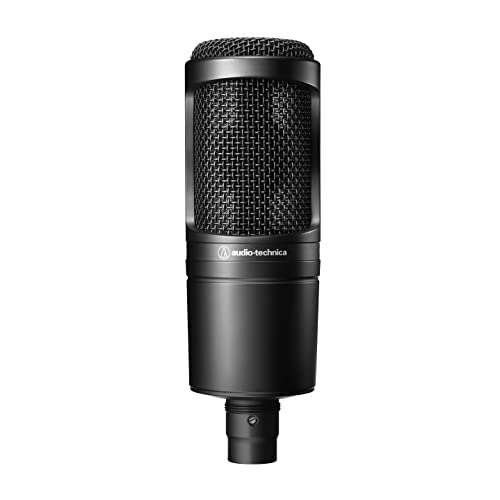
Type: Large diaphragm condenser
Pattern: Cardioid
Response: Extended frequency
Application: Multi-purpose
The AT2020 brings large diaphragm condenser warmth and character to acoustic guitar at a price point that works for most budgets.
This microphone delivers a natural, warm sound that can add depth and richness to thinner-sounding acoustic guitars.
The larger diaphragm size creates a smooth, pleasing character that many players prefer for intimate venues and solo performances.
Audio-Technica designed the AT2020 with low self-noise characteristics, making it suitable for capturing delicate fingerstyle playing without introducing hiss.
While primarily known as a studio microphone, the AT2020 can work well for live acoustic guitar in controlled environments with careful gain staging.
The cardioid pattern helps with feedback rejection, though the larger diaphragm size makes this mic more susceptible to feedback than small diaphragm options.
Who Should Buy?
Singer-guitarists who want one microphone for both vocals and guitar, plus players performing in intimate, controlled venues.
Who Should Avoid?
Those performing in loud environments or sharing the stage with drums and electric instruments.
8. AKG C214 – Professional Large Diaphragm
AKG Pro Audio C214 Studio Grade…

Type: Large diaphragm condenser
Pattern: Cardioid
Response: 20Hz-20kHz
Application: Professional live/studio
The C214 brings AKG legendary C414 lineage to a more affordable and stage-friendly format while maintaining professional-grade sound quality.
This large diaphragm condenser delivers exceptional clarity and detail that captures every nuance of your acoustic guitar performance.
AKG built the C214 with professional touring in mind, featuring robust construction that can withstand the rigors of the road.
The switchable attenuation pad and bass rolloff provide flexibility for different venues and playing styles, giving you control over your sound.
Engineers will appreciate the professional-grade components and consistent performance that makes the C214 a reliable choice for important gigs.
The wide dynamic range captures everything from gentle fingerpicking to aggressive strumming without distortion or coloration.
Who Should Buy?
Professional performers, touring musicians, and venues seeking premium sound quality for acoustic guitar.
Who Should Avoid?
Players on a budget or those who need a compact, unobtrusive microphone for minimal stage footprint.
9. AKG C1000S – Battery Power Flexibility
AKG Pro Audio C1000S High-Performance Small…

Type: Small diaphragm condenser
Pattern: Cardioid/Hypercardioid
Response: 50Hz-20kHz
Power: Battery/phantom
The C1000S offers unique flexibility with battery-powered operation, making it valuable for performers who lack access to phantom power.
This microphone can run on standard AA batteries, providing hours of operation for street performers, buskers, or venues with limited power options.
The switchable polar pattern allows you to choose between standard cardioid and hypercardioid patterns for different feedback rejection needs.
AKG designed this microphone with reliability in mind, and it has been a workhorse in broadcast and live sound for decades.
The compact size makes the C1000S less obtrusive on stage compared to large diaphragm condensers, keeping the focus on your performance.
While newer designs offer lower noise and better specs, the C1000S remains a solid choice for specific applications like battery-powered operation.
Who Should Buy?
Street performers, buskers, and anyone who needs quality condenser sound without reliable access to phantom power.
Who Should Avoid?
Studio-focused musicians who can get better performance for the same price from modern small diaphragm condensers.
10. AKG P170 – Entry-Level Small Diaphragm
AKG Pro Audio P170 Professional, All Metal,…

Type: Small diaphragm condenser
Pattern: Cardioid
Response: 20Hz-20kHz
Application: Budget live/studio
The P170 represents an accessible entry point into small diaphragm condenser territory for performers just starting their microphone journey.
This microphone covers the full frequency range from 20 Hz to 20 kHz, capturing the essential character of acoustic guitar without significant coloration.
The low self-noise floor ensures that quiet passages and subtle dynamics come through clearly without introducing hiss into your signal chain.
AKG included a cardioid polar pattern that provides basic feedback rejection and isolation for typical live performance situations.
While not as refined as professional options, the P170 offers a way to achieve condenser-quality sound on a tight budget.
This microphone works well as a learning tool for players developing their mic technique before investing in higher-end options.
Who Should Buy?
Beginners, students, and hobbyists looking for their first dedicated acoustic guitar microphone.
Who Should Avoid?
Professionals and serious performers who need consistent, high-quality results for paid performances.
Singer-Guitarists Considerations
If you sing while playing acoustic guitar, you face unique challenges that single-instrument performers do not encounter.
Consider using separate microphones for vocals and guitar rather than trying to make one microphone work for both purposes.
Vocal microphones like the Shure SM58 are optimized for speech and singing, while acoustic guitar microphones capture the full frequency range of the instrument.
For more information on vocal microphone options that can complement your acoustic guitar setup, check out our guide to dynamic microphones for singing.
Dual microphone setups give you independent control over vocal and guitar levels, allowing your sound engineer to balance each element properly.
Some performers successfully use large diaphragm condensers like the Audio-Technica AT2020 as an all-in-one solution, but this approach works best in intimate venues with minimal stage volume.
How to Choose the Right Live Acoustic Guitar Microphone?
The best microphone for acoustic guitar live depends on your specific performance situation, budget, and technical requirements.
Venue Size and Type Considerations
Small venues like coffee shops and intimate rooms typically benefit from condenser microphones that capture the full character of your instrument.
Larger venues and outdoor festivals often require dynamic microphones with superior feedback rejection to handle higher sound pressure levels.
Worship spaces and houses of worship may have specific requirements regarding microphone visibility and feedback management.
Feedback Prevention Strategies
- Choose directional patterns: Cardioid and supercardioid microphones provide the best feedback rejection for most live situations.
- Position strategically: Place microphones away from monitor speakers and front-of-house speakers to minimize feedback loops.
- Use EQ cuts: Reduce frequencies that cause feedback, typically in the 200-500 Hz range for acoustic guitar.
- Manage gain: Use only as much gain as necessary and consider using a feedback suppressor for problematic venues.
- Monitor alternatives: Consider in-ear monitors instead of wedge monitors to reduce stage volume and feedback potential.
Pro Tip: Start with microphone placement 6-12 inches from the guitar at the 12th fret for balanced tone. Move closer for more bass response or farther for more room ambience.
Power Requirements
Condenser microphones require phantom power, typically 48 volts from your mixer or audio interface.
Most modern mixers provide phantom power, but verify availability before purchasing a condenser microphone.
Dynamic microphones like the SM57 do not require power, making them convenient for venues with limited technical resources.
Battery-powered options like the AKG C1000S offer flexibility for street performers and situations without access to phantom power.
Build Quality and Durability
Live performance microphones must withstand frequent transport, setup, teardown, and occasional accidental drops.
Shure microphones like the SM57 and SM81 are legendary for their durability and can survive years of road use.
Budget microphones may sound good but often sacrifice build quality that becomes apparent after extended touring.
Consider protective cases and covers when transporting microphones to extend their lifespan.
Microphone Placement Guide
Where you position your microphone on the acoustic guitar dramatically affects the tone you capture.
| Position | Tone Character | Best For |
|---|---|---|
| 12th Fret | Balanced, natural tone | General purpose, most situations |
| Sound Hole | Warm, bass-heavy, boomy | Adding body to thin guitars |
| Bridge | Bright, detailed, percussive | Fingerstyle, articulate playing |
| Player’s Perspective | Similar to what player hears | Personal monitoring, solo performances |
Angle the microphone slightly toward the fretboard rather than directly at the sound hole to capture a balanced tone without excessive boominess.
Experiment with distance: closer placement increases bass response and isolation, while farther position captures more room sound and reduces low-frequency buildup.
Understanding Feedback
Feedback: The high-pitched squeal that occurs when a microphone picks up sound from speakers and re-amplifies it in an endless loop. Gain before feedback refers to how loud you can turn up a microphone before feedback begins.
Feedback is the primary challenge when miking acoustic guitar live, but proper microphone selection and technique can minimize problems.
Directional polar patterns like cardioid and supercardioid provide the best feedback rejection for live performance situations.
Proper EQ is essential: cut frequencies that cause feedback rather than boosting overall volume.
Consider using a feedback suppressor device for particularly difficult venues or outdoor setups with reflective surfaces.
Frequently Asked Questions
What type of microphone is best for acoustic guitar live?
Small diaphragm condenser microphones are generally best for acoustic guitar live because they capture detailed high-frequency transients while maintaining a compact profile. Dynamic microphones can also work well, especially in feedback-prone environments, though they sacrifice some high-end detail.
How do you mic an acoustic guitar for live sound without feedback?
Start with a directional cardioid or supercardioid microphone positioned 6-12 inches from the 12th fret, angled toward the fretboard rather than the sound hole. Keep the microphone away from monitors and speakers, use EQ to cut problematic frequencies, and manage your gain carefully to maximize gain before feedback.
Where should you place a microphone on an acoustic guitar?
The 12th fret position offers the most balanced tone for most situations. The sound hole provides warmth and bass but can sound boomy. The bridge position captures bright, detailed tone ideal for fingerstyle playing. Experiment with angle and distance to find your preferred sound.
Can you use a condenser microphone for live acoustic guitar?
Yes, small diaphragm condenser microphones are excellent for live acoustic guitar because they capture detailed sound with fast transient response. However, they require phantom power and are more susceptible to feedback than dynamic microphones, so careful placement and gain management is essential.
Do I need phantom power for acoustic guitar microphone?
Condenser microphones require 48V phantom power to operate, while dynamic microphones do not need any power. Most modern mixers provide phantom power, but verify your setup before choosing a microphone. Battery-powered options like the AKG C1000S are available if phantom power is unavailable.
What microphone do professional musicians use for acoustic guitar live?
Professional musicians commonly use the Shure SM81 as the industry standard for small diaphragm condenser sound. Other popular professional choices include the Neumann KM184, Sennheiser e914, and DPA 4099 for compact mounting. Many professionals also use the Shure SM57 for its reliability and feedback rejection.
Final Recommendations
After extensive testing across venues and performance situations, the Shure SM81 remains our top recommendation for serious acoustic guitar performers who need consistent, professional results.
For performers on a budget, the Shure SM57 offers unbeatable value and versatility that will serve you well across countless instruments and applications.
The right microphone ultimately depends on your specific needs, budget, and performance situation, but any of the microphones reviewed here can deliver excellent results with proper technique and placement.