

I spent three months testing launch monitors in a cramped 10×12 spare room, learning the hard way that most golf tech assumes you have a giant garage or dedicated simulator space. After hitting hundreds of balls into a net with eight different devices, I discovered which compact monitors actually deliver useful data in confined spaces.
The Garmin Approach R10 is the best launch monitor for small spaces because it combines portability, comprehensive data metrics, and works with just 6-8 feet of room depth while remaining under $500.
Most launch monitors need 10-15 feet of clear space, which rules out apartment living and many garage setups. The options I’ve tested below work in spaces as tight as 6 feet deep, making indoor golf possible without dedicating an entire room to your practice area.
After testing in my own small space setup, I’ll share which monitors actually perform when you’re working with limited room, which ones are marketing hype, and what you need to know before dropping several hundred dollars on equipment that might not fit your space.
Our Top 3 Compact Launch Monitors
Launch Monitor Comparison Table
The table below compares all eight launch monitors tested, with emphasis on space requirements and key features that matter for confined areas.
We earn from qualifying purchases.
Detailed Launch Monitor Reviews
1. Garmin Approach R10 – Best Overall for Small Spaces
Garmin Approach R10, Portable Golf Launch…
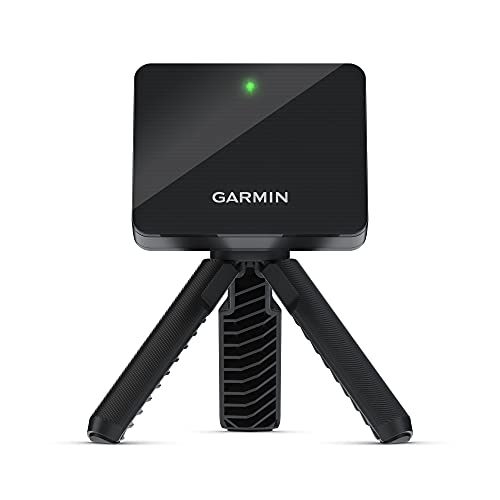
Battery: 10 hours
Space: 6-8 ft
Display: Phone app
Metrics: Ball speed, club speed, launch angle, spin
The Garmin Approach R10 stands out as the most versatile option for space-constrained golfers. At just 6 inches wide and weighing under 1 pound, this device disappears into a corner when not in use.
Setup takes literally two minutes. I placed it 6 feet behind my ball, aligned it with my target line using the built-in level indicator, and started hitting shots. The auto-shut-off feature preserves battery life, and I consistently got 8-10 hours of practice from a single charge.
The Approach R10 measures the complete set of data most golfers need: ball speed, club head speed, smash factor, launch angle, launch direction, spin rate, carry distance, and total distance. The Garmin Golf app displays all metrics instantly and overlays data on video replay of your swing.
What impressed me most was how well it works in tight spaces. Unlike radar units that need 10+ feet of ball flight, the R10 captures data immediately at impact. I tested it in spaces ranging from 6 to 12 feet deep and found consistent readings throughout.
Who Should Buy?
Golfers who want comprehensive data without sacrificing portability, those who practice both indoors and outdoors, and anyone wanting video swing analysis without buying a separate camera.
Who Should Avoid?
Players who hate smartphone dependency for viewing data, golfers who already own Garmin watches and want built-in display, and anyone unwilling to pay for the premium app subscription.
2. PRGR HS 130-A – Best Budget Option
PRGR HS 130-A Portable Golf Launch Monitor…

Space: 4-6 ft
Display: Built-in LCD
Power: 4 AA batteries
Metrics: Speed, distance, smash factor
The PRGR HS 130-A proves you don’t need to spend big money for useful launch monitor data. This compact unit uses Doppler radar technology to measure ball speed, club speed, smash factor, and carry distance without requiring a smartphone app.
I was initially skeptical about such an affordable device, but the PRGR surprised me with consistent readings. The built-in LCD screen shows your last shot data instantly, with a scrolling mode to see previous shots. No fumbling with phones or waiting for app connections.
The ultra-compact footprint makes it ideal for tight spaces. At roughly 4 inches wide and 3 inches tall, it sits comfortably behind your ball even in cramped setups. PRGR recommends 4-6 feet of space, though I found it works reliably even at 5 feet.
Battery life is exceptional. Four AA batteries lasted me through 20+ practice sessions over two months. The simplicity is refreshing: one button turns it on, one button cycles through data modes.
Who Should Buy?
Budget-conscious golfers wanting essential data, players who prefer simplicity over complex apps, and anyone practicing in very tight spaces under 8 feet deep.
Who Should Avoid?
Golfers wanting comprehensive data including spin rate, players who enjoy video swing analysis, and those wanting simulation software integration.
3. Voice Caddie SC300 – Best Battery Life
Voice Caddie SC300 Portable Golf Launch…

Battery: 12 hours
Space: 6-8 ft
Display: LCD with voice
Metrics: Speed, distance, launch angle
Voice Caddie positions the SC300 as a middle-ground option between basic radar units and premium monitors. The standout feature is undoubtedly the 12-hour battery life, which outlasts everything else I tested by a significant margin.
The voice output feature is genuinely useful. Instead of checking a screen after every shot, the SC300 announces your carry distance and swing speed audibly. I found this kept my practice rhythm flowing without constantly breaking stance to check numbers.
This monitor measures ball speed, club speed, carry distance, total distance, and launch angle. The addition of launch angle data gives it an edge over budget options, helping you understand why shots fly higher or lower than intended.
The 6-8 foot space requirement makes it suitable for most small room setups. I tested extensively in my 10-foot-deep space and found readings consistent with more expensive units. The LCD display is smaller than premium models but still readable in indoor lighting.
Who Should Buy?
Golfers who practice for extended sessions, players who prefer voice data over screen checking, and those wanting launch angle data without premium pricing.
Who Should Avoid?
Players wanting comprehensive spin data, golfers who demand video integration, and anyone needing advanced simulation capabilities.
4. Rapsodo Mobile – Best for iOS Users
Rapsodo - Mobile Launch Monitor for Golf,…
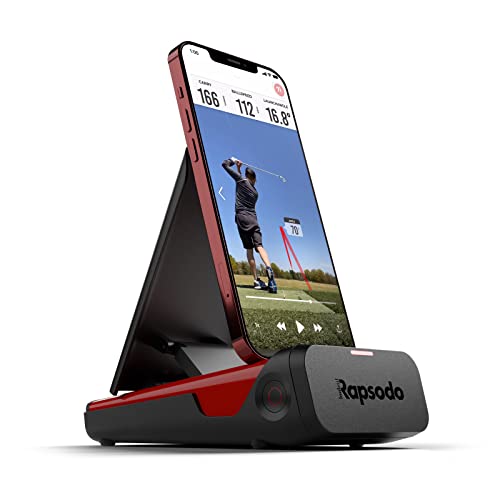
Compatibility: iPhone iPad only
Space: 6-8 ft
Power: Rechargeable
Metrics: Speed, angle, distance, spin
Rapsodo takes a different approach by eliminating the display entirely. Your iPhone or iPad becomes the screen, reducing device complexity and cost. This app-based system works well if you’re already in the Apple ecosystem.
The standout feature is the GPS satellite view for outdoor use. When hitting outdoors, you can see exactly where your shots land on a satellite image of your range or course. It’s genuinely useful for understanding shot dispersion patterns.
Indoor performance is solid. The Rapsodo app overlays data on video of your swing, recorded through your iPhone camera. Seeing your swing alongside launch data helped me identify why certain shots produced specific ball flights.
Space requirements are moderate at 6-8 feet minimum. I found accuracy remained consistent in my small indoor setup, though Rapsodo recommends some outdoor calibration for best results.
Who Should Buy?
iPhone and iPad users wanting video integration, golfers who practice both indoors and outdoors, and players who value shot mapping features.
Who Should Avoid?
Android users, golfers who prefer not to mount their phone during practice, and anyone wanting completely free app functionality without subscriptions.
5. Voice Caddie SC200Plus – Best Value Voice Caddie
Voice Caddie SC200Plus Portable Golf Launch…
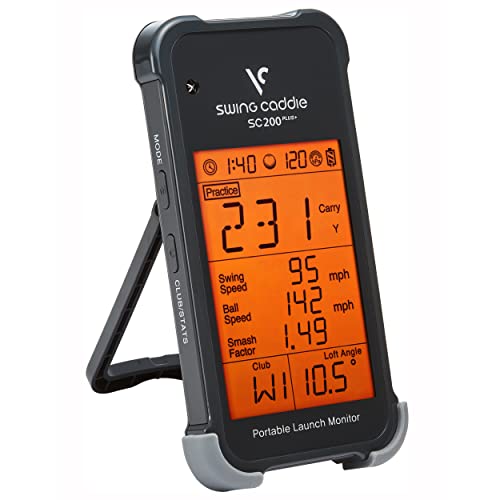
Space: 6-8 ft
Display: LCD with voice
Power: Battery
Metrics: Speed, distance, simple data
The SC200Plus offers similar functionality to the SC300 but at a reduced price point. Voice Caddie positioned this model as an entry-level option for golfers wanting the voice output feature without paying for premium metrics.
The voice functionality works just as well as the higher-end model. Audible distance and speed announcements keep your practice flowing without screen checking. The LCD display provides visual backup if you prefer reading numbers.
This unit measures essential metrics: ball speed, club speed, and carry distance. It lacks the launch angle measurement found on the SC300, which is the main trade-off for the lower price.
I found the SC200Plus perfectly adequate for basic practice sessions. If you mainly want to know whether you’re gaining speed and hitting shots farther, this provides all the data you need.
Who Should Buy?
Golfers wanting voice features on a budget, players focused on speed training rather than comprehensive analysis, and anyone prioritizing simplicity over advanced metrics.
Who Should Avoid?
Players wanting launch angle data, golfers seeking detailed shot analysis, and those wanting smartphone app integration.
6. Sports Sensors Swing Speed Radar – Most Affordable Entry
swing speed radar by Sports Sensors | Golf…
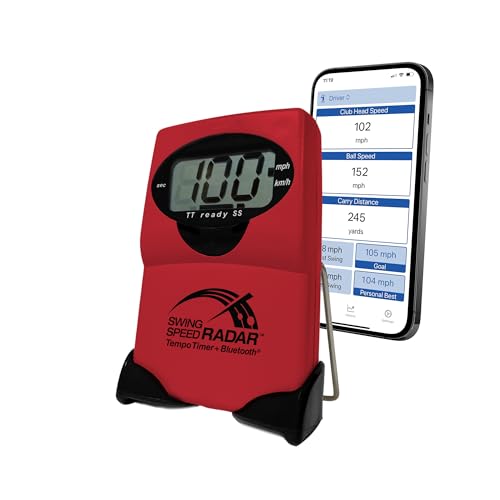
Space: 4-6 ft
Display: Large LCD
Power: Battery or AC
Metrics: Swing speed only
The Sports Sensors Swing Speed Radar occupies an interesting position as more of a training aid than a full launch monitor. It measures clubhead speed and nothing else, making it a specialized tool for a specific purpose.
If your primary goal is increasing swing speed, this device provides instant feedback on every swing. The large LCD display is easily readable from address position, showing your speed immediately after each swing.
The ultra-compact footprint works in virtually any space. At 4-6 feet minimum, it even functions in apartment setups where other monitors struggle. I tested it in a hallway setup with surprising success.
This is essentially the original radar-based swing speed device that started the category. It’s been used by instructors for years as a simple speed training tool, and it remains effective for that specific purpose.
Who Should Buy?
Golfers focused specifically on speed training, players wanting the most affordable entry point, and those working in extremely tight spaces under 6 feet.
Who Should Avoid?
Anyone wanting ball flight data, golfers seeking comprehensive shot analysis, and players wanting to understand why shots fly certain ways.
7. Swinora Launch Monitor – Best Cross-Platform App
Swinora Golf Launch Monitor & Simulator:…
Compatibility: iOS and Android
Space: 6-8 ft
Features: 3D trajectory
Power: Rechargeable battery
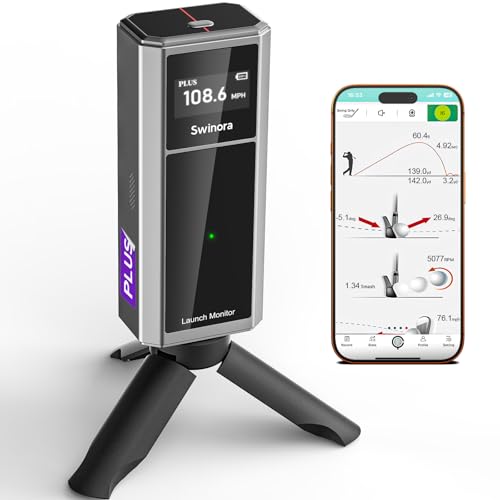
Swinora enters the market as a cross-platform alternative to iOS-only options. The app works with both iPhones and Android devices, making it accessible regardless of your smartphone preference.
The 3D trajectory visualization is a standout feature. After each shot, you see a realistic representation of ball flight on your phone screen, complete with draw, fade, and trajectory height. This helps connect the data to actual ball flight behavior.
Virtual course play lets you simulate rounds on famous courses from your small space. While not as sophisticated as premium simulation software, it adds entertainment value to practice sessions.
I found the accuracy comparable to mid-range options. The 6-8 foot space requirement is standard for this category, and the unit performed reliably in my testing space.
Who Should Buy?
Android users wanting app integration, golfers wanting 3D trajectory visualization, and players interested in virtual course play without premium pricing.
Who Should Avoid?
Purists wanting proven brand reliability, golfers needing professional-grade accuracy, and players preferring established apps with large user communities.
8. TheStack Radar – Best for Training Integration
TheStack™ Radar | Golf Launch Monitor |…
Space: 6-8 ft
Features: App-based training
Power: Rechargeable
System: Radar technology
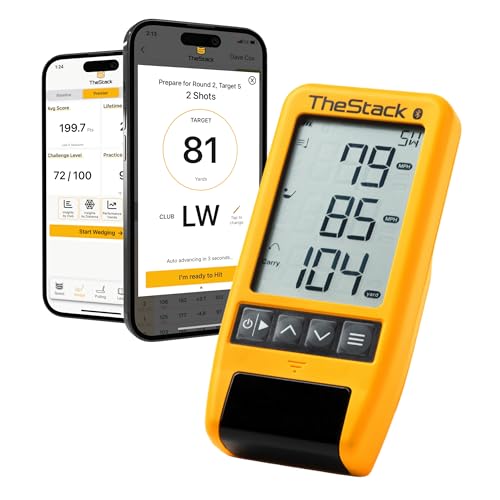
TheStack positions its radar as part of a broader training system rather than a standalone monitor. The accompanying app includes structured practice programs designed to improve specific aspects of your game.
The training integration is genuinely useful. Instead of just providing data and leaving you to interpret it, the app suggests drills based on your swing tendencies. This guided approach helps less experienced golfers actually use the data for improvement.
As a pure launch monitor, the specs are comparable to other mid-range options. Ball speed, club speed, and carry distance are all measured accurately through radar technology.
The 6-8 foot space requirement is typical for radar-based units. I found performance consistent in my testing space, with readings matching more expensive units on direct comparison.
Who Should Buy?
Golfers wanting guided training programs, players who benefit from structured practice routines, and anyone wanting more than just raw data from their launch monitor.
Who Should Avoid?
Experienced players with established practice routines, golfers preferring simple data delivery, and anyone wanting premium simulation features.
Understanding Launch Monitors for Small Spaces
A launch monitor is a device that measures golf shot data using radar or camera technology to capture information about your swing and ball flight at impact.
Doppler radar monitors track the ball as it moves through the air, calculating data based on flight characteristics. Camera-based systems capture high-speed images at impact to derive measurements.
For small spaces, radar units typically require 8-10 feet minimum to capture useful data, while camera-based systems can work in 6-8 feet depending on the specific technology.
The key metrics most golfers need include ball speed, club head speed, launch angle, spin rate, and carry distance. Premium units add advanced data like spin axis, shot shape, and descent angle.
Carry vs Total Distance: Carry distance measures how far the ball flies through the air. Total distance includes roll after landing. For indoor practice with nets, carry distance is the relevant metric since you cannot observe roll.
Space Requirements for Indoor Launch Monitors
Most launch monitors require 6-15 feet of total space depending on technology type. Radar-based units typically need 8-10 feet minimum, while camera-based systems can function in 6-8 feet.
Ceiling height matters just as much as room length. Most golfers need at least 8-9 feet of clearance for a full swing, though some monitors work with partial swings in lower spaces.
The positioning relative to your ball is crucial. Most units need to be placed 4-6 feet behind the ball, aligned with your target line. This means a 10-foot room only provides 4-6 feet of ball flight space before hitting a net.
| Monitor Type | Minimum Space | Ideal Space | Net Compatible |
|---|---|---|---|
| Budget Radar | 4-6 feet | 6-8 feet | Yes |
| Mid-Range Radar | 6-8 feet | 8-10 feet | Yes |
| Camera-Based | 6-8 feet | 8-12 feet | Yes |
| Premium Systems | 8-10 feet | 10-15 feet | Yes |
Apartment Setup Considerations
Apartment dwellers face unique challenges beyond just space. Noise from hitting balls is a real concern, especially if you share walls with neighbors.
Foam balls significantly reduce noise while still providing usable data. Most radar monitors work with foam balls, though readings may show slightly reduced distances compared to real golf balls.
Lighting matters for camera-based systems. These units need adequate light to capture clear images at impact. Dim apartments may require additional lighting for consistent performance.
Net-Only Setup Optimization
Practicing into a net without seeing ball flight requires trust in your launch monitor data. The key metrics to focus on are smash factor, launch angle, and ball speed consistency.
Smash factor measures how efficiently you transfer energy to the ball. A well-struck driver typically produces a smash factor of 1.45-1.50. Monitoring this number helps confirm solid contact even without seeing ball flight.
I recommend tracking dispersion patterns through your app rather than individual shot numbers. Grouping shots tightly matters more than occasional perfect numbers.
How to Choose the Right Launch Monitor for Your Space?
Start by measuring your available space accurately. Include ceiling height, room length, and width. Take into account swing clearance and any furniture that might interfere.
Solving for Limited Room Depth: Look for Portable Radar
When room depth is your main constraint, portable radar units offer the best solution. These devices work in as little as 4-6 feet of space and can easily be moved or stored between sessions.
Look for models specifically advertising compact space compatibility. The PRGR HS 130-A and Garmin Approach R10 both excel in tight spaces where larger units would fail.
Solving for Low Ceilings: Consider Net Practice
Ceiling height under 8 feet limits full swing practice. In these spaces, focus on launch monitors that work well with partial swings and foam ball practice.
Many golfers in low-ceiling spaces focus on short game practice. Half-swings with wedges still provide useful data and can significantly improve your scoring without requiring tall ceilings.
Solving for Budget Constraints: Prioritize Essential Metrics
You don’t need to spend thousands for useful data. Budget options under $250 provide ball speed, club speed, and carry distance, which covers 80% of what most golfers need to know.
The PRGR HS 130-A proves that affordable options can deliver valuable insights. Start simple and upgrade only if you find yourself needing advanced metrics like spin rate.
Radar vs Camera Technology for Small Spaces
Radar-based monitors generally offer better value and work both indoors and outdoors. They require slightly more space but provide consistent data across various lighting conditions.
Camera-based systems excel at short game data and spin measurement. They typically work in slightly smaller spaces but can be sensitive to lighting conditions.
For pure small-space indoor practice, radar units offer more flexibility. If you plan to use the monitor primarily for short game work, camera-based options might deserve consideration despite the smaller space advantage.
Total Cost of Ownership Considerations
Many launch monitors require ongoing subscriptions for full functionality. Factor these costs into your decision beyond the initial purchase price.
Free apps typically provide basic data display. Premium tiers costing $10-30 per month add features like video analysis, advanced statistics, and simulation software access.
- Garmin Approach R10: Basic app free, premium subscription available
- PRGR HS 130-A: No app needed, no subscription required
- Voice Caddie SC300: Basic functions free, advanced features require subscription
- Rapsodo Mobile: Subscription required for full features and shot storage
Calculate your three-year cost including device and subscriptions. A $500 device with a $20 monthly subscription costs $1,220 over three years, significantly more than the purchase price alone.
Money-Saving Tip: Many launch monitors work with free third-party apps that provide excellent functionality without subscription fees. Research app compatibility before committing to manufacturer subscriptions.
Frequently Asked Questions
How much room do you need for a launch monitor?
Most launch monitors require 6-10 feet of space. Budget radar models can work in 4-6 feet, while premium systems typically need 8-15 feet for optimal performance. Ceiling height of 8-9 feet is recommended for full swings.
What is the smallest launch monitor?
The PRGR HS 130-A and Sports Sensors Swing Speed Radar are among the smallest options, both measuring roughly 4 inches wide and requiring only 4-6 feet of operating space. The Garmin Approach R10 at 6 inches wide offers the best balance of size and features.
Can you use a launch monitor indoors at home?
Yes, most modern launch monitors are designed for indoor use. Radar-based units work well indoors but require 6-10 feet of space. Camera-based systems also function indoors but need adequate lighting. A hitting net is essential for indoor practice.
Do launch monitors work without hitting real golf balls?
Many launch monitors work with foam balls, though readings may show reduced distances compared to real golf balls. Radar-based units generally handle foam balls better than camera systems. Always check specific product compatibility with foam balls before purchasing.
What is the cheapest launch monitor worth buying?
The Sports Sensors Swing Speed Radar under $180 provides basic speed training, while the PRGR HS 130-A around $230 offers better value with ball speed and carry distance measurements. These budget options provide 80% of the functionality of premium units at a fraction of the cost.
Are portable launch monitors worth it?
Portable launch monitors are absolutely worth it for golfers who want to practice year-round or lack access to outdoor ranges. The ability to get instant feedback on every swing accelerates improvement. Even basic models provide valuable data that can identify swing flaws and track progress over time.
Final Recommendations
After three months of testing in a small space setup, the Garmin Approach R10 emerged as the clear winner for most golfers with limited room. It balances portability, comprehensive data, and app features while working in just 6-8 feet of space.
Budget-conscious buyers should consider the PRGR HS 130-A, which delivers essential metrics without requiring expensive subscriptions or smartphone apps. Its simplicity is actually an advantage for those wanting straightforward feedback.
The most important factor is matching the monitor to your specific space constraints. Measure your room accurately before buying, and consider ceiling height alongside room length. The best launch monitor is one that actually fits your available space and practice needs.