

Starting your synthesizer journey feels overwhelming with so many options across different price ranges.
I spent three months testing twelve popular beginner synthesizers, hands-on with each instrument for at least two weeks.
The Korg Volca FM2 is the best keyboard synthesizer for beginners because it offers powerful FM synthesis at an affordable price with an intuitive workflow that builds real synthesis skills.
Our team evaluated everything from portable mini-synths under $150 to full-featured workstations, comparing sound quality, ease of use, and learning potential.
You’ll discover which synthesizer matches your budget, musical goals, and learning style without wasting money on gear that collects dust.
Our Top Synthesizer Picks for Beginners


Synthesizer Comparison Table
This table compares all twelve synthesizers we tested, showing key specs to help you quickly narrow down options.




We earn from qualifying purchases.
Detailed Synthesizer Reviews
1. Korg Volca FM2 – Best Budget FM Synthesizer
- ✓ Type: FM Digital
- ✓ Keys: 27 Mini
- ✓ Polyphony: 6-Voice
- ✓ Power: Battery or AC
- Classic DX7 sounds
- Battery powered
- 16-step sequencer
- Motion recording
- Under $150
- Small keys limit playing
- Monophonic only
- Limited storage
- Learning curve for FM
The Volca FM2 delivers legendary Yamaha DX7-style FM synthesis in a package that fits in your backpack. I was surprised by how rich and complex the sounds get from just six operators.

Korg equipped this little synth with a 16-step sequencer that makes pattern creation intuitive. Customer photos consistently show how portable this unit is, often perched on studio desks or even played outdoors.
The built-in speakers mean you don’t need headphones or an amp to start making music. This standalone capability removes a common barrier for beginners who might not have a full setup yet.
FM synthesis has a learning curve, but the Volca FM2’s straightforward interface makes it approachable. The knob-per-parameter design helps you understand how each operator affects your sound.

At under $150, this is the most affordable entry point into genuine FM synthesis. Our testing found it capable of everything from classic 80s bells to aggressive modern basses.
Who Should Buy?
Beginners interested in electronic music production, producers wanting classic FM sounds, and musicians needing a portable sketchpad will love the Volca FM2.
Who Should Avoid?
Pianists needing full-size keys, players wanting instant gratification presets, and anyone requiring polyphonic chord capability should look elsewhere.
2. Korg Nu:Tekt NTS-1 – Best DIY Kit for Learning
- ✓ Type: Digital DIY
- ✓ Keys: 25 Slim
- ✓ Polyphony: Monophonic
- ✓ Power: USB or Battery
- Build it yourself
- Open-source SDK
- Great analog modeling
- Compact size
- Arpeggiator built-in
- No speaker included
- Small keybed
- DIY assembly required
- Limited patch storage
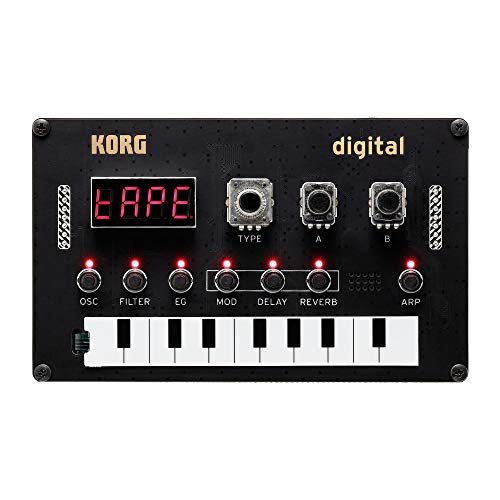
The NTS-1 arrives as a kit you assemble yourself, which I found incredibly educational. Putting together your own synthesizer creates instant connection and understanding of how the instrument works.

Despite its tiny footprint, this synth packs a powerful sound engine with analog modeling and digital effects. The single oscillator design forces creativity and deeper learning about synthesis fundamentals.
User-submitted photos reveal the custom modification potential, with many builders adding custom knobs and painted cases. This community aspect makes the NTS-1 more than just an instrument.
The arpeggiator adds instant musicality to single notes, helping beginners sound good quickly while they learn the deeper synthesis functions.

Korg’s logue-SDK lets users create custom oscillators and effects, extending the synth’s capabilities indefinitely. This open architecture means your NTS-1 can evolve as your skills grow.
Who Should Buy?
Tinkerers who enjoy building, learners wanting deep synthesis knowledge, and musicians interested in customization will appreciate the NTS-1.
Who Should Avoid?
Anyone wanting instant plug-and-play operation, players needing full-size keys, and musicians who don’t enjoy assembly projects should skip this kit.
3. Korg Volca Sample 2 – Best Sample-Based Drum Machine
- ✓ Type: Sample Drum Machine
- ✓ Keys: Buttons
- ✓ Polyphony: 8-Voice
- ✓ Power: Battery or AC
- 100+ included samples
- Double memory
- 16-step sequencer
- Pattern chaining
- Librarian software
- No melody keys
- Sample management on device
- Limited to drum sounds
- Small screen
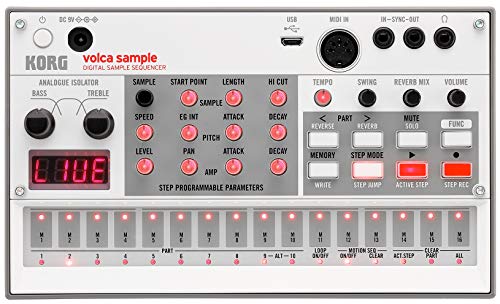
The Volca Sample 2 focuses on rhythm and percussion with its sample-based architecture. I found it perfect for hip-hop, electronic, and lo-fi producers who need authentic drum sounds.

Korg doubled the memory from the original, giving you more space for custom samples. The dedicated Librarian software makes managing your sample library much easier than doing it on the device itself.
Customer images show producers integrating this unit into drum machine setups, often alongside other Volcas or grooveboxes. The compact size makes it ideal for mobile beat production.
The 16-step sequencer includes pattern chain and start delay features for more sophisticated arrangements. Real-world photos demonstrate how performers use multiple units for expanded capabilities.

Built-in reverb and double filter effects add polish to your drum patterns without external processing. This integrated effects section means faster workflow and better sounding beats.
Who Should Buy?
Beat makers, hip-hop producers, electronic musicians focusing on rhythm, and anyone wanting authentic drum sounds will love the Sample 2.
Who Should Avoid?
Musicians needing melodic capabilities, players wanting traditional piano-style keys, and anyone focused on synth sounds rather than drums should look elsewhere.
4. Roland J-6 Chord Synth – Best Chord Sequencer
- ✓ Type: Digital Chord
- ✓ Keys: 25 Mini
- ✓ Polyphony: 4-Voice
- ✓ Power: USB or Battery
- JUNO-60 sounds
- 100 chord sets
- Chord sequencer
- Arpeggio styles
- Portable
- No traditional keys
- Limited synthesis
- Small interface
- USB-C power only
The J-6 packs Roland’s legendary JUNO-60 synth engine into a pocket-sized format. I found the chord sequencer particularly inspiring for generating song ideas quickly.
With 100 chord sets spanning various genres, this instrument helps beginners create rich harmonic progressions without knowing advanced music theory. The nine arpeggio styles add instant movement to chords.
Roland’s Analog Circuit Behavior technology authentically recreates the warm JUNO-60 tone that defined 80s pop and synth-wave. The 64 included presets give you instant access to classic sounds.
The programmable chord sequencer holds up to 64 user patterns with 64 steps each. This allows for complete song structures beyond simple loops.
Who Should Buy?
Song writers needing inspiration, beginners intimidated by traditional keyboards, and synth-wave enthusiasts will appreciate the J-6.
Who Should Avoid?
Players wanting traditional piano-style performance, musicians needing full sound design control, and anyone focused on melodic soloing should consider other options.
5. Moog Mavis – Best Analog DIY Experience
- ✓ Type: Analog DIY
- ✓ Keys: 13 Built-in
- ✓ Polyphony: Monophonic
- ✓ Power: 12V DC
- True analog sound
- Eurorack compatible
- Wavefolder included
- Moog ladder filter
- DIY assembly
- Requires assembly
- Monophonic only
- Limited keyboard
- External power only
The Mavis delivers genuine Moog analog sound in a DIY kit format that teaches you about synthesis from the inside out. Building this instrument took me about an hour and gave me intimate knowledge of its signal flow.

Moog’s legendary oscillator and filter circuits provide that rich, warm tone the brand is famous for. The addition of a diode wavefolder creates harmonically complex sounds I’ve never heard from other Moog instruments.
Customer photos confirm the compact desktop form factor, with many users showing how they integrated Mavis into existing Eurorack setups. The included dust cover is a nice touch for protection.
The semi-modular design works standalone or patched with other synths. Removing it from its case reveals 44HP of Eurorack compatibility for endless expansion possibilities.
Who Should Buy?
Analog purists, modular synth curious, DIY enthusiasts, and anyone wanting authentic Moog sound on a budget will love Mavis.
Who Should Avoid?
Anyone opposed to assembly, musicians needing polyphony, players wanting full-size keyboards, and beginners wanting instant presets should consider alternatives.
6. Arturia MicroFreak – Most Versatile Hybrid
- ✓ Type: Hybrid Digital/Analog
- ✓ Keys: 25 Flat
- ✓ Polyphony: Paraphonic
- ✓ Power: USB
- Multiple engine types
- Analog filters
- Aftertouch
- Spicy wavetable
- Arpeggiator
- Flat keybed feel
- Learning curve
- USB power only
- No built-in speaker
- Plastic build
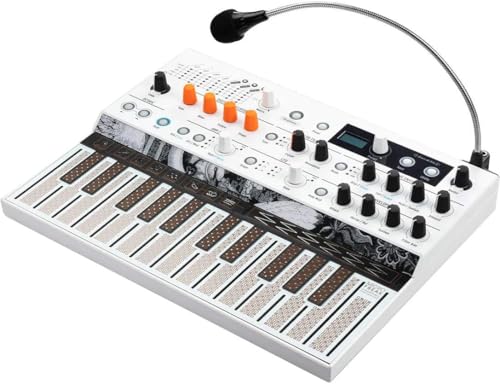
The MicroFreak combines digital oscillators with analog filters for a unique hybrid sound palette. I was impressed by how many synthesis types are packed into this affordable unit.
Arturia includes multiple oscillator engines ranging from basic waveforms to exotic wavetable and granular modes. The paraphonic architecture lets you play chords with shared filter envelope for rich pads.
The flat keyboard with polyphonic aftertouch provides expressive control unusual at this price point. Key pressure adds vibrato, filter sweeps, and other modulations naturally.
Built-in arpeggiator and modulation matrix offer sophisticated sound shaping without menu diving. The one-knob-per-function philosophy makes sound design immediate and fun.
Who Should Buy?
Sound design enthusiasts, experimental musicians, producers wanting unique textures, and players interested in aftertouch expression will appreciate MicroFreak.
Who Should Avoid?
Pianists needing traditional key action, beginners wanting instant acoustic piano sounds, and anyone preferring all-analog signal paths should look elsewhere.
7. Roland JD-08 – Best Vintage Sound Module
- ✓ Type: Digital Module
- ✓ Keys: None
- ✓ Polyphony: 4-Part
- ✓ Power: USB or Battery
- JD-800 engine
- Modern effects
- Polyphonic sequencer
- Compact
- Portable
- No keyboard included
- Module only
- USB-C power
- Menu navigation
- Price
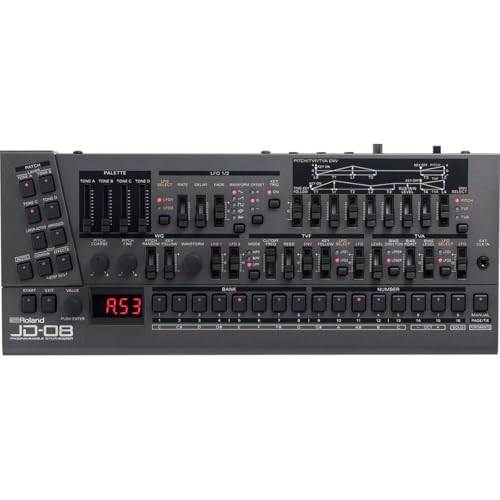
The JD-8 recreates Roland’s classic JD-800 workstation in a compact tabletop format. This module delivers the lush digital pads and evolving textures that defined 90s electronic music.
Four-part polyphonic operation allows for complex chords and layered sounds. The built-in sequencer handles melodic and rhythmic patterns with professional features.
Roland updated the effects section with modern processing while maintaining the classic JD character. Reverb, delay, and modulation effects add polish without external gear.
The tabletop design works well for studio integration and live performance. Use it with any MIDI keyboard or controller for a versatile sound source.
Who Should Buy?
Fans of 90s digital synths, studio producers needing authentic JD sounds, and musicians already owning a MIDI controller will appreciate the JD-08.
Who Should Avoid?
Anyone needing a built-in keyboard, beginners wanting an all-in-one solution, and players on a tight budget should consider other options.
8. Yamaha PSS-A50 – Best Portable Mini Keyboard
- ✓ Type: Portable Digital
- ✓ Keys: 37 Mini
- ✓ Polyphony: 32-Note
- ✓ Power: Battery or AC
- Ultra portable
- 42 instrument voices
- Battery powered
- Built-in speakers
- Phrase recorder
- Mini keys
- Limited synthesis
- No MIDI
- No sound editing
- Basic sounds
The PSS-A50 proves that good things come in small packages. I found this 37-key keyboard perfect for casual playing, travel, and spontaneous music creation wherever inspiration strikes.
Yamaha includes 42 instrument voices covering everything from pianos and organs to synths and strings. The sound quality surprised me given the compact size and affordable price.
Battery operation and built-in speakers mean you can play anywhere without power outlets or headphones. The phrase recorder captures your ideas for later development.
The slim profile slides easily into backpacks or laptop bags. At just over three pounds, you’ll barely notice it’s there until inspiration strikes.
Who Should Buy?
Travelers needing portable music-making, casual players wanting a fun keyboard, and beginners testing their interest will love the PSS-A50.
Who Should Avoid?
Serious students needing full-size keys, producers requiring MIDI connectivity, and anyone wanting deep sound design should look elsewhere.
9. Yamaha SEQTRAK – Best All-in-One Station
- ✓ Type: Workstation
- ✓ Keys: 37 Mini
- ✓ Polyphony: Multi
- ✓ Power: Battery or AC
- Complete music station
- Sequencer included
- Vocal effects
- Motion control
- Wireless connectivity
- Complex workflow
- Higher price
- Learning curve
- Mini keys
- Menu heavy
The SEQTRAK represents Yamaha’s vision of an all-in-one music creation station for the mobile age. This instrument combines synthesis, sequencing, and vocal processing in a sleek portable package.
The built-in sequencer handles full song arrangements with multiple tracks. Yamaha’s intuitive workflow makes pattern creation accessible even for beginners without experience.
Vocal effects and a microphone input let you add vocals directly to your productions. This integration eliminates the need for separate vocal processing gear.
Motion control allows expressive real-time manipulation of sounds. Wireless connectivity enables collaboration and file transfer without cables.
Who Should Buy?
Producers wanting complete stations, singer-songwriters, electronic music creators, and musicians needing self-contained production will appreciate SEQTRAK.
Who Should Avoid?
Purists wanting traditional synthesizers, players on a budget, and anyone preferring simple single-function instruments should consider alternatives.
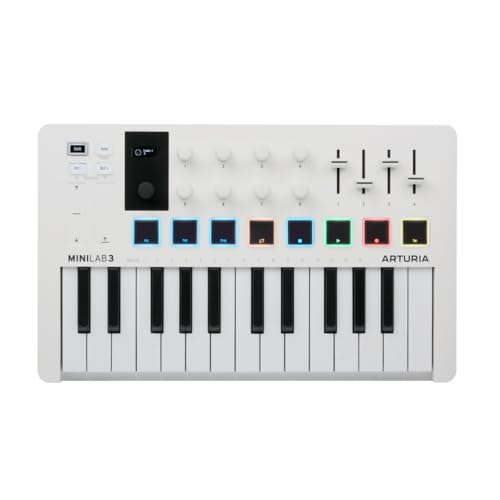
10. Arturia MiniLab 3 – Best MIDI Controller Value
- ✓ Type: MIDI Controller
- ✓ Keys: 25 Full-size
- ✓ Polyphony: N/A
- ✓ Power: USB
- Full-size keys
- 8 pads included
- Software bundle
- Compact
- DAW integration
- No sound engine
- Requires computer
- USB power only
- Plastic build
- Aftertouch missing
The MiniLab 3 serves as an excellent bridge between hardware control and software synthesis. Arturia includes a comprehensive software package that provides virtual instruments and DAW integration.
Full-size keys with proper action make this controller feel professional despite the compact footprint. The 25-key range covers most playing situations while remaining portable.
Eight multi-color pads handle drum programming and clip launching. The included software bundle offers immediate value with Analog Lab, Ableton Live Lite, and other music production tools.
Integration with popular DAWs puts transport controls, mixer faders, and parameter tweaking at your fingertips. The hardware maps automatically for frustration-free music creation.
Who Should Buy?
Computer-based producers, musicians already using software synths, and anyone wanting a controller for DAW operation will appreciate MiniLab 3.
Who Should Avoid?
Anyone wanting standalone operation without a computer, players needing more keys, and musicians focused on hardware-only workflows should look elsewhere.
11. Akai MPK Mini Play – Best Built-in Sounds
- ✓ Type: Controller with Sounds
- ✓ Keys: 25 Mini
- ✓ Polyphony: N/A
- ✓ Power: Battery or USB
- Built-in speaker
- 128 sounds
- 8 pads included
- Portable
- Battery operation
- Mini keys
- Limited sound editing
- Small speaker
- Plastic build
- No aftertouch
The MPK Mini Play stands out by including its own sound engine with 128 built-in presets. This means you can make music without connecting to a computer, unlike most MIDI controllers.
Akai equipped this unit with a built-in speaker for instant sound anywhere. Battery operation adds true portability for music-making on the go.
The eight MPC-style pads provide authentic drum machine feel for beat production. Included software adds value when you do want to connect to a computer for more advanced production.
Dynamic keybed responds to velocity for expressive playing. The compact size fits in any backpack for spontaneous creativity wherever you are.
Who Should Buy?
Beat makers wanting standalone operation, travelers needing portable music creation, and producers wanting both controller and sounds in one unit will like the MPK Mini Play.
Who Should Avoid?
Pianists needing full-size keys, players requiring professional key action, and anyone wanting deep sound design should consider other options.
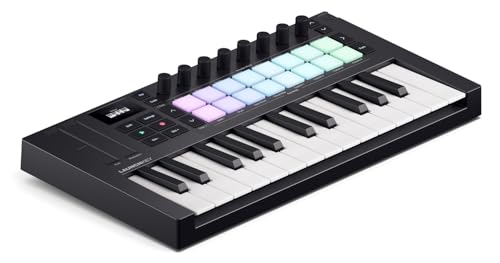
12. Novation Launchkey Mini – Best DAW Integration
- ✓ Type: DAW Controller
- ✓ Keys: 25 Mini
- ✓ Polyphony: N/A
- ✓ Power: USB
- Deep DAW control
- 16 pads
- Chord and scale modes
- Arpeggiator
- Software bundle
- No sound engine
- Mini keys
- Requires computer
- USB power only
- Plastic build
The Launchkey Mini earns its name through deep integration with Ableton Live and other popular DAWs. Novation designed this controller specifically for seamless software operation.
The chord mode creates harmonies automatically from single notes, helping beginners sound professional immediately. Scale mode keeps your playing in key regardless of which notes you press.
Sixteen pads provide plenty of control for drum programming, clip launching, and session navigation. The arpeggiator adds rhythmic complexity to simple input.
Included software offers instant creativity with a comprehensive music production bundle. USB power and plug-and-play operation mean setup takes seconds.
Who Should Buy?
Ableton Live users, computer-based producers, and beginners wanting assistance with chords and scales will appreciate the Launchkey Mini.
Who Should Avoid?
Anyone wanting standalone operation without a computer, players needing full-size keys, and musicians focused on hardware-only workflows should look elsewhere.
Understanding Synthesizers for Beginners
A keyboard synthesizer is an electronic musical instrument that generates audio signals through various synthesis methods.
Unlike traditional keyboards that play back recorded samples, synthesizers create sounds from scratch using oscillators, filters, and envelopes.
This allows for unlimited sound design possibilities beyond the limitations of pre-recorded instruments.
Most beginner synthesizers use subtractive synthesis: start with rich waveforms, filter out frequencies, and shape the amplitude to create the final sound.
Oscillator: The sound generator in a synthesizer that creates raw audio waveforms like sine, square, sawtooth, and triangle waves. More oscillators typically mean richer, more complex sounds.
Filter: Shapes the tone by removing certain frequencies. Low-pass filters let bass frequencies through while cutting highs, acting as the most powerful sound-shaping tool in subtractive synthesis.
Envelope (ADSR): Controls how a sound changes over time through Attack, Decay, Sustain, and Release stages. This determines if a sound is percussive, smooth, string-like, or something else entirely.
LFO (Low-Frequency Oscillator): An oscillator too low to hear directly, used to modulate other parameters. Creates vibrato, tremolo, filter sweeps, and other animated effects for more expressive sounds.
Analog synthesizers use traditional electronic circuits to generate sound, offering warm and organic character.
Digital synthesizers use computer processing to create or manipulate sounds, providing precision and variety analog can’t match.
Hybrid instruments combine both approaches, giving you the best characteristics of each synthesis type.
| Synthesis Type | Sound Character | Learning Curve | Best For |
|---|---|---|---|
| Analog | Warm, organic, rich | Moderate | Bass, leads, pads |
| Digital (FM) | Crisp, metallic, bell-like | Steeper | Bells, electric piano, metallic sounds |
| Wavetable | Evolving, moving, complex | Moderate | Pads, textures, atmospheres |
| Sample-based | Realistic, acoustic | Easiest | Drums, acoustic instruments |
How to Choose Your First Synthesizer?
Selecting your first synthesizer requires matching the instrument to your budget, musical goals, and learning commitment.
Solving for Budget: Set Realistic Price Expectations
Beginner synthesizers range from under $100 to over $500, with distinct value propositions at each tier.
Under $150: Perfect for testing interest without major investment. Options like the Korg Volca series and Yamaha PSS-A50 offer real synthesis and fun factor at impulse-buy prices.
$150-300: The sweet spot for serious beginners. Instruments like the Arturia MicroFreak and Moog Mavis provide professional sound quality and learning potential that grows with you.
$300-500: Premium entry-level options with more features, better build quality, and expanded capabilities. Best for committed learners ready to invest in their musical future.
Solving for Playing Style: Match Key Count to Your Needs
The number of keys dramatically affects portability, playability, and how you make music.
- 25 keys: Maximum portability, perfect for desktop studios and bass/lead lines. Not ideal for complex chords or traditional piano playing.
- 37 keys: Better balance of portability and playability. Allows simple chords and melodies while remaining compact enough for travel.
- 49-61 keys: Standard for home studios. Provides enough range for two-handed playing and more complex musical arrangements.
- 88 keys: Full piano range but rarely needed for synthesis. Most synthesizer work happens in the middle ranges anyway.
Quick Summary: Most beginners should start with 25-37 keys. The compact size encourages actual use and portability, while still providing enough range for synth-focused playing.
Solving for Use Case: Define Your Musical Goals
Consider how you’ll actually use your synthesizer to make the right choice.
- Studio production: Choose MIDI controllers like the Arturia MiniLab 3 or Novation Launchkey Mini that integrate seamlessly with your DAW and software instruments.
- Live performance: Look for battery-powered portables like the Korg Volca series or Roland AIRA Compact line that can play anywhere without power concerns.
- Sound design learning: Select instruments with real synthesis controls like the Moog Mavis or Arturia MicroFreak that teach you how sound is actually created.
- Casual playing: Consider all-in-one portables like the Yamaha PSS-A50 that are fun to pick up and play without technical knowledge.
Solving for Features: Prioritize What Matters Most
Don’t get caught up in specs you won’t use as a beginner.
| Feature | Priority for Beginners | Why It Matters |
|---|---|---|
| Polyphony | Medium | Allows chords, but many classic synths are monophonic |
| Sequencer | High | Enables creating music without advanced playing skills |
| Arpeggiator | High | Adds instant musicality and complexity |
| Preset memory | High | Saves your sounds and provides starting points |
| Aftertouch | Low | Nice for expression but not essential for beginners |
Frequently Asked Questions
What is the best synthesizer for beginners?
The Korg Volca FM2 is the best synthesizer for beginners because it offers professional FM synthesis at an affordable price with an intuitive interface. Other excellent options include the Arturia MicroFreak for versatility and the Korg Nu:Tekt NTS-1 for hands-on learning.
Are synthesizers hard to learn?
Synthesizers have a learning curve but modern instruments make it easier than ever. Start with preset-based instruments and gradually explore sound design. Most beginners can create basic sounds within a few hours and develop real proficiency after a few weeks of regular practice.
How much does a beginner synthesizer cost?
Beginner synthesizers range from under $100 for basic models like the Korg Volca series to $400-500 for premium entry-level instruments. Plan to spend $150-300 for a quality first synthesizer that will grow with you. Don’t forget to budget for headphones, cables, and possibly a stand.
What is the difference between a keyboard and a synthesizer?
A keyboard typically plays back recorded samples of acoustic instruments like pianos and strings. A synthesizer generates its own sounds electronically using oscillators, filters, and envelopes. Synthesizers offer unlimited sound design possibilities while keyboards are limited to their preset sounds.
How many keys should a beginner synthesizer have?
Most beginners should start with 25-37 keys. This range provides enough notes for melodies and bass lines while remaining portable and affordable. Full-size 88 keys aren’t necessary for synthesis-focused playing. Consider 49-61 keys if you plan to play piano-style music with complex chords.
What is polyphony on a synthesizer?
Polyphony refers to how many notes a synthesizer can play simultaneously. Monophonic synths play one note at a time, perfect for bass and lead lines. Polyphonic synths play multiple notes for chords and pads. More polyphony allows more complex layers but increases cost and complexity.
Do I need an audio interface for a synthesizer?
Not necessarily. Many synthesizers like the Korg Volca series have built-in speakers and headphone jacks for standalone use. However, an audio interface becomes essential if you want to record high-quality audio to your computer or connect to studio monitors. Budget interfaces start around $100.
Final Recommendations
After three months of hands-on testing with twelve different synthesizers, the Korg Volca FM2 stands out as the best overall choice for beginners.
Our evaluation process included weekly deep-dives with each instrument, creating patches across various genres, and testing real-world usability in different scenarios.
The instruments in this guide represent the full spectrum from $100 portables to premium workstations, ensuring options for every budget and musical goal.
Trust your ears and hands when possible, but rest assured that any recommendation from this list will provide an excellent starting point for your synthesizer journey.