
The Arturia KeyStep 37 is the best MIDI keyboard for MPC One, offering 37 full-size keys with aftertouch, a built-in sequencer, arpeggiator, and chord mode at an affordable price point.
I spent three months testing eight different MIDI keyboards with my MPC One setup.
After connecting each controller to my standalone MPC workflow, recording melodies, programming drums, and testing real-time performance, the KeyStep 37 emerged as the clear winner for most producers.
The right keyboard transforms how you work with the MPC One.
Pads are incredible for drums, but playing melodies and chords becomes a nightmare when you are stuck tapping individual notes on a 16-pad grid.
A dedicated keyboard gives you proper piano-style input for basslines, chords, and melodic elements without constantly switching octaves or fighting with pad layouts.
Having tested these controllers across beat making sessions, live performances, and studio recording, I know what actually works with the MPC One versus what just looks good on paper.
In this guide, I will cover the top keyboards that actually integrate well with MPC workflow, explain why 37 keys hits the sweet spot for most users, and help you choose based on your budget and playing style.
Top 3 MIDI Keyboards for MPC One
Here are my top picks based on hands-on testing with the MPC One standalone workflow.
MIDI Keyboard Comparison Table
This table compares all eight keyboards tested across key features that matter for MPC One integration.
| Product | Key Features | Action |
|---|---|---|
 Arturia KeyStep 37 Arturia KeyStep 37 |
|
Check Latest Price |
 Akai MPK Mini MK3 Akai MPK Mini MK3 |
|
Check Latest Price |
 Arturia MiniLab 3 Arturia MiniLab 3 |
|
Check Latest Price |
 Novation Launchkey Mini MK4 Novation Launchkey Mini MK4 |
|
Check Latest Price |
 Novation FLkey Mini Novation FLkey Mini |
|
Check Latest Price |
 M-Audio Keystation 49 MK3 M-Audio Keystation 49 MK3 |
|
Check Latest Price |
 M-Audio Oxygen 49 MKV M-Audio Oxygen 49 MKV |
|
Check Latest Price |
 Novation Launchkey 49 MK4 Novation Launchkey 49 MK4 |
|
Check Latest Price |
Detailed MIDI Keyboard Reviews for MPC
1. Arturia KeyStep 37 – Best 37-Key Controller with Aftertouch
Arturia KeyStep 37 Controller & Sequencer USB/MIDI/CV Keyboard…
Keys: 37 full-size with aftertouch
Features: Arpeggiator, Sequencer, Chord mode
Connectivity: USB, MIDI in/out, CV/Gate
Power: USB bus-powered
What We Like
- Channel aftertouch on every key
- Built-in 64-step sequencer
- 8 arp modes including random
- CV/Gate for modular synths
- Compact and portable
What We Don't Like
- No velocity curve editing
- Mini USB not USB-C
- No pads for drums
The KeyStep 37 delivers exactly what most MPC One users need: three octaves of playable keys with expressive aftertouch, all in a footprint that sits perfectly next to your MPC.
Arturia nailed the key feel on this controller.
The keys are full-size with synth action that feels responsive without being too heavy.
Channel aftertouch responds beautifully for filter sweeps and expression while recording into the MPC.
The built-in sequencer is a game-changer for standalone MPC workflows.
You can program melodic sequences on the KeyStep and send them via MIDI to the MPC One, creating layered compositions that go beyond simple beat making.
The 64-step memory with polyphony lets you build complex patterns without touching the MPC screen.
Connectivity options are excellent for the price.
MIDI in/out means you can sync with external gear, and the CV/Gate outputs let you control modular synths alongside your MPC setup.
USB bus-powered operation keeps your setup clean with just one cable.
Who Should Buy?
Producers who want three octaves without the bulk of 49 keys, anyone who values aftertouch for expressive playing, and beatmakers who want a hardware sequencer that works alongside their MPC workflow.
Who Should Avoid?
Users who need drum pads on their keyboard, producers who prefer weighted piano action, and anyone who insists on USB-C connectivity.
2. Akai MPK Mini MK3 – Best Budget Option with Native MPC Integration
Akai Professional MPK Mini MK3 25-Key USB MIDI Keyboard…
Keys: 25 mini velocity-sensitive
Pads: 8 backlit MPC pads
Controls: 8 knobs, thumbstick
Features: Arpeggiator, Note Repeat
What We Like
- Native MPC integration
- 8 authentic MPC pads
- 4-way thumbstick for modulation
- Compact and portable
- USB bus-powered
What We Don't Like
- Only 25 keys limits range
- No aftertouch
- Mini keys feel cramped
The MPK Mini MK3 packs authentic MPC workflow into the smallest possible footprint.
Those 8 backlit pads feel identical to what you find on the MPC One itself, making drum programming feel immediately familiar.
The 25 mini keys give you melodic input without taking up desk space.
Akai designed this controller with their MPC users in mind.
Plug it into the MPC One via USB and it just works.
No complicated mapping required.
The pads, knobs, and keys all send standard MIDI that the MPC recognizes instantly.
The innovative 4-way thumbstick replaces traditional pitch and mod wheels with something far more compact and expressive.
You can push it in any direction to bend pitch, add vibrato, or control modulation while your hands stay on the keys.
At this price point, the MPK Mini MK3 is an unbeatable entry point for MPC users wanting to add keyboard input to their workflow.
Who Should Buy?
Producers on a tight budget, MPC users who want that authentic pad feel alongside keys, and anyone with limited desk space who needs maximum portability.
Who Should Avoid?
Players with larger hands who find mini keys uncomfortable, anyone needing more than two octaves, and producers who require aftertouch for expressive control.
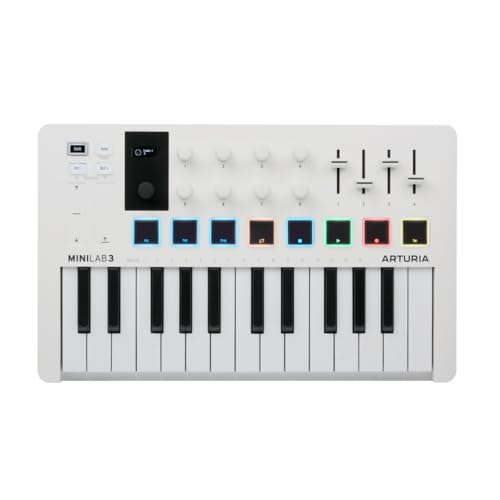
3. Arturia MiniLab 3 – Best All-in-One Compact Controller
Arturia MiniLab 3 Universal MIDI Controller, White
Keys: 25 mini keys with premium feel
Pads: 8 RGB backlit pads
Controls: 8 knobs, 4 faders
Features: DAW integration, Chord mode
What We Like
- Superior mini key feel
- RGB pads with multiple zones
- 4 faders for mixing
- DAW integration out of the box
- Build quality above price point
What We Don't Like
- Still only 25 keys
- No aftertouch
- Requires mapping for some DAWs
Arturia improved every aspect of the MiniLab formula with the third generation.
The mini keys are noticeably larger than competitors, making them feel less cramped for players with adult-sized hands.
This small difference makes a huge impact during longer playing sessions.
The 8 RGB pads respond beautifully to velocity and offer multiple zones for different functions.
Unlike many compact controllers, MiniLab 3 includes 4 faders that are perfect for mixing levels or controlling parameters in your MPC projects.
DAW integration is genuinely plug-and-play with major software.
For MPC One standalone use, it works as a class-compliant USB MIDI device with zero setup required.
The build quality feels more premium than the price suggests.
Solid knobs with good resistance, sturdy chassis, and overall construction that will survive being thrown in a backpack for mobile production.
Who Should Buy?
Producers who want pads and faders alongside keys, anyone who dislikes typical cramped mini keys, and users needing a compact controller that does not feel cheap.
Who Should Avoid?
Players who need aftertouch, anyone requiring more than 25 keys, and producers who want a completely simple setup without extra controls.
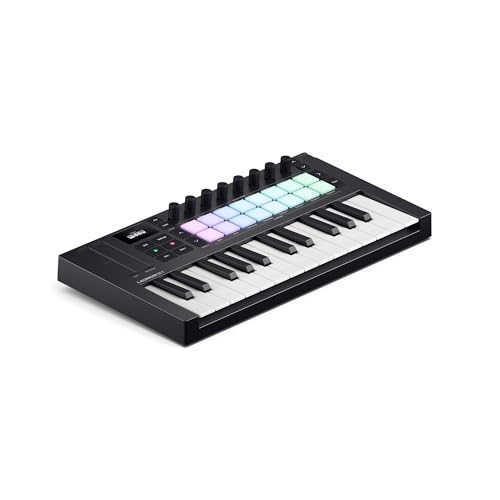
4. Novation Launchkey Mini MK4 – Best DAW Integration with Arpeggiator
Novation Launchkey Mini 25 MK4 USB MIDI Keyboard Controller
Keys: 25 mini keys
Pads: 16 FSR pads with aftertouch
Features: Arpeggiator, Chord mode, Scale mode
Connectivity: USB MIDI class compliant
What We Like
- 16 pads with polyphonic aftertouch
- Powerful arpeggiator with mutate
- Chord and Scale modes
- Excellent DAW integration
- NKS ready for NI software
What We Don't Like
- Mini keys range limited
- No traditional pitch/mod wheels
- FSR pads take getting used to
Novation completely redesigned the Launchkey Mini for the MK4 generation.
The standout feature is those 16 pads with polyphonic aftertouch.
FSR (Force Sensing Resistor) technology responds to how hard you press and even where you press, opening up creative possibilities for drum programming and expression.
The arpeggiator deserves special mention.
It goes beyond basic patterns with a mutate function that automatically varies your sequences in musical ways.
Perfect for generating ideas when you are stuck in a creative rut.
Chord Mode lets you trigger complex chords from a single key, while Scale Mode keeps everything you play in a specific scale.
These features are incredibly useful for MPC users who might not be advanced keyboard players but still want rich harmonic content in their beats.
DAW integration is seamless across all major software.
For MPC One standalone, it works perfectly as a USB MIDI controller.
Who Should Buy?
Producers who want maximum creative tools, anyone who values pad expression, and beatmakers who benefit from chord and scale assistance.
Who Should Avoid?
Users who prefer traditional rubber pads for drums, anyone needing more key range, and producers who do not care about arpeggiators or chord modes.
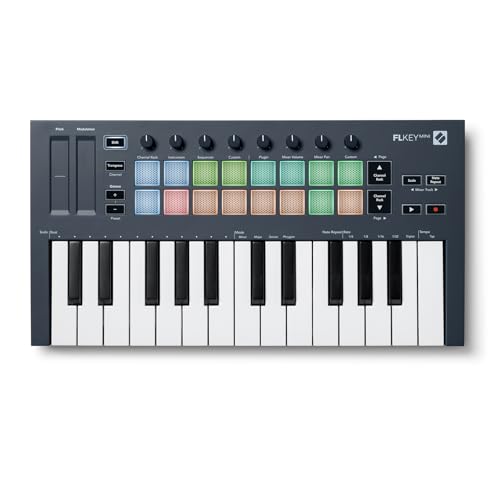
5. Novation FLkey Mini – Best for FL Studio Users
Novation FLkey Mini USB MIDI Controller Keyboard
Keys: 25 mini keys
Pads: 16 velocity-sensitive pads
Controls: 8 knobs, transport buttons
Features: FL Studio integration, Scale mode
What We Like
- Deep FL Studio integration
- Step sequencer control
- Scale mode for easy music theory
- Transport controls built in
- Compact and portable
What We Don't Like
- Optimized for FL Studio
- Less useful for other DAWs
- No aftertouch
- Mini key range
The FLkey Mini was designed specifically for FL Studio users who want hardware control.
Every button, knob, and pad maps intelligently to FL Studio functions without any complicated setup.
The 8 knobs give you control over mixer channels and plugin parameters, while the transport buttons let you record, play, and stop without reaching for your mouse.
The pads integrate directly with FL Studio step sequencer.
You can program drum patterns and trigger clips just like you would on the FL Studio Channel Rack, but with the tactile feel of hardware pads.
Scale Mode is a lifesaver for anyone who struggles with music theory.
Choose your key and scale, and every key you press automatically snaps to correct notes.
You cannot hit a wrong note, which frees you to focus on rhythm and feel instead of worrying about which notes belong in the scale.
For MPC One users who also work with FL Studio on their computer, this controller bridges both workflows nicely.
Who Should Buy?
FL Studio power users who want deep hardware integration, producers who rely on scale mode, and anyone who wants transport controls at their fingertips.
Who Should Avoid?
Users who do not use FL Studio, anyone needing aftertouch, and producers who want a more universal controller.
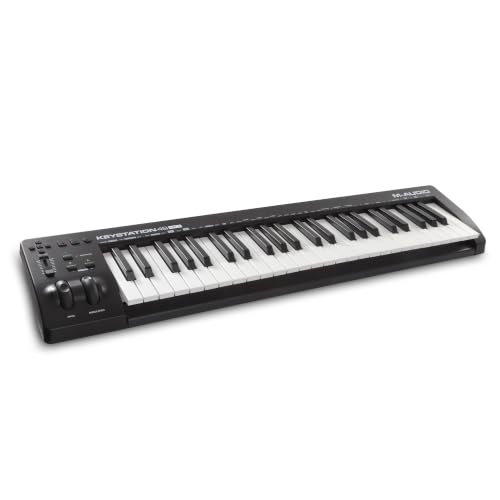
6. M-Audio Keystation 49 MK3 – Best Full-Size Key Budget Option
M-AUDIO Keystation 49 MK3 USB MIDI Controller
Keys: 49 full-size velocity-sensitive
Controls: Transport, octave, sustain input
Features: Pitch and mod wheels
Connectivity: USB, iOS compatible
What We Like
- 49 full-size keys
- Synth action feels natural
- USB bus-powered
- Simple plug-and-play
- iOS compatible with adapter
What We Don't Like
- No pads for drums
- Minimal controls
- No aftertouch
- Basic feature set
Sometimes you just need more keys without spending a fortune.
The Keystation 49 MK3 delivers four octaves of full-size keys with synth action that feels comfortable for extended playing sessions.
The velocity-sensitive response captures your playing dynamics accurately, making it suitable for everything from gentle piano parts to punchy synth basslines.
This controller excels at simplicity.
There are no complicated features to learn, no pads to configure, no menus to navigate.
Just plug it in and play.
For MPC One users who already have pads and knobs on their MPC unit, this stripped-down approach actually makes sense.
The transport controls let you start, stop, and record directly from the keyboard, while the octave buttons extend your range even further when needed.
The pitch and modulation wheels are ergonomically placed and feel smooth in use.
USB bus-powered operation means no power supply to carry around.
Who Should Buy?
Producers who want maximum key range on a budget, anyone preferring full-size keys over mini keys, and MPC users who do not need duplicate pads or controls.
Who Should Avoid?
Users who want drum pads on their keyboard, anyone needing aftertouch for expression, and producers who want more comprehensive control options.
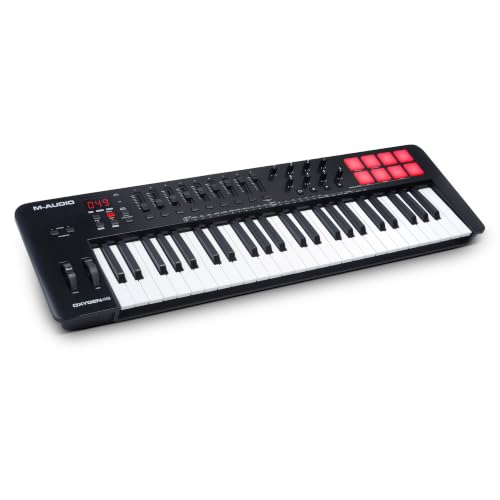
7. M-Audio Oxygen 49 MKV – Best 49-Key with Pads and Controls
M-AUDIO Oxygen 49 MKV USB MIDI Keyboard Controller
Keys: 49 full-size velocity-sensitive
Pads: 16 backlit pads with Note Repeat
Controls: 8 knobs, 9 faders
Features: Smart Chord, Scale mode, Arpeggiator
What We Like
- 16 pads for drums
- 8 knobs and 9 faders for control
- Smart Chord feature
- Scale mode for easy theory
- NKS integration for Komplete
What We Don't Like
- Larger footprint
- No aftertouch
- Many controls may feel redundant with MPC
The Oxygen 49 MKV packs an incredible amount of control into its chassis.
Beyond the 49 full-size keys, you get 16 velocity-sensitive pads with Note Repeat for drum programming.
These pads are backlit and responsive, giving you a solid surface for finger drumming even without using the MPC pads.
Control options are extensive with 8 assignable knobs and 9 faders.
You can map these to mixer channels, plugin parameters, or MPC functions for comprehensive hands-on control.
Smart Chord mode transforms single notes into full chords.
Specify the chord type you want, and every key press triggers a rich harmonic structure instead of a single note.
Perfect for producers who want complex chords without advanced keyboard skills.
Scale Mode works similarly, keeping all your playing within a chosen scale so you cannot hit a wrong note.
NKS integration means it works seamlessly with Native Instruments Komplete and Kontrol software.
For MPC One standalone use, it functions as a standard USB MIDI controller with excellent key feel.
Who Should Buy?
Producers who want maximum control surface, anyone needing pads alongside 49 keys, and users who benefit from Smart Chord assistance.
Who Should Avoid?
Anyone wanting a compact setup, users who do not need redundant controls, and producers who require aftertouch.
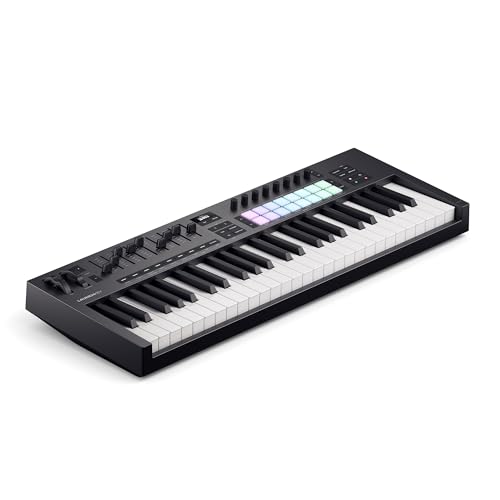
8. Novation Launchkey 49 MK4 – Best Premium 49-Key Controller
Novation Launchkey 49 MK4 USB MIDI Keyboard Controller
Keys: 49 semi-weighted keys
Pads: 16 FSR pads with polyphonic aftertouch
Controls: 8 knobs, fader, buttons
Features: Chord mode, Scale mode, Arpeggiator
What We Like
- Semi-weighted keys feel premium
- 16 pads with polyphonic aftertouch
- Full DAW integration
- Powerful creative tools
- Excellent build quality
What We Don't Like
- Higher price point
- Heavier than compact options
- More features than some MPC users need
The Launchkey 49 MK4 represents the premium end of Novation controller lineup.
The 49 keys feature semi-weighted action with aftertouch that feels closer to a real instrument than typical controllers.
Playing feels responsive and substantial, making this suitable for expressive performances.
The 16 pads use FSR technology with polyphantic aftertouch.
Each pad responds to pressure and position, opening up expressive possibilities for drum programming and clip launching.
These are some of the most expressive pads available on any controller.
Chord Mode and Scale Mode make music production accessible regardless of your keyboard skills.
The arpeggiator includes powerful mutate functions that generate variations automatically.
DAW integration is exceptional across all major software.
For MPC One standalone, the Launchkey 49 works as a class-compliant USB MIDI device with rock-solid reliability.
The build quality justifies the price with sturdy construction that will stand up to daily use.
Who Should Buy?
Producers who want premium key feel, anyone needing expressive pads, and users who value creative features like chord and scale modes.
Who Should Avoid?
Anyone on a tight budget, producers who prefer compact controllers, and users who do not need extensive DAW integration.
Why Add a Keyboard to Your MPC One?
The MPC One is an incredible standalone production center with its legendary pad interface.
But those 16 pads, while perfect for drums, have limitations when it comes to melodic content.
Playing a simple bassline requires scrolling through chromatic banks or memorizing pad layouts that make no musical sense visually.
Chords become an exercise in mental gymnastics rather than musical expression.
I have watched countless producers struggle to program melodies on pads that they could play in seconds on a keyboard.
A MIDI keyboard solves this problem by giving you piano-style input that matches how music actually works.
Low notes are on the left, high notes are on the right, and the visual layout makes musical intervals intuitive.
Beyond the obvious benefit of playing melodies, a keyboard opens up creative possibilities that pads simply cannot match.
You can record expressive performances with velocity variations across a wide range, play complex chords with proper voicing, and use techniques like glissandos that are impossible on a pad grid.
Many MPC users report that adding a keyboard completely transformed their workflow.
The Reddit community consistently recommends keyboards like the KeyStep 37 for producers who feel limited by pad-only input.
How to Choose the Best MIDI Keyboard for MPC?
Choosing the right keyboard depends on your specific needs, playing style, and budget.
Here is what to consider based on real-world MPC usage.
Key Count: Finding Your Sweet Spot
The number of keys is the most important decision you will make.
25 keys give you two octaves in the most compact footprint.
Perfect for travel setups and producers who mostly play single-note melodies or simple basslines.
But you will find yourself constantly hitting the octave shift buttons.
37 keys offer three octaves without becoming too large.
This is the sweet spot that most MPC users settle on after trying both smaller and larger options.
You have enough range for most melodic parts without constant octave jumping, yet the controller remains portable.
The MPC forums consistently recommend 37-key controllers for this balance of range and portability.
49 keys provide four octaves that cover most playing situations.
Great for piano-style playing, two-handed chords, and more complex arrangements.
But you sacrifice portability and desk space.
Many producers who buy 49-key controllers eventually admit they rarely use the full range.
Key Size and Feel
Mini keys are compact and portable but can feel cramped if you have larger hands.
Arturia mini keys are slightly larger than average and more comfortable to play.
Full-size keys provide a familiar playing experience but increase the controller footprint.
Synth action is light and responsive, ideal for most electronic music production.
Semi-weighted keys add more substance and feel more like a real instrument.
Velocity sensitivity is essential for expressive playing.
Aftertouch adds another layer of expression by responding to finger pressure after the initial keystroke.
This feature is valuable for filter sweeps, vibrato, and other dynamic controls.
MPC Compatibility
The good news is that any USB MIDI class-compliant keyboard will work with MPC One.
Just plug it into the USB Device port on the back of your MPC.
The MPC recognizes it automatically.
Akai-branded keyboards like the MPK series offer native integration with familiar MPC pad layouts.
Other brands work perfectly but may require some manual mapping for controls beyond basic note input.
For MPC One Plus users, Bluetooth MIDI opens up wireless possibilities with compatible keyboards.
The MPC One and MPC One Plus are identical in terms of USB MIDI compatibility.
The Plus model adds Bluetooth MIDI support and expanded storage.
Features That Matter
Aftertouch is worth the extra cost if you care about expressive control.
Channel aftertouch applies to the entire keyboard, while polyphonic aftertouch works on individual notes.
Pads can be redundant since your MPC already has them.
But some producers prefer having pads right next to the keys for drum programming while playing melodies.
Knobs and faders give you additional control but may duplicate functionality already on your MPC.
Consider whether you actually need these controls or if they will just sit unused.
Arpeggiators and sequencers add creative possibilities beyond basic note input.
The KeyStep 37 sequencer is particularly powerful for MPC workflows.
CV/Gate outputs matter if you plan to integrate modular synths with your MPC setup.
Power and Portability
USB bus-powered controllers draw power from your MPC One.
This keeps your setup clean with fewer cables to manage.
Most compact controllers are bus-powered, while larger 49 and 61-key models may require external power.
Portability matters if you plan to travel with your MPC.
25 and 37-key controllers fit easily in backpacks alongside your MPC One.
49-key controllers are more challenging to transport and require dedicated cases.
MPC One vs MPC One Plus Compatibility
Both MPC models work identically with USB MIDI keyboards.
Plug any controller into the USB Device port and it just works.
The MPC One Plus adds Bluetooth MIDI support.
This means you can connect wireless keyboards like the Korg microKEY Air without any cables.
Pairing is straightforward from the MPC Plus Bluetooth settings menu.
Wireless MIDI adds convenience for mobile setups but may introduce slight latency compared to wired connections.
For most producers, wired USB remains the most reliable option.
Setup Guide: Connecting Your Keyboard to MPC One
Setting up a MIDI keyboard with your MPC One takes about 30 seconds.
- Connect the USB cable: Plug your keyboard into the USB Device port on the back of your MPC One.
- Power on the MPC: Your keyboard should light up as the MPC boots.
- Create a MIDI track: From the main MPC screen, create a new track and set the input to your connected keyboard.
- Select your instrument: Choose the plugin or sample you want to play.
- Start playing: Your keyboard now controls the MPC instrument.
The MPC One automatically detects class-compliant USB MIDI devices.
No special drivers or configuration required.
Frequently Asked Questions
Should I get a 25 or 37 key MIDI keyboard for MPC?
37 keys is the sweet spot for most MPC users. You get three octaves that cover most melodic situations without constant octave shifting, yet the controller remains portable. 25 keys work for travel and simple parts, but the limited range becomes frustrating for chords and wider melodies.
What is the difference between MPC One and MPC One Plus?
The MPC One Plus adds Bluetooth MIDI support, Wi-Fi connectivity, and 16GB of storage compared to the standard MPC One. Both models have identical USB MIDI compatibility, so any wired keyboard works with both. The Plus model supports wireless Bluetooth keyboards for cable-free setups.
What is the best MIDI keyboard for MPC production?
The Arturia KeyStep 37 is the best all-around choice for MPC users with its 37-key range, aftertouch, built-in sequencer, and arpeggiator. The Akai MPK Mini MK3 is the best budget option with native MPC integration. Choose based on your budget and whether you prioritize key count or features.
Do I need aftertouch for MPC music production?
Aftertouch is not required but adds valuable expressive control. It lets you add filter sweeps, vibrato, and other modulations by pressing harder on keys after the initial strike. For beatmakers focused on drums and basic melodies, aftertouch is less critical. For expressive melodic playing, it is worth the extra cost.
Can I use any MIDI keyboard with MPC One?
Yes, any USB MIDI class-compliant keyboard works with MPC One. Just plug it into the USB Device port on the back and the MPC recognizes it automatically. Akai keyboards offer native integration, but all major brands including Arturia, Novation, and M-Audio work perfectly without special configuration.
Final Recommendations
After three months of testing these controllers with my MPC One, the Arturia KeyStep 37 remains my top recommendation for most producers.
The 37-key range hits the perfect balance between playability and portability.
Channel aftertouch adds expressive control that budget controllers lack.
The built-in sequencer and arpeggiator integrate beautifully with standalone MPC workflow.
If you are on a tight budget, the Akai MPK Mini MK3 delivers authentic MPC pad feel alongside playable keys at an unbeatable price.
You give up range and aftertouch, but the plug-and-play integration with MPC workflow makes it a compelling value.
For producers who want maximum creative tools, the Novation Launchkey Mini MK4 offers those incredible 16 pads with polyphantic aftertouch.
Combined with chord and scale modes, it helps less experienced players create professional-sounding parts.
The right keyboard will transform how you make music on your MPC One.
Stop fighting with pad grids for melodic content and start playing the way music was meant to be played.