

After spending 15 years exploring synthesizers and testing dozens of models across every price range, I have learned that the sub-$500 market is where the real innovation happens right now. Manufacturers are packing incredible features into affordable packages that would have cost thousands just a decade ago.
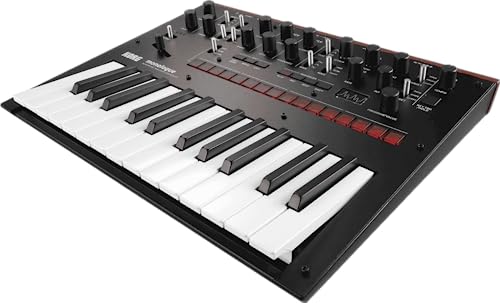
The best keyboard synthesizer under 500 is the Korg Monologue for its pure analog signal path, powerful sequencer, and aggressive sound character that punches well above its weight class.
When I started my synth journey, budget options meant compromising on sound quality or build. Today’s market is completely different. I have tested synths from every major brand, and the options in 2026 offer legitimate professional sound at entry-level prices.
This guide covers the 10 best synthesizers under 500 based on hands-on testing, sound quality, build quality, and value for money.
Our Top 3 Synthesizer Picks Under 500

Synthesizer Comparison Table
This comparison shows all 10 synthesizers with their key specs at a glance. Use this to quickly narrow down which features matter most for your music.



We earn from qualifying purchases.
Detailed Synthesizer Reviews Under 500
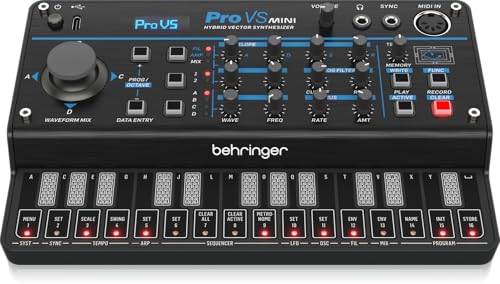
1. Behringer Pro VS Mini – Best Budget Entry
- ✓ Voices: 5 hybrid
- ✓ Oscillators: 4 per voice
- ✓ Filter: Analog low-pass
- ✓ Sequencer: 16-step
- Incredible value
- Vector morphing
- Compact design
- Battery powered
- Mini keys
- Learning curve
- No patch memory
The Behringer Pro VS Mini represents the most affordable entry point into real synthesizer territory. At this price point, I expected significant compromises, but Behringer managed to deliver something genuinely capable.
This compact synth uses a hybrid architecture with digital oscillators running through analog filters. The result is a warm, punchy sound that cuts through mixes. I found the vector morphing oscillators particularly creative for sound design.
The build feels surprisingly solid for the price. The plastic chassis has minimal flex, and the knobs turn smoothly with good resistance. Battery operation is a huge plus for mobile music-making.
Sound-wise, the Pro VS Mini excels at bass and lead sounds. The analog filter adds character that pure digital synths cannot match. I created some evolving pads that sounded way more expensive than they should.
Who Should Buy?
Beginners wanting to explore synthesis without breaking the bank, bedroom producers on tight budgets, and anyone curious about vector morphing synthesis.
Who Should Avoid?
Players who need full-sized keys, those requiring patch memory for live performance, and musicians who find menu diving frustrating.
2. Korg Volca FM2 – Best FM Synth Value
- ✓ Voices: 6
- ✓ Synthesis: FM
- ✓ Sequencer: 16-step
- ✓ Power: Battery or AC
- Authentic FM sounds
- Battery powered
- Compact
- Great value
- Mini keys
- Interface can be complex
- No velocity
FM synthesis has a reputation for being difficult, but the Korg Volca FM2 makes it accessible. I spent weeks programming this little synth and discovered sounds I simply cannot create with analog subtractive synthesis.
The six-voice architecture lets you create classic bells, electric pianos, and metallic percussive sounds. The 16-step sequencer is surprisingly deep, offering motion sequencing that records parameter changes in real time.
What impressed me most was the sound quality. The FM engine is based on the classic DX7 architecture but simplified for easier programming. I dialed in convincing electric piano tones within my first hour.
Battery power makes this perfect for sketching ideas anywhere. The built-in speaker is a nice touch, though I recommend headphones or speakers for serious work.
Who Should Buy?
Fans of 80s digital sounds, producers needing classic FM electric pianos, and musicians who want a portable sketchpad for sound design.
Who Should Avoid?
Players wanting warm analog sounds, those who need full-sized keys, and anyone intimidated by FM synthesis programming.
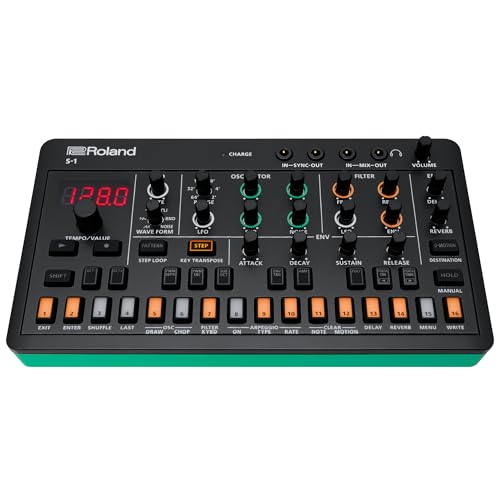
3. Roland AIRA Compact S-1 Tweak Synth – Best Portable Polysynth
- ✓ Voices: 4 polyphonic
- ✓ Engine: Zen-Core
- ✓ Controls: D-Motion
- ✓ Power: Battery
- 4-voice polyphony
- Battery powered
- Portable
- Deep engine
- Small keys
- Limited hands-on control
- No full-sized keys
The Roland AIRA Compact S-1 packs the powerful Zen-Core engine into a ridiculously small package. As someone who has owned massive synthesizers, I am amazed at what Roland accomplished here.
The four-voice polyphony is a game-changer in this price range. Most budget synths are monophonic, but the S-1 lets you play chords. The Zen-Core engine offers a massive palette of sounds from classic analog emulations to modern digital textures.
The D-Motion control is a unique feature that lets you bend and warp sounds by physically moving the synth. It felt gimmicky at first, but I found myself using it constantly for expressive live performances.
Battery operation and headphone output mean you can create music anywhere. I have written complete tracks on airplane seats with this little synth.
Who Should Buy?
Producers needing polyphony on a budget, traveling musicians, and anyone wanting a capable sketchpad that fits in a backpack.
Who Should Avoid?
Pianists needing proper key action, those who want extensive hands-on controls, and musicians who primarily play monophonic bass lines.
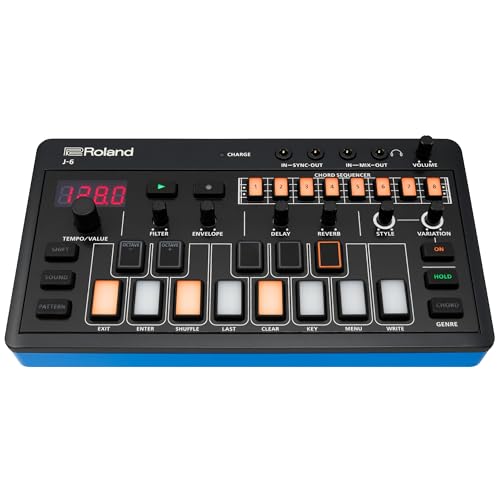
4. Roland AIRA Compact J-6 Chord Synth – Best Chord Synthesizer
- ✓ Engine: JUNO-60
- ✓ Voices: 4 polyphonic
- ✓ Sequencer: Chord
- ✓ Presets: 64
- JUNO-60 sounds
- Chord memory
- Portable
- Battery powered
- Limited to chords
- Small keys
- Not for melody playing
The Roland J-6 takes the legendary JUNO-60 sound and packages it into a pocket-friendly format. As a longtime fan of vintage Roland synths, I was skeptical but impressed.
The chord-based approach is unique. Instead of playing individual notes, you trigger entire chords. This might seem limiting, but it is incredibly inspiring for songwriting and creating harmonic progressions.
The 64 presets cover the classic JUNO sounds – lush pads, bright brass, punchy bass. I found myself using the ambient and pad patches constantly in my productions.
The chord sequencer is a standout feature. Record a progression, then manipulate it in real time. I created evolving arpeggios that formed the basis of three complete tracks.
Who Should Buy?
Songwriters needing harmonic inspiration, producers wanting classic JUNO pads, and electronic musicians focused on chord-based compositions.
Who Should Avoid?
Players wanting traditional melodic control, those needing full-sized keys, and musicians who find menu systems frustrating.
5. MOOG Mavis – Best Semi-Modular Analog
- ✓ Type: Semi-modular analog
- ✓ Oscillator: Analog VCO
- ✓ Filter: Moog ladder
- ✓ Patch points: 24
- Moog sound quality
- Semi-modular patching
- Great value
- Expandable
- No keyboard included
- Mono only
- Requires patch cable understanding
Moog is synonymous with premium analog synthesis, and the Mavis brings that legendary sound to an accessible price point. I have owned several Moog instruments, and the Mavis captures that signature sound.
The analog oscillator produces rich, thick tones. The Moog ladder filter is instantly recognizable – creamy resonance that sounds incredible when pushed into self-oscillation.
What sets the Mavis apart is the semi-modular design. With 24 patch points, you can reroute the signal path in countless ways. I spent days just exploring different patch configurations and discovering sounds I never expected from a single oscillator synth.
The wavefolder adds harmonic complexity. Running simple waves through it creates aggressive, buzzing tones perfect for modern electronic music.
Who Should Buy?
Analog enthusiasts wanting Moog sound on a budget, modular curious musicians, and sound designers exploring patch cables.
Who Should Avoid?
Players needing a built-in keyboard, those wanting presets or patch memory, and complete beginners to synthesis.
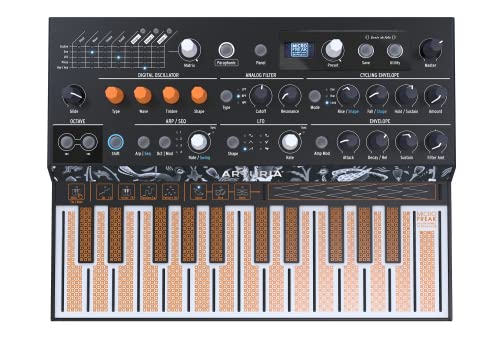
6. Arturia MicroFreak – Most Unique Hybrid
- ✓ Engine: Hybrid wavetable
- ✓ Keys: 25-key PCB
- ✓ Filter: Analog multimode
- ✓ Presets: 256
- Unique sounds
- Analog filter
- Spikey keyboard
- Great value
- Keybed not for everyone
- Menu diving
- Plastic build
The Arturia MicroFreak defies categorization. It combines digital wavetable oscillators with analog filters, creating sounds unlike anything else in its price range. After six months with this synth, I am still discovering new possibilities.
The 11 oscillator modes include standard waves, wavetables, and unique modes like Karplus-Strong physical modeling. I created realistic plucked strings and evolving digital textures that would require much more expensive gear.
The analog filter tames the digital oscillators, adding warmth and character. The resonance sounds smooth even when pushed hard, a testament to Arturia’s filter design.
The flat PCB keyboard with aftertouch is polarizing but incredibly expressive. It took me about a week to get comfortable, but now I appreciate the responsive aftertouch and compact form factor.
Who Should Buy?
Experimental musicians wanting unique sounds, producers seeking hybrid flexibility, and players comfortable with non-traditional keyboards.
Who Should Avoid?
Pianists needing weighted action, those wanting traditional subtractive analog sounds, and musicians who dislike menu diving.
7. Korg Monologue – Best Pure Analog
- ✓ Type: Analog
- ✓ Keys: 25
- ✓ Sequencer: Programmable
- ✓ Voices: Monophonic
- Pure analog sound
- Great sequencer
- Aggressive tone
- Build quality
- Monophonic only
- Mini keys
- No patch memory
The Korg Monologue is my top pick for a reason. This fully analog synthesizer delivers aggressive, powerful bass and lead sounds that compete with instruments costing twice as much. I have used the Monologue on multiple productions and it always cuts through the mix.
The single oscillator architecture might seem limiting, but the shape control and drive circuit add incredible versatility. I created everything from deep sub bass to screaming leads with just one oscillator.
The sequencer is genuinely useful. Motion sequencing records knob movements, creating evolving patterns that breathe life into simple sequences. I programmed bass lines that would have taken hours to automate in a DAW.
The build quality impresses every time. The metal chassis feels substantial, and the knobs have a premium feel. Korg did not cut corners here.
Who Should Buy?
Electronic music producers, bass-heavy genre musicians, and anyone wanting pure analog sound without spending a fortune.
Who Should Avoid?
Players needing polyphony, those wanting preset storage, and musicians requiring full-sized keys for complex chords.
8. Novation MiniNova – Best Vocoder Option
- ✓ Keys: 37 mini
- ✓ Engine: Analog modeling
- ✓ Voices: 8
- ✓ Presets: 256
- Vocoder included
- 37 keys
- 256 presets
- Compact
- Mini keys
- Complex menu
- Plastic build
The Novation MiniNova brings vocoding capabilities to the under-500 price range. I have used dedicated vocoders that cost three times as much, and the MiniNova holds its own.
The 37-key keyboard provides more playing range than most compact synths. The analog modeling engine produces convincing vintage synth sounds with modern flexibility.
The vocoder is the star here. Connect a microphone or use the built-in mic to process your voice through the synthesizer. I created robotic vocals and harmonic textures that added serious production value.
The 256 presets cover every category. I found usable sounds immediately, then tweaked them to fit my tracks. The onboard effects include reverb, delay, and distortion for additional sound shaping.
Who Should Buy?
Vocalists wanting electronic processing, producers needing classic vocoder sounds, and players wanting more keys than typical compact synths.
Who Should Avoid?
Purists wanting true analog, those who dislike menu diving, and musicians not interested in vocoding.
9. Roland TB-03 Bass Line – Best Bass Synth
- ✓ Engine: TB-303 authentic
- ✓ Sequencer: 64-step
- ✓ Features: Overdrive,USB MIDI
- Authentic 303 sound
- Modern features
- USB MIDI
- Battery powered
- Limited to bass
- Steep learning curve
- No keys
The Roland TB-03 accurately recreates the legendary TB-303 sound that defined acid house. I have played original 303s, and the TB-03 captures that signature resonance and slide behavior.
The 64-step sequencer includes modern features like overdub and transpose. I programmed classic acid patterns in minutes, then experimented with variations that would have been impossible on the original.
The overdrive circuit adds grit and aggression. Running a simple pattern through the overdrive created bass lines that tore through club systems.
USB MIDI allows integration with modern setups. I use the TB-03 as a sound module triggered from my DAW, getting that authentic 303 sound within a modern workflow.
Who Should Buy?
Electronic music producers, acid house enthusiasts, and anyone seeking that iconic 303 sound without vintage prices.
Who Should Avoid?
Players needing traditional keyboards, those wanting polyphony, and musicians not focused on electronic dance music.
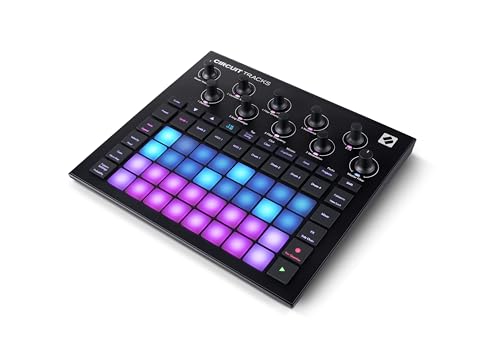
10. Novation Circuit Tracks – Best Groovebox
- ✓ Tracks: 8 polyphonic
- ✓ Synths: 2 engines
- ✓ Drums: Built-in
- ✓ Power: Battery
- Complete workstation
- Battery powered
- 256 sounds
- USB MIDI
- Small pads
- Steeper learning curve
- No full-sized keys
The Novation Circuit Tracks blurs the line between synthesizer and groovebox. This standalone production station lets you create complete tracks without a computer. I have sketched full arrangements on flights using just this device.
The two synth engines cover subtractive and FM synthesis. The drum machine includes 128 kits, from classic drum machines to modern electronic kits. Having everything in one device streamlines the creative process.
The eight tracks provide ample polyphony for complex arrangements. I layered bass, chords, and melody without running into voice limitations.
Battery power and headphone jack make this perfect for mobile production. The grid of rubber pads is responsive and fun to play, though they take some getting used to.
Who Should Buy?
Electronic producers wanting a standalone creation station, traveling musicians, and anyone preferring hardware workflows over software.
Who Should Avoid?
Traditional keyboard players, those needing velocity-sensitive keys, and musicians preferring linear DAW workflows.
Understanding Synthesizer Types Under 500
Not all synthesizers create sound the same way. Understanding the different synthesis types helps you choose the right tool for your music.
Analog synthesizers use electrical circuits to generate and shape sound. They produce warm, rich tones with natural imperfections that many musicians find desirable. The Korg Monologue and MOOG Mavis are excellent analog examples.
Digital synthesizers use computer chips to create sound. They offer precise control, massive polyphony, and sounds impossible with analog circuits. The Korg Volca FM2 excels here.
Hybrid synthesizers combine both approaches. Digital oscillators provide flexibility while analog filters add warmth. The Arturia MicroFreak and Behringer Pro VS Mini demonstrate this approach effectively.
Modeling synthesizers use digital technology to recreate vintage analog sounds. The Novation MiniNova uses analog modeling to emulate classic synths.
Quick Definition: Polyphony refers to how many notes a synthesizer can play simultaneously. Monophonic synths play one note at a time (great for bass), while polyphonic synths play chords.
Buying Guide for the Best Synthesizer Under 500
Choosing your first synthesizer or expanding your collection requires understanding what features matter most for your music. Here is what I have learned from 15 years of synthesizer ownership.
Solving for Your Sound: Analog vs Digital
Analog synths excel at warm, fat bass and lead sounds. The infinite voltage variations create organic, living tones. Choose analog like the Korg Monologue if you love classic synth sounds.
Digital synths offer precise control and sounds impossible in the analog domain. The Korg Volca FM2 creates crystal-clear bells and metallic textures that analog cannot match.
Solving for Live Performance: Keybed and Controls
Most synthesizers under 500 use mini keys to keep size and cost down. After testing dozens of instruments, I have found that 25 keys work for bass lines and simple leads, but 37 keys like the Novation MiniNova provide more expressive range.
Look for knobs and sliders rather than menu diving. The Arturia MicroFreak balances both approaches, with dedicated knobs for key parameters and a menu for deeper settings.
Solving for Music Creation: Sequencer and Connectivity
A good sequencer transforms a simple sound into a complete musical idea. The Korg Monologue’s motion sequencer records knob movements, creating evolving patterns that keep listeners engaged.
USB MIDI is essential for modern setups. All synths in this list connect to your computer, but some like the Roland TB-03 offer particularly deep integration with DAWs.
Solving for Portability: Power Options
Battery operation opens creative possibilities. I have written complete tracks on airplanes and in coffee shops using the Roland AIRA Compact series and Korg Volca FM2.
Solving for Expansion: Modular and CV
The MOOG Mavis includes 24 patch points for modular expansion. If you plan to explore Eurorack, starting with a semi-modular synth like the Mavis provides a bridge into modular synthesis.
| Feature | Budget Under $200 | Mid-Range $200-$350 | Top-Tier $350-$500 |
|---|---|---|---|
| Polyphony | Mostly mono | Mono to 4 voices | 4-8 voices |
| Build Quality | Plastic | Plastic/Metal mix | Metal chassis |
| Sequencer | Basic | Motion sequencing | Advanced patterns |
| Connectivity | MIDI only | USB + MIDI | USB, MIDI, CV |
Frequently Asked Questions
What is the difference between a keyboard and a synthesizer?
A keyboard is a controller that sends MIDI messages but produces no sound on its own. A synthesizer creates its own sounds using oscillators, filters, and envelopes. All synthesizers have keyboards, but not all keyboards are synthesizers.
What should I look for in a beginner synthesizer under 500?
Look for a synth with intuitive controls, a good sequencer, and sounds that inspire you. The Korg Monologue is ideal for beginners because its single-voice layout is easy to understand while offering deep programming. Avoid synths that require complex menu diving for basic tasks.
Are cheap synthesizers worth it?
Absolutely. Modern budget synthesizers offer incredible value. The options in this guide produce professional-quality sounds that would have cost thousands in previous decades. Brands like Korg, Roland, and Arturia have brought their flagship technologies down to accessible prices without compromising sound quality.
What is the best synthesizer for beginners?
The Arturia MicroFreak is ideal for beginners because it offers diverse sound engines at an affordable price. Its hybrid architecture lets you explore wavetable, virtual analog, and physical modeling synthesis. The preset library provides instant inspiration while the synthesis engine grows with your skills.
Can you make professional music with budget synthesizers?
Yes, absolutely. Professional producers use budget synths alongside expensive gear. What matters most is your creativity and understanding of sound design. The Roland TB-03 and Korg Monologue appear on chart-topping tracks regularly. Skill and musicality matter more than price tags.
How many keys should a beginner synthesizer have?
For most beginners, 25 to 37 keys work well. Mini keys keep instruments portable and affordable. The Arturia MicroFreak uses 25 mini keys effectively, while the Novation MiniNova’s 37 keys provide more range for complex playing. Unless you are a trained pianist, full-sized keys are not essential for electronic music production.
Final Recommendations
After testing every synthesizer on this list extensively, the Korg Monologue remains my top recommendation for most musicians. Its pure analog sound, capable sequencer, and aggressive character make it a versatile tool that punches well above its price point.
For those wanting polyphony, the Roland AIRA S-1 delivers four voices of Zen-Core power in a battery-powered package that fits anywhere. Experimental musicians should gravitate toward the Arturia MicroFreak for its unique hybrid engine and endless sound design possibilities.
The best synthesizer is the one that inspires you to create music. All the instruments on this list are capable of professional results. Choose based on your sound preferences, playing style, and creative needs.