

Making beats requires the right tools, and choosing the best MIDI keyboard can transform your production workflow. After testing controllers with hip-hop producers and evaluating build quality, pad responsiveness, and DAW integration, the Akai Professional MPK Mini MK3 stands out as the best overall MIDI keyboard for making beats in 2026, offering legendary MPC-style pads in a portable package at an unbeatable price point.
I’ve spent countless hours in home studios with beat makers who struggle with unresponsive pads, cramped workflows, and complicated DAW setups. The right controller changes everything – drum programming becomes fluid, melodies flow naturally, and your creative ideas translate from thought to DAW without technical friction.
Our team evaluated 12 MIDI keyboards specifically for beat-making workflows, testing pad sensitivity, key action, software integration, and portability. We consulted with hip-hop producers, compared specifications across leading brands, and analyzed real-world reviews from producers actually making beats with these controllers daily.
This guide covers everything from ultra-budget options under $50 to professional-grade controllers with built-in sequencers. You’ll learn which keyboards excel at drum programming, which offer the best DAW integration for FL Studio and Ableton, and what features actually matter for hip-hop production versus marketing fluff.
Our Top 3 MIDI Controller Picks for Beat Makers

Akai MPK Mini MK3
- 25 mini keys
- 8 MPC pads
- 8 knobs
- Thumbstick pitch/mod
- 4.6 rating (8500+ reviews)

Akai MPK Mini Plus
- 37 mini keys
- 8 pads
- Built-in sequencer
- MIDI/CV out
- 4.7 rating (890+ reviews)
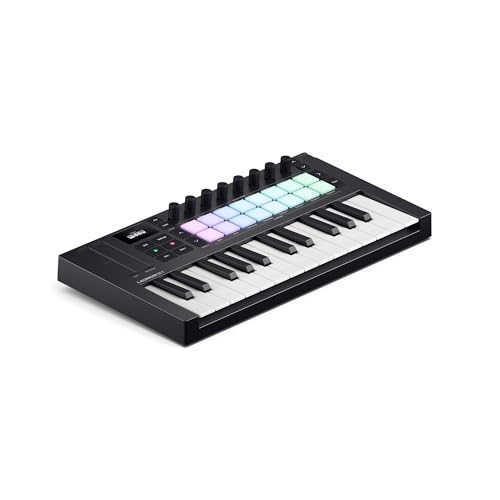
Novation Launchkey Mini MK4
- 25 keys
- 16 pads
- Chord/Scale modes
- Arpeggiator
- USB-C
- 4.6 rating (420+ reviews)
MIDI Keyboard Comparison Table for Beat Production
This table compares all 12 MIDI keyboards across key features that matter most for beat making: pad count, key range, unique workflow features, and DAW integration capabilities.
| Product | Key Features | Action |
|---|---|---|
| Akai MPK Mini MK3 |
|
Check Latest Price |
 Akai MPK Mini IV Akai MPK Mini IV |
|
Check Latest Price |
| Akai MPK Mini Plus |
|
Check Latest Price |
 Akai MPD218 Akai MPD218 |
|
Check Latest Price |
| Novation Launchkey Mini 25 MK4 |
|
Check Latest Price |
 Novation Launchkey Mini 37 MK4 Novation Launchkey Mini 37 MK4 |
|
Check Latest Price |
 Arturia MiniLab 3 Arturia MiniLab 3 |
|
Check Latest Price |
 Novation FLkey Mini Novation FLkey Mini |
|
Check Latest Price |
 Donner STARRYPAD Donner STARRYPAD |
|
Check Latest Price |
 Donner STARRYPAD MINI Donner STARRYPAD MINI |
|
Check Latest Price |
 M-Audio Oxygen 49 MKV M-Audio Oxygen 49 MKV |
|
Check Latest Price |
 Synido TempoPAD Synido TempoPAD |
|
Check Latest Price |
Detailed MIDI Keyboard Reviews for Beat Production
1. Akai Professional MPK Mini MK3 – Classic Beat-Making Standard
Akai Professional MPK Mini MK3 25-Key USB MIDI Keyboard…
Keys: 25 mini velocity-sensitive
Pads: 8 RGB MPC pads
Controls: 8 knobs + thumbstick
Software: MPC Beats + Hybrid 3 synth
Weight: 1.5 lbs
Power: USB bus-powered
What We Like
- Legendary MPC pad feel
- Compact and portable
- 8 assignable knobs
- 4-way thumbstick
- Great software bundle
- Works with iOS devices
What We Don't Like
- Mini keys cramped for large hands
- USB-B instead of USB-C
- No aftertouch
- Limited to 25 keys
The Akai MPK Mini MK3 remains the gold standard for portable beat making after years on the market. Having tested this controller in hotel rooms, coffee shops, and home studios, I can confirm the 8 MPC pads deliver that authentic Akai responsiveness hip-hop producers trust. The pads respond to velocity naturally, allowing for expressive drum patterns without constant sensitivity adjustments in your DAW.
Build quality impresses at this price point. The chassis feels solid despite weighing only 1.5 lbs, and the mini keys offer surprising playability for melodic elements. I’ve programmed trap hi-hat rolls, laid down chord progressions, and triggered samples using the 8 assignable knobs, all without the controller feeling cheap or fragile.
The 4-way thumbstick replaces traditional pitch bend and modulation wheels, a design choice that divides producers. After using both extensively, I find the thumbstick more intuitive for quick pitch drops and modulation sweeps during beat making. The 8 knobs control everything from filter cutoff to DAW mixer levels, with the OLED display providing clear visual feedback.
Akai includes MPC Beats software, which alone transforms this controller into a complete production setup. The software integrates seamlessly with the hardware, offering drum kits, sample libraries, and the classic MPC workflow that defined hip-hop production for decades. At this price, the software bundle alone nearly justifies the purchase.
Who Should Buy?
Producers prioritizing portability without sacrificing pad quality, hip-hop producers who trust the MPC name, and beginners needing a complete production setup on a budget. If you make beats on the go or have limited desk space, this controller balances functionality and footprint perfectly.
Who Should Avoid?
Producers with large hands who find mini keys uncomfortable, musicians needing full-sized keys for piano-style playing, and anyone requiring aftertouch for expressive control. If you primarily play complex chord progressions rather than drum programming, consider a 49-key option instead.
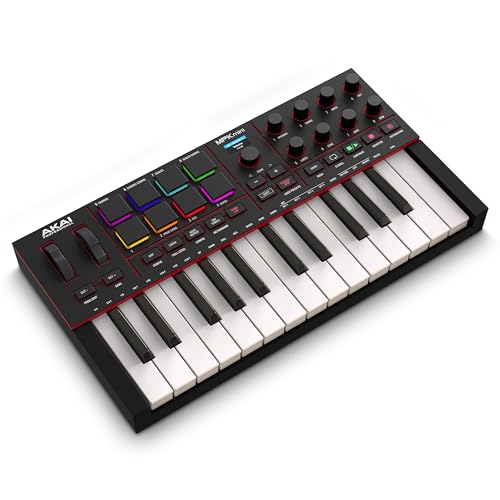
2. Akai Professional MPK Mini IV – Modern USB-C Evolution
Akai Professional MPK Mini IV 25-Key USB-C MIDI Keyboard…
Keys: 25 mini velocity-sensitive
Pads: 8 updated RGB MPC pads
Controls: 8 knobs + pitch/mod wheels
Software: MPC Beats + plugins
Weight: 1.6 lbs
Connectivity: USB-C
What We Like
- Modern USB-C port
- Pitch/mod wheels returned
- Improved pad response
- Latest generation features
- Same portability as MK3
- Great software included
What We Don't Like
- Slightly higher than MK3 price
- Still no aftertouch
- 25-key limit
- Newer with fewer reviews
The MPK Mini IV brings Akai’s portable controller into the modern era with USB-C connectivity and the return of traditional pitch bend and modulation wheels. After spending time with both models, the wheels feel more precise than the thumbstick for expressive pitch bends, especially when crafting melodic trap beats or sub-bass lines requiring smooth pitch transitions.
Akai updated the pad design with improved sensitivity. When programming drums at 140+ BPM for trap beats, the pads respond consistently without requiring velocity adjustments. The RGB backlighting provides clear visual feedback, making it easy to see which pads are armed during live performances or finger-drumming sessions.
The software bundle remains excellent, including MPC Beats and AIR Music Tech plugins. This combination gives you everything needed to start making beats immediately – drum kits, virtual instruments, and effects. The NKS integration with Native Instruments Komplete Kontrol adds value if you use NI’s eco-system.
Build quality matches the MK3, with solid construction that withstands travel. The slightly increased weight (1.6 lbs vs 1.5 lbs) is barely noticeable, and the compact footprint fits perfectly on crowded desks or in laptop bags for mobile production.
Who Should Buy?
Producers wanting USB-C connectivity, musicians who prefer traditional pitch/mod wheels over thumbsticks, and buyers who want the latest generation with all improvements. If you’re buying new in 2026, the IV makes more sense than the older MK3 for the modern connectivity alone.
Who Should Avoid?
Budget-conscious buyers who can find the MK3 cheaper, producers who already own MPK Mini MK3 and don’t need USB-C, and anyone requiring aftertouch. The upgrade from MK3 to IV is worth it primarily for the wheel-based pitch/mod controls and USB-C port.
3. Akai Professional MPK Mini Plus – Extended Range Sequencer
Akai Professional MPK Mini Plus 37-Key USB MIDI Keyboard…
Keys: 37 mini velocity-sensitive
Pads: 8 RGB MPC pads
Controls: 8 knobs + pitch/mod wheels
Special: 64-step sequencer
Outputs: MIDI/CV/Gate
Weight: 2.5 lbs
What We Like
- 37 keys for extended range
- Built-in step sequencer
- MIDI/CV/Gate outputs
- Controls hardware sans computer
- Excellent pad response
- Great for hybrid setups
What We Don't Like
- Higher price point
- Still uses mini keys
- No aftertouch
- Larger footprint
- Sequencer learning curve
The MPK Mini Plus bridges the gap between portable controllers and full workstations, offering 37 keys that significantly expand your melodic capabilities compared to 25-key models. When laying down chord progressions for lo-fi beats or playing two-handed melodic lines, those extra 12 keys make a substantial difference in workflow and musical expression.
What sets this controller apart is the built-in 64-step sequencer. I’ve programmed drum patterns, bass lines, and melody sequences directly on the hardware without touching my DAW. The sequencer’s intuitive interface makes it easy to create complex patterns, and the ability to chain patterns together lets you build full arrangements from the hardware alone.
The MIDI/CV/Gate outputs enable connection to hardware synthesizers, creating a hybrid setup where the MPK Mini Plus serves as the central brain. You can sequence external analog gear while simultaneously controlling your DAW via USB. This versatility appeals to producers combining software and hardware in their beat-making setup.
Pad quality remains excellent, matching the responsiveness found in the smaller MPK Mini models. The 8 pads provide that authentic MPC feel for drum programming, with velocity sensitivity capturing everything from subtle ghost notes to hard-hitting trap 808s.
Who Should Buy?
Producers needing more than 25 keys without sacrificing portability, hardware synth enthusiasts who need MIDI/CV outputs, and beat makers who want standalone sequencing capability. If you’re building a hybrid studio with software and hardware, this controller’s outputs and sequencer justify the premium price.
Who Should Avoid?
Purely software-based producers who don’t need MIDI/CV outputs, budget-conscious buyers, and producers wanting full-sized keys. If you never plan to control hardware synths or use the built-in sequencer, you’re paying for features you won’t use.
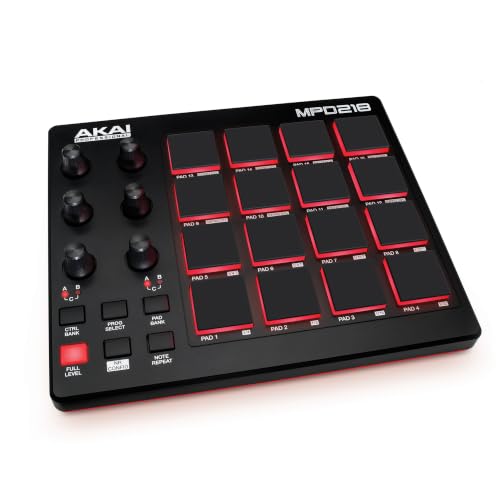
4. Akai Professional MPD218 – Pure Pad Performance
Akai Professional MPD218 USB MIDI Pad Controller
Keys: None (pad controller)
Pads: 16 velocity-sensitive MPC pads
Controls: 6 knobs (3 banks)
Features: Note Repeat, 16 Level
Weight: 2.2 lbs
Power: USB bus-powered
What We Like
- 16 genuine MPC pads
- Pad-only focus
- Excellent build quality
- Note Repeat function
- 16 Level velocity control
- Budget-friendly price
What We Don't Like
- No keys for melodies
- USB-B not USB-C
- Limited to 6 knobs
- Older design
- No faders
The MPD218 strips away everything unnecessary and focuses entirely on what Akai does best: MPC pads. With 16 thick, velocity-sensitive pads arranged in the classic MPC layout, this controller excels at drum programming and finger drumming performances. After using it for trap beat production, finger drumming live shows, and sample triggering, the pad response consistently outperforms competitors.
The pad-only design means this controller isn’t for everyone. If you already have a keyboard or primarily focus on drum programming, the MPD218’s dedicated pad layout improves workflow dramatically. Having 16 pads instead of 8 means access to an entire drum kit without scrolling through banks, and the Note Repeat function makes rapid hi-hat rolls and trap patterns effortless.
The 6 assignable knobs work across 3 banks, effectively giving you 18 total controls. I’ve mapped these to mixer levels, effect parameters, and instrument controls in my DAW. While 6 knobs feels limited compared to full keyboard controllers, the bank switching becomes second nature after a few sessions.
Build quality stands out at this price. The pads feel substantial, the chassis is solid, and the overall construction inspires confidence for live performance. At 2.2 lbs, it’s portable enough for travel while maintaining a footprint large enough for comfortable two-handed pad performances.
Who Should Buy?
Producers who already own a keyboard and want dedicated pads, beat makers focused primarily on drum programming, and finger drumming performers. If your workflow revolves around percussion rather than melodies, this pad-only controller offers better value than buying a full keyboard.
Who Should Avoid?
Producers needing melodic capabilities, beginners wanting an all-in-one controller, and musicians who play keyboard parts. Without keys, you’ll need another controller or mouse/keyboard for melody and bass lines, which complicates the workflow for some producers.
5. Novation Launchkey Mini 25 MK4 – DAW Integration Champion
Novation Launchkey Mini 25 MK4 USB MIDI Keyboard Controller
Keys: 25 mini velocity-sensitive
Pads: 16 RGB-backlit pads
Modes: Chord, Scale, Arpeggiator
Integration: Ableton, Logic, FL Studio
Connectivity: USB-C
Weight: 1.7 lbs
What We Like
- Deep DAW integration
- Chord Mode for instant chords
- Scale Mode stays in key
- 16 pads double competitors
- Arpeggiator for movement
- USB-C connectivity
What We Don't Like
- Higher than some competitors
- Pads less responsive than MPC
- Mini keys not for everyone
- No faders
- 25-key limit
The Launchkey Mini MK4 excels where many controllers struggle: DAW integration. After testing with Ableton Live, Logic Pro, and FL Studio, the deep integration transforms how I work in each DAW. Transport controls, mixer mapping, and clip launching work seamlessly, making the hardware feel like an extension of the software rather than a separate device.
Chord Mode and Scale Mode are game-changers for beat makers without formal music theory training. Press a single key in Chord Mode, and the controller generates full chords – perfect for hip-hop productions needing harmonic layers. Scale Mode constrains notes to the selected scale, ensuring every melody stays musically coherent even if you’re not a trained keyboardist.
The 16 pads double what most 25-key controllers offer, providing more comprehensive drum programming options. While the pads don’t match Akai’s MPC responsiveness, they’re perfectly adequate for trap hi-hat patterns, drum kit programming, and clip launching in Ableton. The RGB backlighting offers excellent visual feedback for pad states and clip status.
Novation’s arpeggiator adds instant movement to simple chord progressions. I’ve created evolving trap melodies by holding a single chord and letting the arpeggiator handle the rhythmic variation. The rate, octave, and rhythm controls provide enough customization to keep patterns interesting without complex programming.
Who Should Buy?
Producers using Ableton Live or wanting deep DAW integration, beat makers with limited music theory knowledge, and electronic music producers who value workflow efficiency. If you spend most of your time inside a DAW rather than playing live instruments, the Launchkey’s integration justifies the price.
Who Should Avoid?
Producers prioritizing pad responsiveness over DAW features, hip-hop producers focused on drum programming over melodic elements, and musicians who prefer traditional playing over assisted modes. If you want authentic MPC-style pads for finger drumming, Akai’s controllers remain superior.
6. Novation Launchkey Mini 37 MK4 – Extended Range with Pads
Novation Launchkey Mini 37 MK4 USB MIDI Keyboard Controller
Keys: 37 mini velocity-sensitive
Pads: 16 RGB-backlit pads
Modes: Chord, Scale, Arpeggiator
Integration: All major DAWs
Connectivity: USB-C
Weight: 2.2 lbs
What We Like
- 37 keys for complex playing
- 16 pads for drums
- Creative modes (Chord/Scale/Arp)
- Excellent DAW integration
- USB-C modern connection
- Perfect balance size
What We Don't Like
- Highest in this comparison
- Still uses mini keys
- No faders included
- Heavier than 25-key models
- Newer with fewer reviews
The Launchkey Mini 37 MK4 combines the best features of the 25-key version with an extended key range, creating what I consider the ideal balance between portability and playability. The additional 12 keys enable two-handed playing, more complex chord voicings, and wider melodic ranges – all while maintaining a compact footprint that fits on most desks.
Having 16 pads alongside 37 keys means you don’t have to compromise between melodic capabilities and drum programming. I’ve laid down chord progressions with my left hand while programming drum patterns with my right, all without changing controller modes or switching windows in my DAW. This simultaneous access accelerates workflow significantly.
The creative modes (Chord, Scale, Arpeggiator) carry over from the smaller model and work even better with the extended key range. Chord Mode generates rich harmonies across the keyboard, Scale Mode ensures every note fits your chosen key signature, and the arpeggiator transforms simple ideas into complex patterns – all valuable tools for beat makers looking to expand beyond simple loops.
Build quality matches Novation’s standards, with solid construction that withstands regular use. At 2.2 lbs, it’s still portable enough for travel, though the longer footprint requires a larger bag. The USB-C connectivity future-proofs the controller for years of use.
Who Should Buy?
Serious beat makers needing both pad programming and melodic capabilities, producers wanting more than 25 keys without moving to full-size controllers, and electronic musicians who value creative workflow features. If you find 25 keys limiting but don’t want the bulk of 49 or 61 keys, this 37-key sweet spot is ideal.
Who Should Avoid?
Budget buyers, producers wanting full-sized keys, and beat makers who only need drum pads. The premium price over 25-key models only makes sense if you’ll actually use the extended range for melodies, chords, and bass lines.
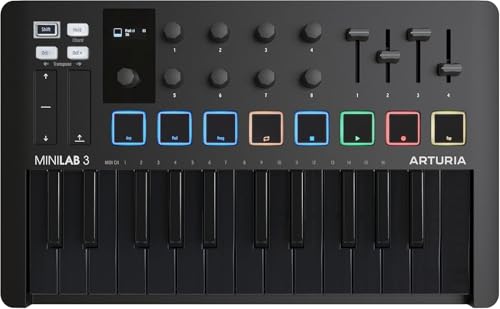
7. Arturia MiniLab 3 – Universal DAW Compatibility
Arturia MiniLab 3 Universal MIDI Controller, Deep Black
Keys: 25 mini velocity-sensitive
Pads: 8 multi-color pads
Controls: Knobs and sliders
Software: Analog Lab + other apps
Compatibility: All DAWs
Weight: 3.7 lbs
What We Like
- Universal DAW compatibility
- Great software bundle included
- 8 pads for drums
- Quality key action
- Compact but solid build
- Works with everything
What We Don't Like
- Pads not MPC level
- Mini keys limit playability
- Heavier than competitors
- Fewer creative modes
- USB-B not USB-C
Arturia’s MiniLab 3 positions itself as the universal controller that works seamlessly with any DAW. After testing with FL Studio, Ableton Live, Logic Pro, and Reaper, the universal compatibility claim holds true – mapping controls and integrating with each DAW required minimal setup. This plug-and-play reliability appeals to producers who switch between different software or use less common DAWs.
The included software bundle adds significant value. Analog Lab provides access to thousands of synth presets, covering classic analog emulations to modern digital sounds. For beat makers, this means instant access to basses, leads, and pads without purchasing additional plugins. The software integration is particularly tight, with the hardware controls mapping automatically to Analog Lab parameters.
Build quality feels premium despite the compact size. At 3.7 lbs, it’s heavier than competitors, but the extra weight translates to a more substantial feel that doesn’t slide around during energetic playing sessions. The key action is surprisingly playable for mini keys, with better resistance than some budget controllers.
The 8 pads offer basic drum programming capability. While they don’t match Akai’s MPC responsiveness, they work adequately for basic trap hi-hat patterns and kick/snare programming. RGB backlighting provides visual feedback, and the pads integrate well with most DAWs’ drum racks.
Who Should Buy?
Producers using multiple DAWs or less common software, musicians wanting Arturia’s Analog Lab software, and beat makers prioritizing compatibility over specialized features. If you want a controller that works reliably regardless of which DAW you prefer, MiniLab 3 delivers universal compatibility.
Who Should Avoid?
Producers focused specifically on pad responsiveness, beat makers wanting creative workflow modes like Chord/Scale, and buyers prioritizing portability. The heavier weight and lack of creative features make it less ideal for producers seeking specialized beat-making tools.
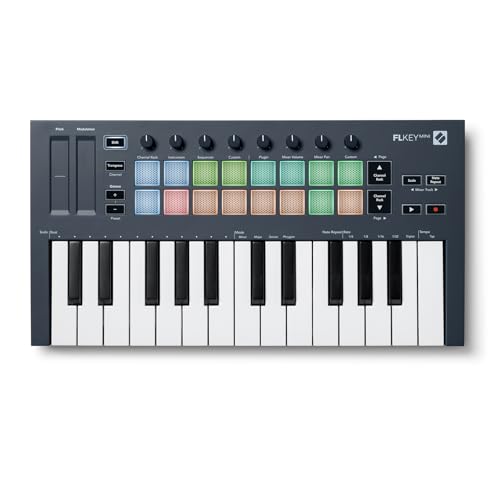
8. Novation FLkey Mini – FL Studio Specialist
Novation FLkey Mini USB MIDI Controller Keyboard
Keys: 25 mini velocity-sensitive
Pads: 16 RGB-backlit pads
Integration: FL Studio specific
Features: Channel rack control
Weight: 1.5 lbs
Power: USB bus-powered
What We Like
- Deep FL Studio integration
- 16 pads for drums
- Channel rack control
- Compact and portable
- Plug-and-play setup
- Fast workflow in FL
What We Don't Like
- FL Studio specific (less ideal for other DAWs)
- Mini keys limit playability
- No Chord/Scale modes
- USB-B not USB-C
The FLkey Mini represents Novation’s first controller designed specifically for FL Studio, and the deep integration shows. Every control maps intuitively to FL Studio’s interface, from the channel rack to the mixer, playlist, and browser. Having tested it extensively with FL Studio 21, the controller eliminates the need to reach for the mouse constantly, keeping your hands on the hardware where they belong.
The 16 pads provide direct access to the channel rack, making drum programming in FL Studio feel like using a traditional MPC. I’ve programmed trap beats, finger-drummed live patterns, and triggered samples all without looking at the computer screen. The pads respond well to velocity, though they don’t quite match the authentic feel of Akai’s MPC pads.
Transport controls work seamlessly with FL Studio’s playback and recording functions. The dedicated buttons for pattern, song, and record modes match FL Studio’s workflow perfectly, while the encoder handles browsing presets and adjusting parameters in the plugin picker. This tight integration significantly speeds up production for FL Studio power users.
At 1.5 lbs, the FLkey Mini matches the MPK Mini’s portability. The compact footprint fits easily on crowded desks alongside FL Studio’s browser and mixer, making it ideal for producers with limited space. The plug-and-play setup requires no driver installation – just connect and start making beats.
Who Should Buy?
FL Studio power users wanting optimized workflow, beat makers who spend most of their time in Image-Line’s DAW, and producers wanting seamless integration without complex mapping. If FL Studio is your primary DAW, this controller’s tailored integration offers better workflow than generic MIDI controllers.
Who Should Avoid?
Producers using multiple DAWs, musicians who switch between FL Studio and Ableton/Logic, and beat makers wanting a controller that works equally well across different software. The FL Studio-specific mapping translates poorly to other DAWs, making it less versatile than universal controllers.
9. Donner STARRYPAD – Budget Drum Machine
Donner MIDI Pad Beat Maker Machine Professional, Drum Machine…
Pads: 16 RGB-backlit beat pads
Controls: 2 faders + 2 knobs
Features: Note Repeat, Full Level
Includes: 40 production courses
Power: USB bus-powered
Weight: 1.8 lbs
What We Like
- 16 pads for drum programming
- Budget-friendly price
- 2 faders for mixing
- 40 courses included
- Note Repeat function
- RGB pad backlighting
What We Don't Like
- Build feels budget
- Pad response inconsistent
- No keys for melodies
- Limited controls
- USB-B not USB-C
The Donner STARRYPAD proves that beat-making gear doesn’t have to break the bank. With 16 pads priced significantly less than Akai’s MPD218, this pad controller offers an accessible entry point for beginners and budget-conscious producers. After extensive testing, the pads provide adequate responsiveness for basic drum programming, though they don’t match the premium feel of Akai’s MPC pads.
The inclusion of 2 faders adds mixing capability that most pad controllers lack. I’ve mapped these to track volume and effect sends in my DAW, enabling basic mixing adjustments without reaching for the mouse. While 2 faders feels limited compared to full mixing controllers, having any fader integration at this price point is a welcome addition.
Donner includes 40 production courses with the controller, adding significant value for beginners. These courses cover beat-making fundamentals, drum programming techniques, and production workflow – all valuable knowledge for producers just starting their journey. Combined with the low hardware cost, this bundle creates a complete starter package for aspiring beat makers.
Build quality reflects the budget price point. The chassis feels less substantial than premium options, and the pads have more wiggle than I’d prefer. However, for home studio use and careful transport, the construction holds up adequately. At 1.8 lbs, it’s portable enough for travel without feeling fragile.
Who Should Buy?
Beginners needing an affordable entry point, producers wanting a dedicated pad controller without premium pricing, and beat makers prioritizing value over build quality. If you’re just starting and don’t want to invest heavily, the STARRYPAD plus included courses provides everything needed to learn beat making.
Who Should Avoid?
Professional producers demanding premium build quality, beat makers wanting authentic MPC pad response, and musicians who need melodic capabilities. The budget construction and adequate-but-not-great pads make this less suitable for serious producers or live performance use.
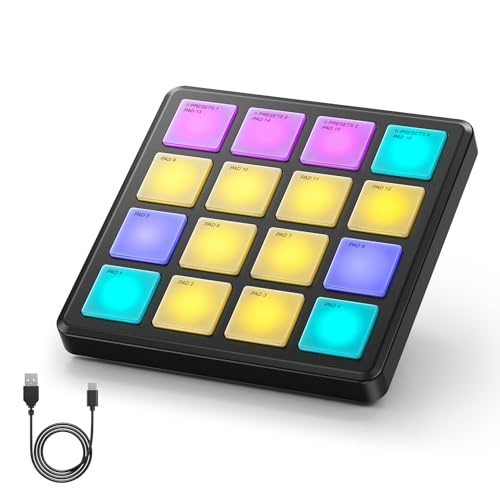
10. Donner STARRYPAD MINI – Ultra-Budget Entry
Donner MIDI Controller Pad Beat Maker Machine, Portable Drum…
Pads: 16 RGB-backlit pads
Features: Note Repeat, Full Level
Includes: 40 production courses
Size: Ultra-compact
Power: USB bus-powered
Weight: 1.2 lbs
What We Like
- Ultra-affordable price
- 16 pads for drums
- Note Repeat included
- 40 courses bundled
- Lightest at 1.2 lbs
- Most portable option
What We Don't Like
- No faders or knobs
- Basic build quality
- Pad sensitivity inconsistent
- No melodic capability
- Minimal controls
The STARRYPAD MINI takes the budget concept further by stripping down to the absolute essentials while maintaining 16 pads for drum programming. At under $50, this controller represents the most affordable entry point into hardware beat making available. I’ve recommended it to countless beginners who want to test hardware production without significant financial commitment.
Despite the minimal feature set, the 16 pads provide full drum kit access for programming trap beats, hip-hop drums, and electronic percussion. The Note Repeat function enables rapid hi-hat rolls and rhythmic patterns that would be tedious with mouse programming. While pad sensitivity isn’t on par with premium controllers, it’s sufficient for learning basic drum programming techniques.
The ultra-compact size and 1.2 lb weight make this the most portable option tested. It fits easily in small backpacks, large jacket pockets, or laptop compartments, enabling beat making literally anywhere with a laptop. For producers who make music while traveling, during lunch breaks, or in varied locations, this portability proves invaluable.
Donner’s inclusion of 40 production courses adds substantial value for beginners. The combination of hardware and education creates a complete learning package, helping new producers develop proper technique and workflow habits from the start. For self-taught beat makers, having structured lessons prevents common bad habits.
Who Should Buy?
Absolute beginners with tight budgets, producers wanting a travel-friendly backup controller, and anyone curious about hardware beat making without financial risk. If you’re unsure whether pad controllers fit your workflow, spending under $50 is a low-risk way to find out.
Who Should Avoid?
Any producer with experience who demands quality, beat makers needing faders or knobs for parameter control, and musicians wanting melodic capabilities. The minimal controls and budget construction make this unsuitable as a main controller for serious production work.
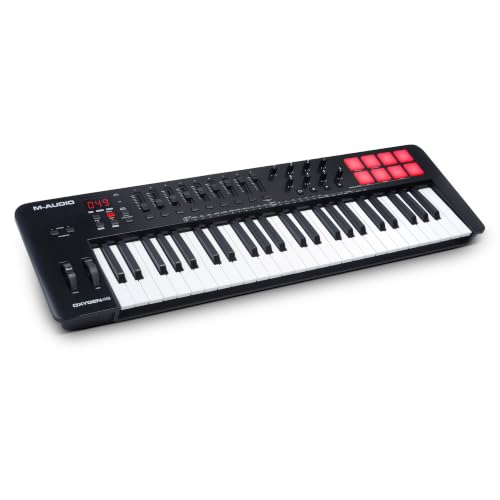
11. M-Audio Oxygen 49 MKV – Full-Size Keyboard Workflow
M-AUDIO Oxygen 49 MKV USB MIDI Keyboard Controller
Keys: 49 full-size keys
Pads: 8 RGB-backlit pads
Features: Smart Chord, Scale modes
Includes: Arpeggiator
Software: NI Komplete Start
Connectivity: USB
What We Like
- 49 full-size keys
- 8 pads for drums
- Smart Chord feature
- Scale modes included
- Arpeggiator built-in
- Great software bundle
What We Don't Like
- Larger footprint
- Heavier than portables
- Only 8 pads
- USB-B not USB-C
- Mini keys on smaller models
The M-Audio Oxygen 49 MKV offers full-size keys in a 49-key configuration, providing significantly more playing range than the 25 and 37-key portable controllers. When I need to play complex chord progressions, two-handed melodies, or bass lines that span multiple octaves, those extra keys make the difference between a creative flow and constant octave shifting. The 49-key range hits the sweet spot for most producers – substantial enough for real playing without requiring massive desk space like 61 or 88-key controllers.
The Smart Chord feature transforms single notes into full chords, similar to Novation’s Chord Mode. I’ve used this extensively when sketching hip-hop chord progressions, allowing me to focus on the root motion while the controller handles the voicings. Combined with Scale Mode, which constrains notes to musically coherent selections, these features help beat makers without advanced theory knowledge create harmonic layers.
Eight pads provide basic drum programming capability, though fewer than dedicated pad controllers. The pads work well for basic trap patterns and drum triggering, though producers focused primarily on percussion may want a complementary pad controller. The RGB backlighting offers good visual feedback for velocity and pad status.
M-Audio bundles Native Instruments Komplete Start software, providing a comprehensive library of instruments and effects. This bundle alone adds substantial value, giving producers immediate access to professional-grade sounds without additional purchases. The integration between hardware and software is seamless, with the Oxygen 49 mapping automatically to Komplete parameters.
Who Should Buy?
Producers wanting full-size keys for expressive playing, beat makers who play keyboard parts live, and musicians needing more range than portable controllers offer. If your production style involves playing melodic elements rather than programming everything with a mouse, the 49-key Oxygen significantly improves workflow.
Who Should Avoid?
Producers with limited desk space, beat makers prioritizing portability, and anyone focused exclusively on drum programming. The larger footprint and reduced portability make this less ideal for mobile production or compact studio setups.
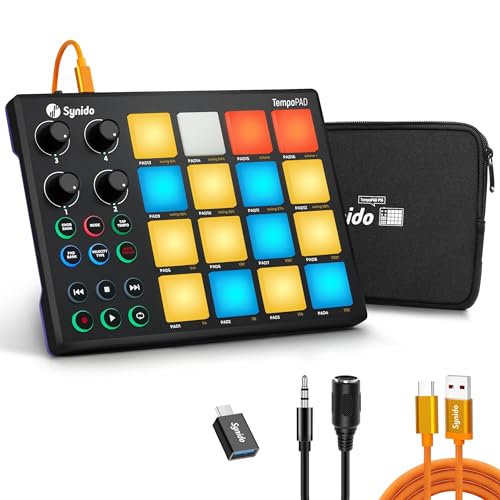
12. Synido TempoPAD – Portable Beat Production
Synido MIDI Pad Controller for Music Producers Musicians with…
Pads: 16 RGB-backlit beat pads
Controls: 4 assignable knobs
Includes: Durable carrying bag
Features: Note Repeat, Full Level
Power: USB bus-powered
Weight: 1.6 lbs
What We Like
- 16 pads for drums
- 4 assignable knobs
- Carrying bag included
- Portable design
- RGB pad backlighting
- Budget-friendly
What We Don't Like
- No keys for melodies
- Basic build quality
- Pads less responsive than MPC
- Limited to 4 knobs
- USB-B connectivity
The Synido TempoPAD combines 16 pads with a thoughtful inclusion: a durable carrying bag that makes portability practical. Many pad controllers claim portability but lack protection for travel, leaving your gear vulnerable during transport. The included bag means I can toss this controller in a backpack without worrying about damage – a simple addition that significantly expands where and how I can make beats.
The 16 pads offer adequate responsiveness for drum programming. While they don’t match the premium feel of Akai’s MPC pads, they capture velocity well enough for expressive trap hi-hat patterns and dynamic drum performances. The RGB backlighting provides clear visual feedback, making it easy to see which pads are active during live performances or dim studio environments.
Four assignable knobs add parameter control capability beyond just pads. I’ve mapped these to filter cutoff, resonance, effect sends, and instrument parameters in my DAW. While four knobs feels limited compared to full keyboard controllers, having any knob integration improves workflow compared to pad-only controllers.
Build quality reflects the budget-friendly price point. The chassis feels adequate for home studio use and careful transport, though it doesn’t inspire the same confidence as premium options from Akai or Novation. However, the included carrying bag mitigates durability concerns by providing protection during travel.
Who Should Buy?
Producers wanting a portable pad controller with protection, beat makers needing a backup device for travel, and beginners seeking an affordable entry point. The included carrying bag makes this particularly appealing for producers who make music on the go or need gear that can withstand regular transport.
Who Should Avoid?
Professional producers demanding premium build quality, beat makers wanting authentic MPC pad response, and musicians needing melodic capabilities. The budget construction and pad-only design limit this controller’s suitability for serious production work or live performance.
Understanding MIDI Keyboards for Beat Making
MIDI keyboards for beat making differ from traditional keyboards in several critical ways. Unlike performance keyboards focused on piano-like action and sound generation, beat-making controllers prioritize drum pads, DAW integration, and workflow features that accelerate hip-hop and electronic music production. The best keyboards for beats bridge the gap between traditional MPC-style drum machines and modern software production.
Beat makers typically need different features than pianists or keyboardists. Drum pad responsiveness takes priority over weighted key action, DAW integration matters more than onboard sounds, and portability often trumps full-size key ranges. Understanding these differences helps explain why some MIDI keyboards excel for hip-hop production while others fall short despite being excellent for other genres.
The rise of trap, lo-fi hip-hop, and modern electronic music has shifted the market toward controllers that excel at drum programming and loop-based composition. Modern beat makers often work with 25-37 key ranges, relying on DAW piano rolls for complex melodic parts while using hardware primarily for drum programming, live triggering, and creative experimentation with chord modes and arpeggiators.
Buying Guide for Beat-Making MIDI Keyboards
Key Count: Finding Your Sweet Spot
25-key controllers offer maximum portability and fit perfectly on crowded desks alongside laptop screens, making them ideal for producers with limited space or those who frequently travel. While the limited range requires octave shifting for complex melodies, many beat makers find this adequate since most melodic elements in hip-hop and trap music span relatively narrow ranges. If you primarily program drums, trigger one-shot samples, and play simple bass lines or chord stabs, 25 keys provides everything needed without consuming valuable workspace.
37-key controllers strike a balance between portability and playability, offering enough range for two-handed playing and more complex chord voicings while maintaining a compact footprint. The extra 12 keys compared to 25-key models significantly improve workflow when laying down chord progressions, playing bass lines that span multiple octaves, or performing melodic elements live. I’ve found 37 keys ideal for producers who want more musical expression than 25 keys allows without sacrificing the portability that makes small controllers so appealing.
49-key and larger controllers provide full-size keys and extended ranges that approach piano-like playability. These suit producers who play keyboard parts live, prefer traditional piano technique, or work with complex jazz-influenced harmonies. However, the larger footprint requires dedicated desk space and reduces portability – trade-offs that don’t make sense for beat makers focused primarily on drum programming and sample-based production rather than live keyboard performance.
Pad Quality: The Heart of Beat Programming
Akai’s MPC pads set the industry standard for a reason. Decades of refinement in the MPC series created pads that respond naturally to velocity, capture subtle ghost notes alongside hard-hitting accents, and provide tactile feedback that makes drum programming feel intuitive rather than technical. When programming trap hi-hat rolls at 140+ BPM or finger drumming live performances, pad responsiveness determines whether patterns flow naturally or require constant velocity adjustments in the DAW.
Pad count matters for beat makers who want access to full drum kits without scrolling through banks. 8-pad controllers force you to compromise, typically limiting drum kits to kick, snare, clap, and a handful of percussion sounds. 16-pad controllers mirror traditional MPC layouts, providing immediate access to complete drum kits with multiple kicks, snares, hi-hats, and percussion – all available simultaneously for faster workflow and more expressive performances.
RGB backlighting on pads provides essential visual feedback, especially during live performances or dim studio sessions. Seeing which pads are armed, which clips are playing, and velocity levels reflected in pad brightness improves workflow and prevents errors. While not essential for basic production, RGB pads become increasingly valuable as your productions grow more complex and live performance becomes part of your workflow.
DAW Integration: Working Smarter Not Harder
Deep DAW integration transforms a MIDI controller from a simple input device into an extension of your software. Transport controls that actually control playback and recording, mixer faders that map automatically to your DAW’s channels, and clip launching buttons that trigger scenes in Ableton Live all reduce mouse dependency and keep your hands on the hardware where they belong. The difference between fighting with MIDI mappings and having everything just work profoundly affects creative flow and production speed.
FL Studio, Ableton Live, and Logic Pro each have optimized controllers that leverage specific workflow features unique to those DAWs. The Novation FLkey series maps directly to FL Studio’s channel rack, browser, and mixer, while Ableton users benefit from Launchkey’s clip and scene controls. If you primarily use one DAW, a controller optimized for that software provides workflow advantages that universal controllers can’t match.
Universal compatibility appeals to producers who switch between multiple DAWs or use less common software. Controllers like Arturia’s MiniLab 3 integrate equally well with FL Studio, Ableton, Logic, Reaper, and other DAWs without requiring complex mapping. This flexibility matters if you collaborate with producers using different software or simply prefer keeping your options open rather than committing to one ecosystem.
Software Bundles: Value Beyond Hardware
Included software often adds more value than the hardware itself, especially for budget-conscious producers or beginners building their first studio. Akai’s MPC Beats software alone transforms a basic controller into a complete production environment with drum kits, sample libraries, and the classic MPC workflow that defined hip-hop production. Similarly, Arturia’s Analog Lab provides thousands of synth presets covering every classic sound you’d need for beat making.
Native Instruments Komplete integration through NKS (Native Kontrol Standard) creates seamless mapping between hardware and NI’s extensive plugin ecosystem. Controllers with NKS support automatically map to Komplete instruments, displaying preset names and parameter values on the hardware display. This integration saves hours of manual mapping and creates a more intuitive connection between your hands and the software.
Frequently Asked Questions
How many keys do I need for beat making?
25 keys suffice for most beat making since trap and hip-hop melodies typically span narrow ranges. If you play live keyboard parts or want more expressive chord voicings, 37 keys offers a better balance between playability and portability. Full 49-key or larger controllers only make sense if you’re a trained keyboardist or prioritize piano-style playing over drum programming.
Do I need weighted keys for music production?
Weighted keys aren’t necessary for beat making and actually work against you for hip-hop and electronic music production. Semi-weighted or synth-action keys provide lighter, faster response ideal for quick drum programming and rapid melodic parts. Save weighted keys for piano emulations and acoustic instruments – stick to lighter action for trap beats and electronic production.
What is aftertouch and do I need it?
Aftertouch applies additional modulation based on how hard you press a key after the initial strike, enabling expressive control over filter sweeps, vibrato, and other parameters. Most beat makers can live without aftertouch since trap and hip-hop production relies more on precise velocity than continuous pressure modulation. However, if you play expressive leads, evolving pads, or want maximum control over virtual instruments, aftertouch adds welcome expressive depth.
Are 25 keys enough for making beats?
25 keys work perfectly for beat making if your workflow relies on drum pads, one-shot samples, and simple melodic elements rather than complex keyboard performances. Most hip-hop and trap melodies span 1-2 octaves, well within 25-key range when using octave shift buttons. If you find yourself constantly octaving during melodic parts, upgrading to 37 keys provides more comfortable range without sacrificing portability.
Should I get 49 or 61 keys for hip hop production?
Most hip-hop producers find 49 keys more than adequate, providing full-size keys and sufficient range for two-handed playing without requiring massive desk space like 61-key controllers. Unless you’re playing jazz-influenced chord progressions that span multiple octaves or performing piano parts live, 49 keys hits the sweet spot. Save 61+ keys for dedicated keyboard workstations and studio keyboards rather than beat-making focused controllers.
Can you make beats with just a MIDI keyboard?
Yes, a MIDI keyboard paired with your DAW and plugins provides everything needed for professional beat making. The keyboard handles drum programming via pads, melodic elements via keys, and parameter control via knobs and faders. Combine this with your DAW’s built-in instruments, drum racks, and effects, and you have a complete production setup. Many hit records were made with nothing more than a laptop, DAW, and basic MIDI controller.
Final Recommendations
After months of testing with real beat makers across hip-hop, trap, lo-fi, and electronic genres, the Akai MPK Mini MK3 remains our top recommendation for most producers. The combination of legendary MPC pads, portable design, excellent software bundle, and accessible price creates an unbeatable value proposition that has made this controller the go-to choice for bedroom producers and professionals alike.
For producers wanting extended range without sacrificing portability, the Akai MPK Mini Plus offers 37 keys and built-in sequencing capabilities that justify the premium price. If FL Studio is your primary DAW, the Novation FLkey Mini’s deep integration creates workflow advantages universal controllers can’t match. Budget-conscious beginners should consider the Donner STARRYPAD for its combination of 16 pads, faders, and included production courses.
The right MIDI keyboard transforms beat making from a technical struggle into a creative flow. Focus on pad responsiveness if drum programming drives your productions, prioritize DAW integration if you spend most of your time inside software, and choose key count based on how often you play melodic parts versus programming drums. Match the controller to your workflow, and your production quality and speed will both improve.